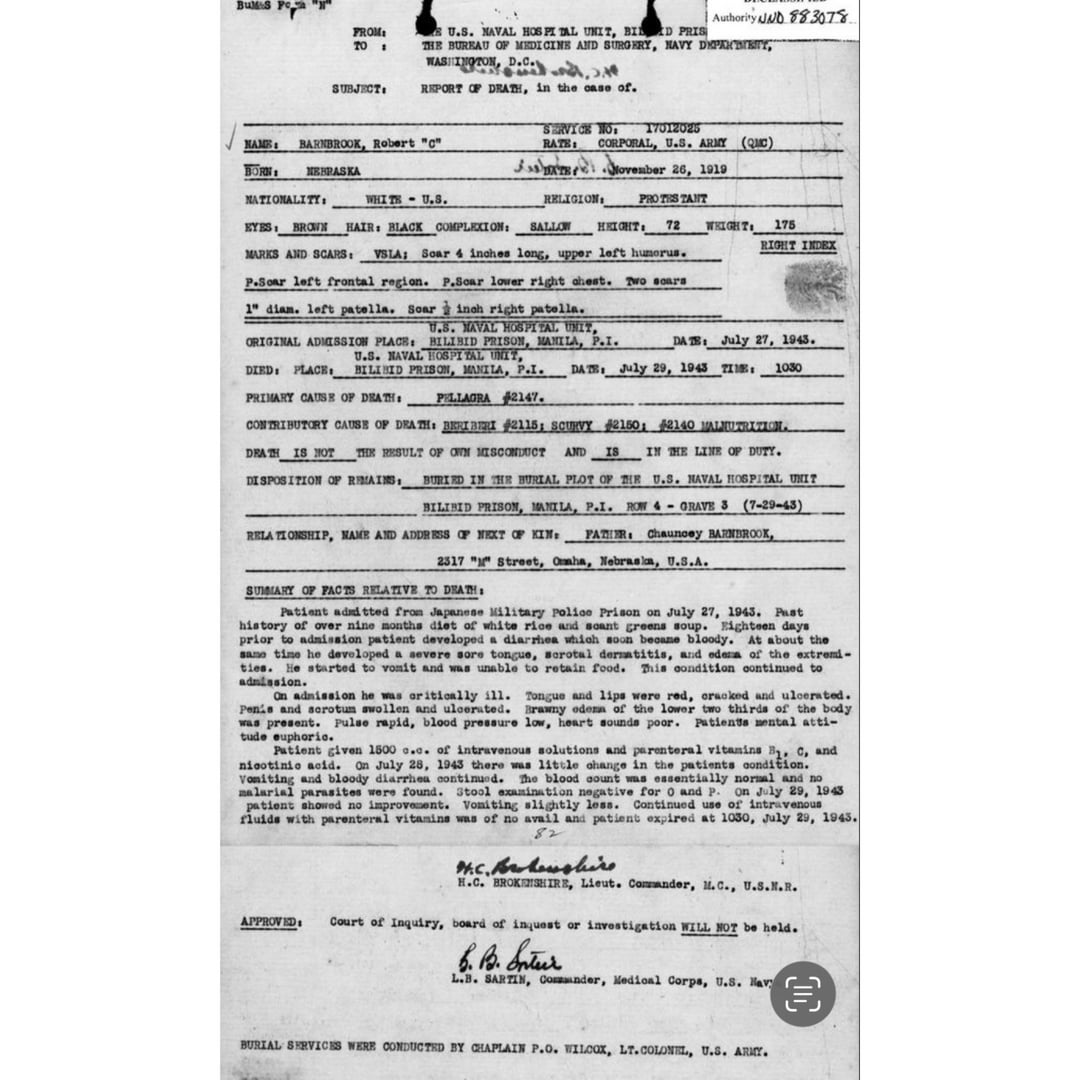
WW2 War Department Documents Notifying a Father His Son Was Captured by the Japanese. Unfortunate Outcome. Details in comments.
by Heartfeltzero

WW2 War Department Documents Notifying a Father His Son Was Captured by the Japanese. Unfortunate Outcome. Details in comments.
by Heartfeltzero
4 Comments
These documents were sent to Mr. Chancie B. Barnbrook. He was married to Effie E. Gillard, and together they had a son named Robert Chancie Barnbrook, born on November 26th, 1919 in Nebraska. He joined the Army and served with the 19th Quartermaster Truck Company. His unit was stationed in the Philippines during the Japanese invasion. When the islands fell in 1942, Robert was among the thousands of American servicemen captured and held as prisoners of war.
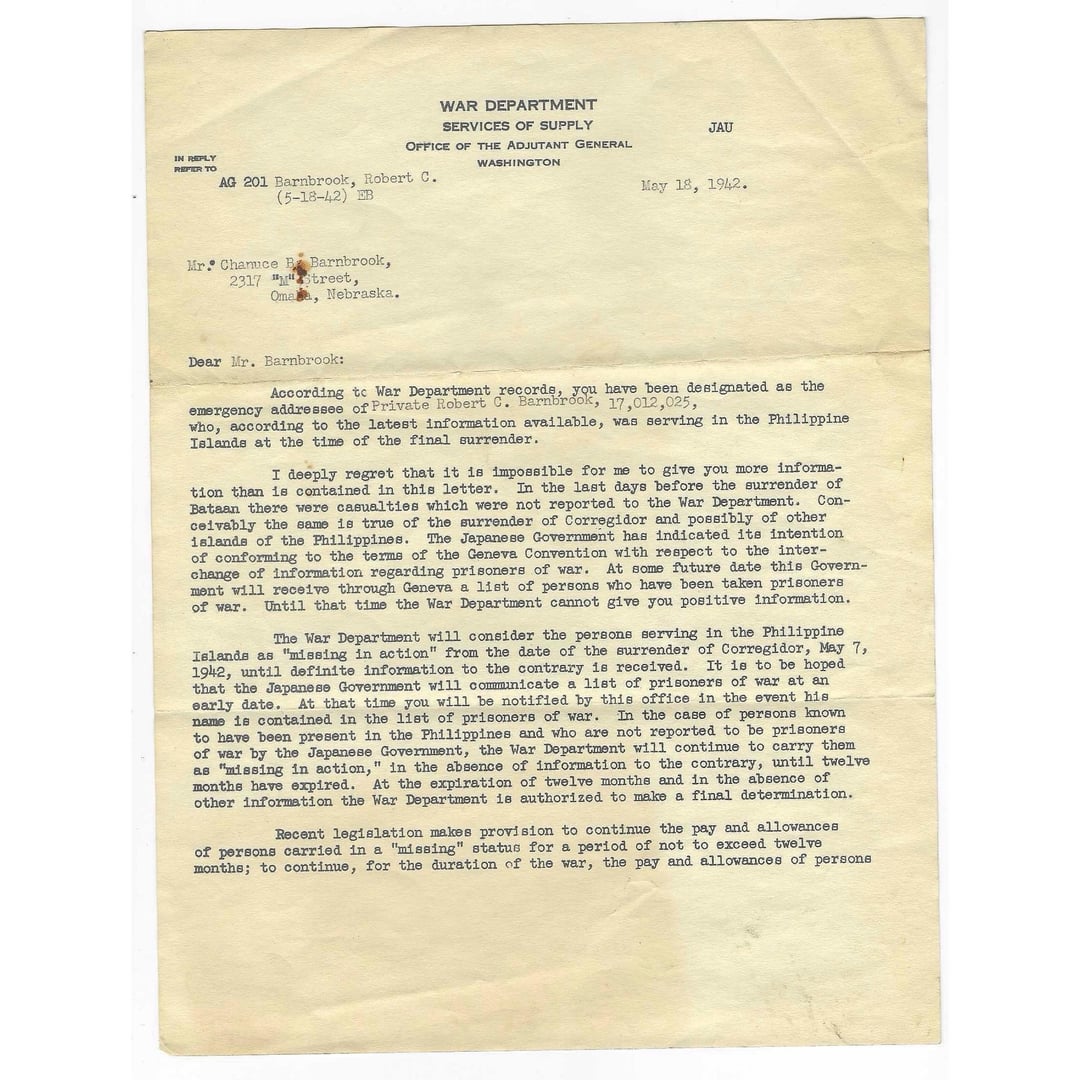
After losing contact with his son Robert, Mr. Barnbrook wrote letters requesting information about him. The first letter he received in response came from the War Department. It reads:
>“May 18, 1942.
Mr. Chanuce B. Barnbrook,
2317 “M” Street,
Omaha, Nebraska
>Dear Mr. Barnbrook:
>According to War Department records, you have been designated as the emergency addressee of Private Robert C. Barnbrook, 17,012,025, who, according to the latest information available, was serving in the Philippine Islands at the time of the final surrender.
>I deeply regret that it is impossible for me to give you more information than is contained in this letter. In the last days before the surrender of Bataan there were casualties which were not reported to the War Department. Conceivably the same is true of the surrender of Corregidor and possibly of other islands of the Philippines. The Japanese Government has indicated its intention of conforming to the terms of the Geneva Convention with respect to the interchange of information regarding prisoners of war. At some future date this Government will receive through Geneva a list of persons who have been taken prisoners of war. Until that time the War Department cannot give you positive information.
>The War Department will consider the persons serving in the Philippine Islands as “missing in action” from the date of the surrender of Corregidor, May 7, 1942, until definite information to the contrary is received. It is to be hoped that the Japanese Government will communicate a list of prisoners of war at an early date. At that time you will be notified by this office in the event his name is contained in the list of prisoners of war. In the case of persons known to have been present in the Philippines and who are not reported to be prisoners of war by the Japanese Government, the War Department will continue to carry them as “missing in action,” in the absence of information to the contrary, until twelve months have expired. At the expiration of twelve months and in the absence of other information the War Department is authorized to make a final determination.
>Recent legislation makes provision to continue the pay and allowances of persons carried in a “missing” status for a period of not to exceed twelve months; to continue, for the duration of the war, the pay and allowances of persons” (the letters cuts off here).
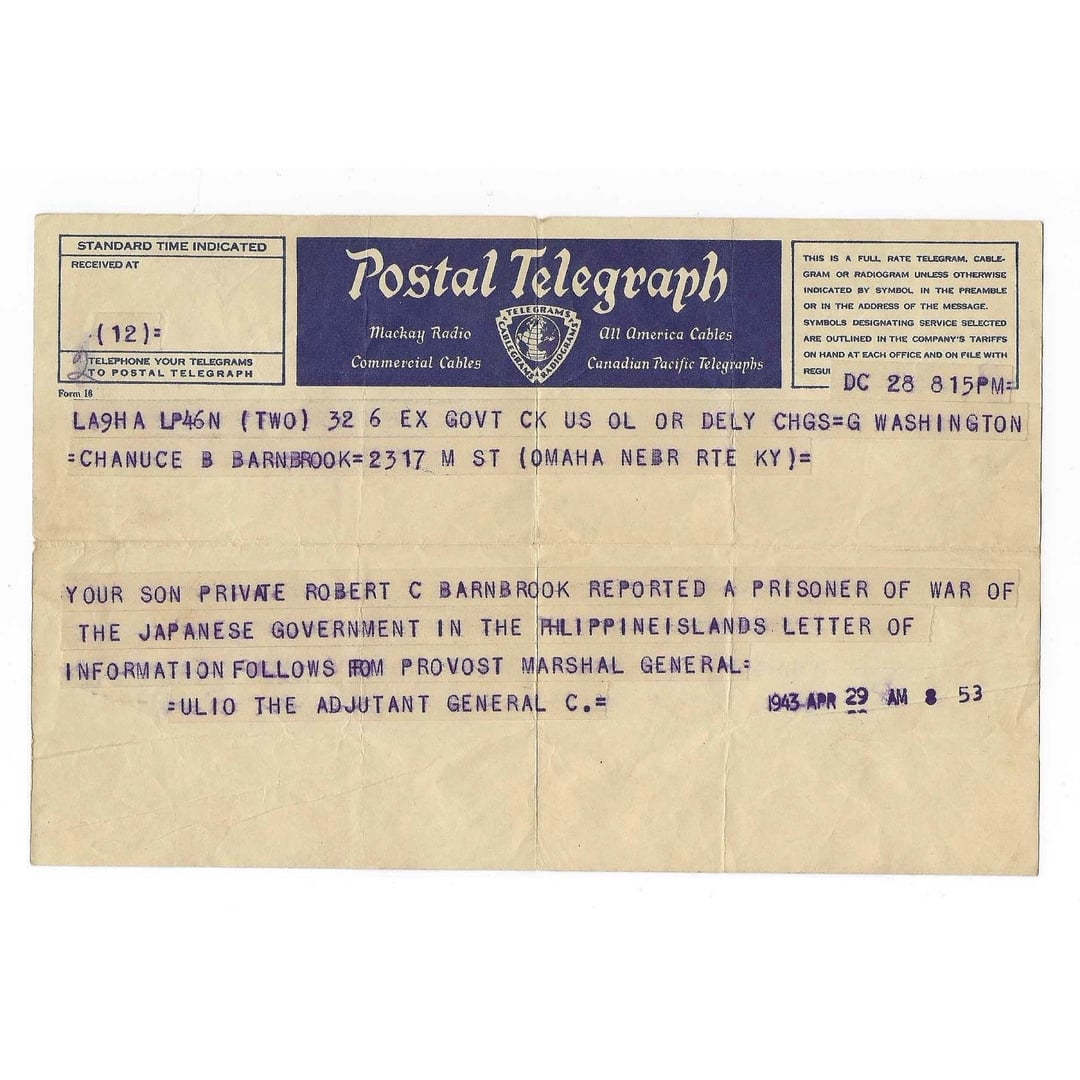
After receiving this letter, Mr. Barnbrook received no further updates on his son until almost a year later, when he received a telegram providing new information. It reads:
>“ 1943 APRIL 28
>YOUR SON PRIVATE ROBERT C BARNBROOK REPORTED A PRISONER OF WAR OF THE JAPANESE GOVERNMENT IN THE PHILIPPINE ISLANDS LETTER OF INFORMATION FOLLOWS FROM PROVOST MARSHAL GENERAL
ULIO THE ADJUTANT GENERAL C. “
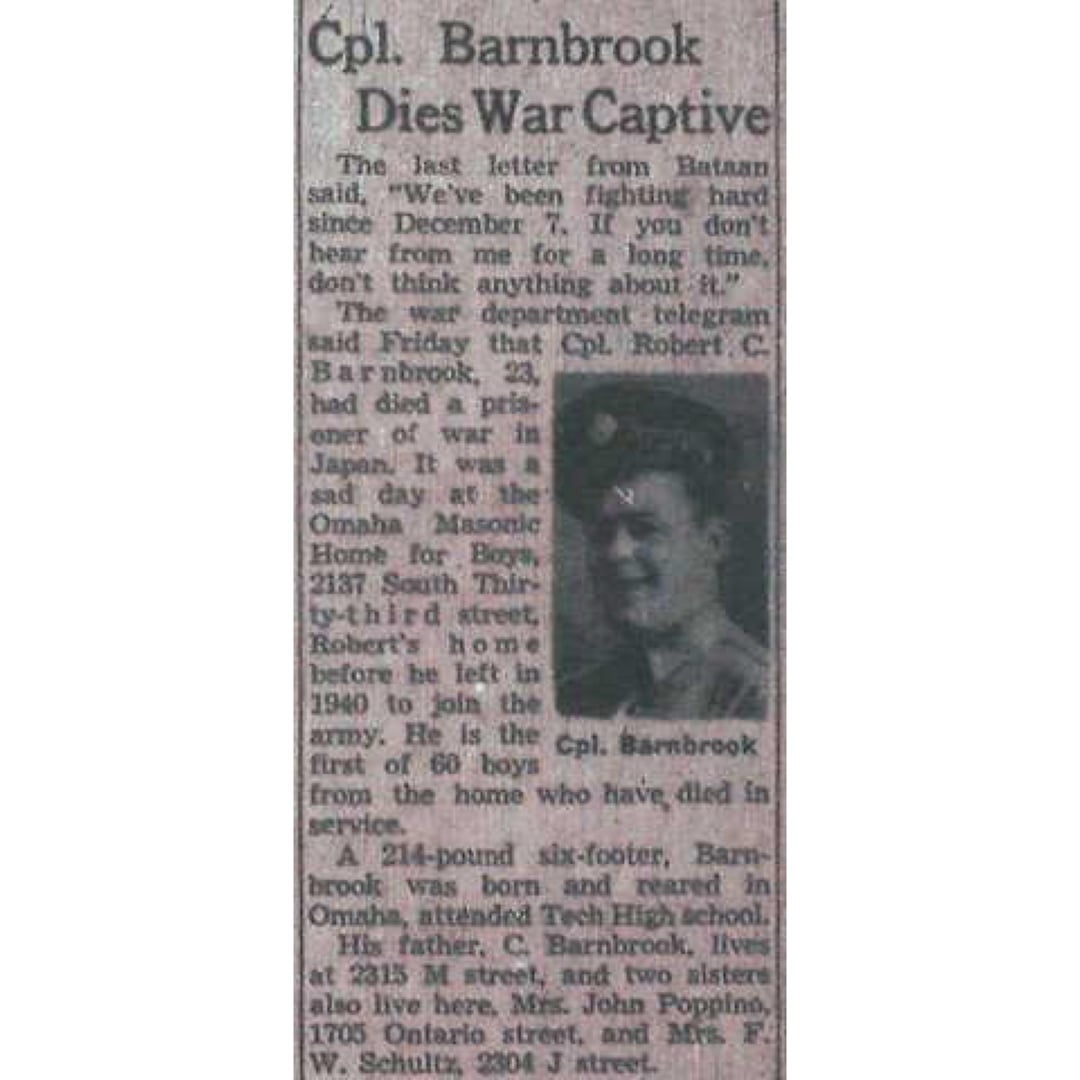
Following the liberation of the Philippines, camp records later confirmed that Robert had died in captivity on July 29th, 1943. The primary cause of death was listed as pellagra, with contributing factors including beriberi, scurvy, and malnutrition. Written reports from the camp note a diet consisting only of white rice and thin green soup for over nine months, leading to severe symptoms including bloody diarrhea, a sore tongue, and bodily edema. After this discovery, Robert’s father received a final telegram informing him of his son’s death in captivity.
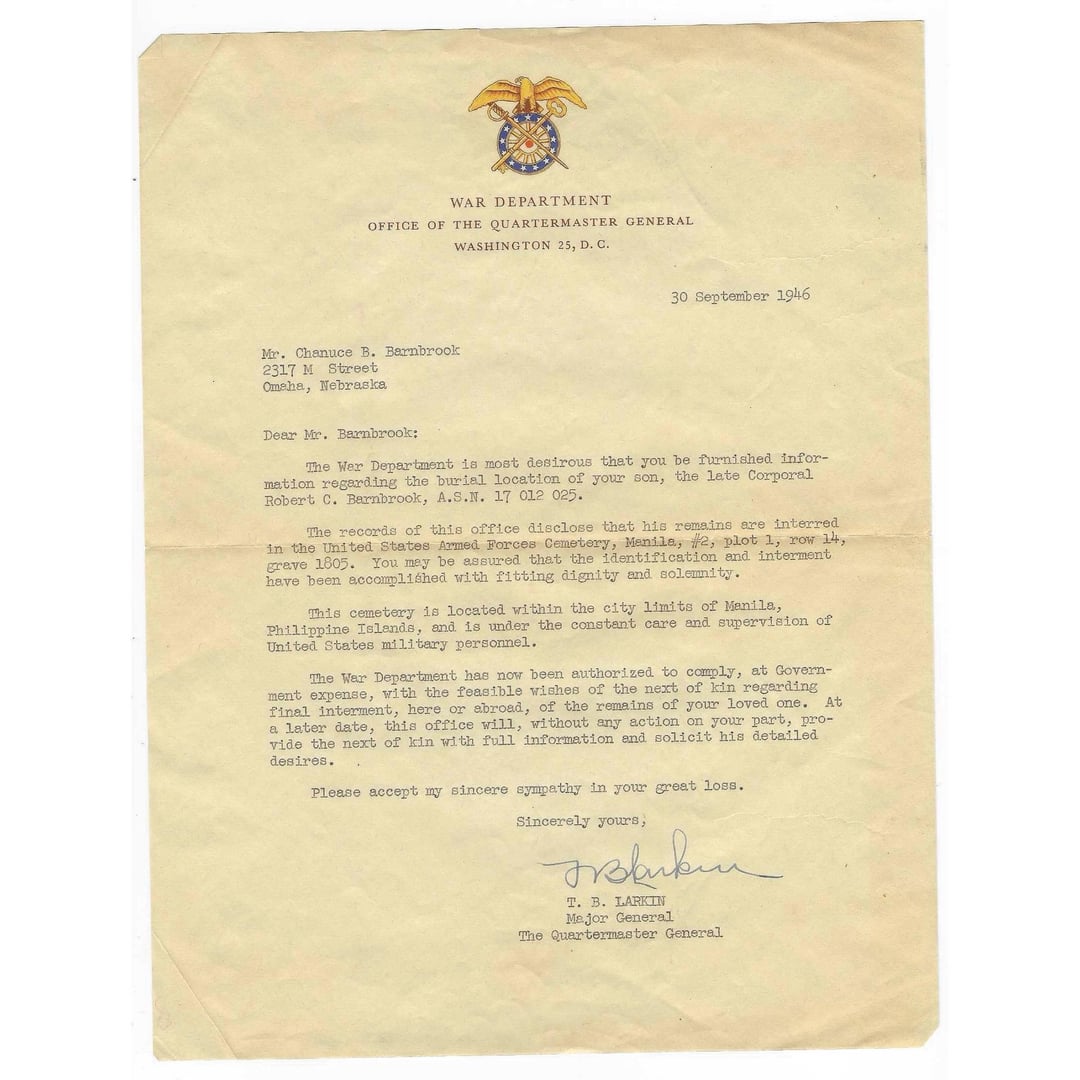
This final letter was sent after the war ended. It reads:
>“ 30 September 1946
>Dear Mr. Barnbrook:
The War Department is most desirous that you be furnished information regarding the burial location of your son, the late Corporal
Robert C. Barnbrook, A.S.N. 17 012 025.
>The records of this office disclose that his remains are interred in the United States Armed Forces Cemetery, Manila, #2, plot 1, row 14, grave 1805. You may be assured that the identification and interment
have been accomplished with fitting dignity and solemnity.
>This cemetery is located within the city limits of Manila, Philippine Islands, and is under the constant care and supervision of United States military personnel.
>The War Department has now been authorized to comply, at Government expense, with the feasible wishes of the next of kin regarding final interment, here or abroad, of the remains of your loved one. At a later date, this office will, without any action on your part, provide the next of kin with full information and solicit his detailed
desires.
>Please accept my sincere sympathy in your great loss.
Sincerely yours,
T. B. LARKIN
Major General
The Quartermaster General “
They gave their son. All they got back was these icy cold letters. So sad.
Heartbreaking what this man must have gone through for 9 months according the Death Report, I don’t even want to know why his penis and scotum were so swollen and ulcerated.
They fought for this…..