
I simulated 60,000 rounds of a 1D random walk (Heads = +1, Tails = -1) to see how long it takes for the score to return to exactly zero.
While probability theory guarantees a return to zero eventually, the expected waiting time is practically infinite due to its extreme heavy-tailed nature.
Swipe through the gallery to see:
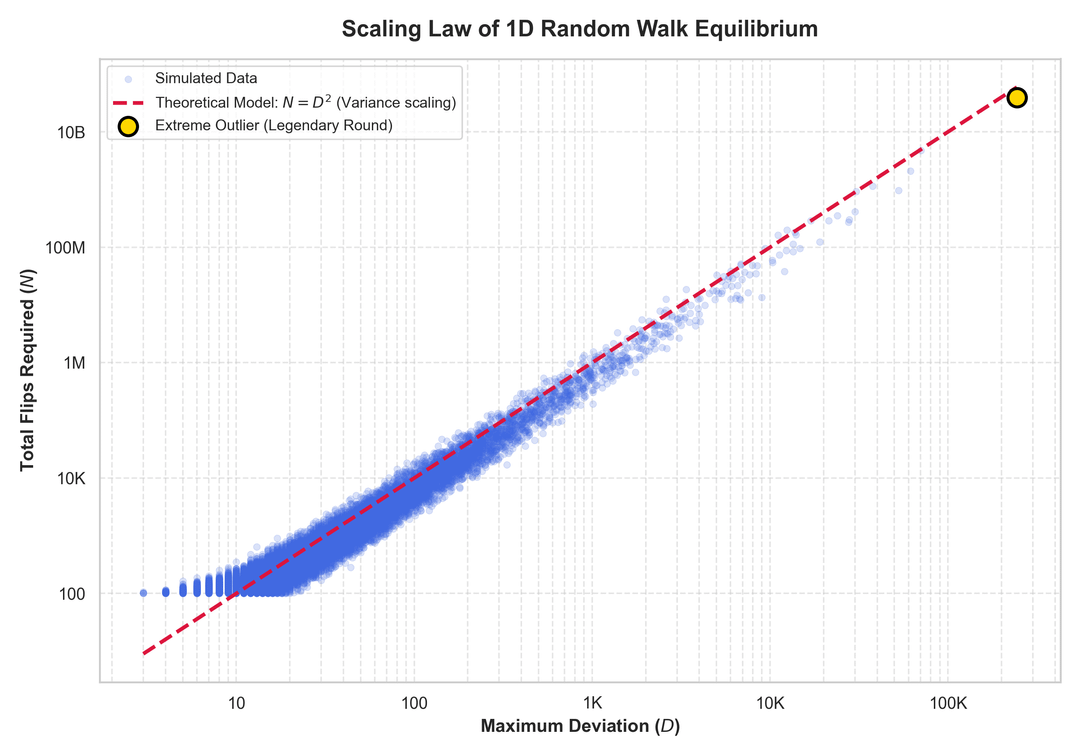
- Graph 1: The $N = D^2$ Scaling Law (and my multi-billion flip outlier).
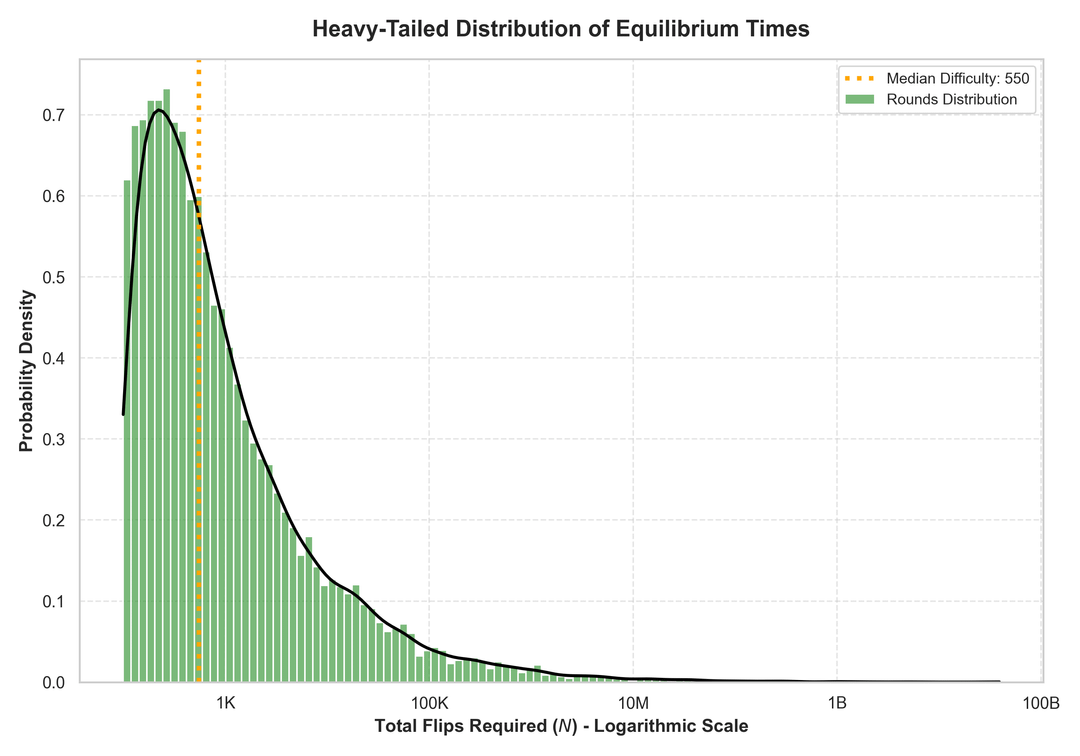
- Graph 2: The Heavy-Tailed Distribution of equilibrium times.
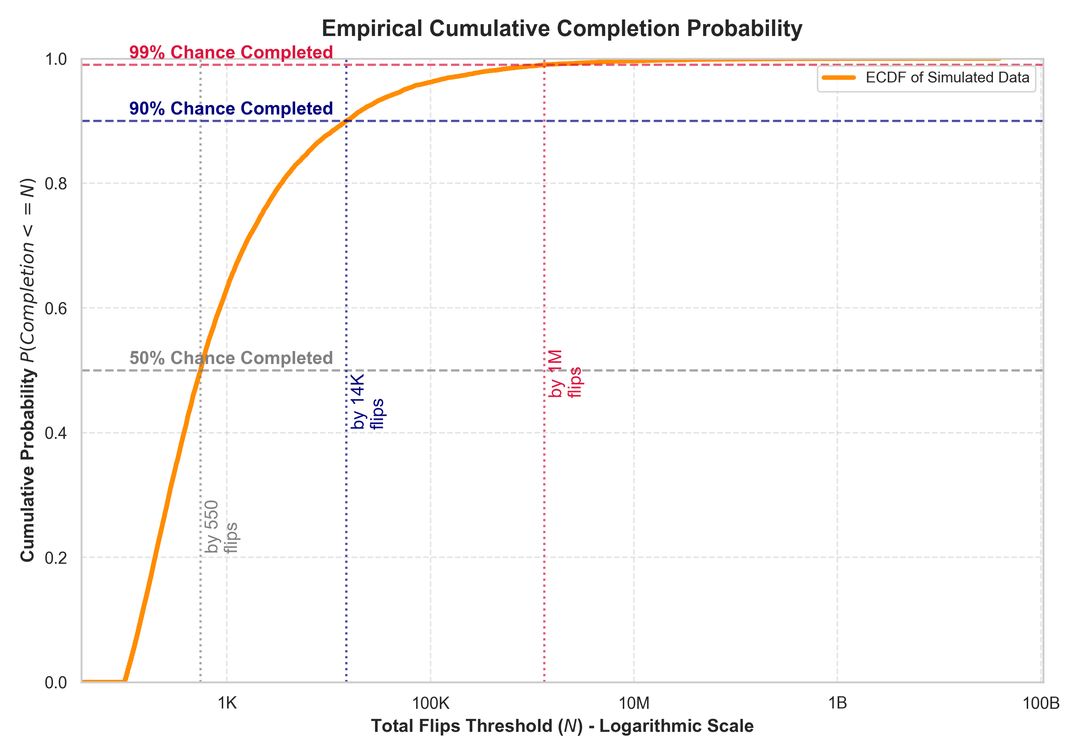
- Graph 3: The Cumulative Completion Probability (The 1% Trap).
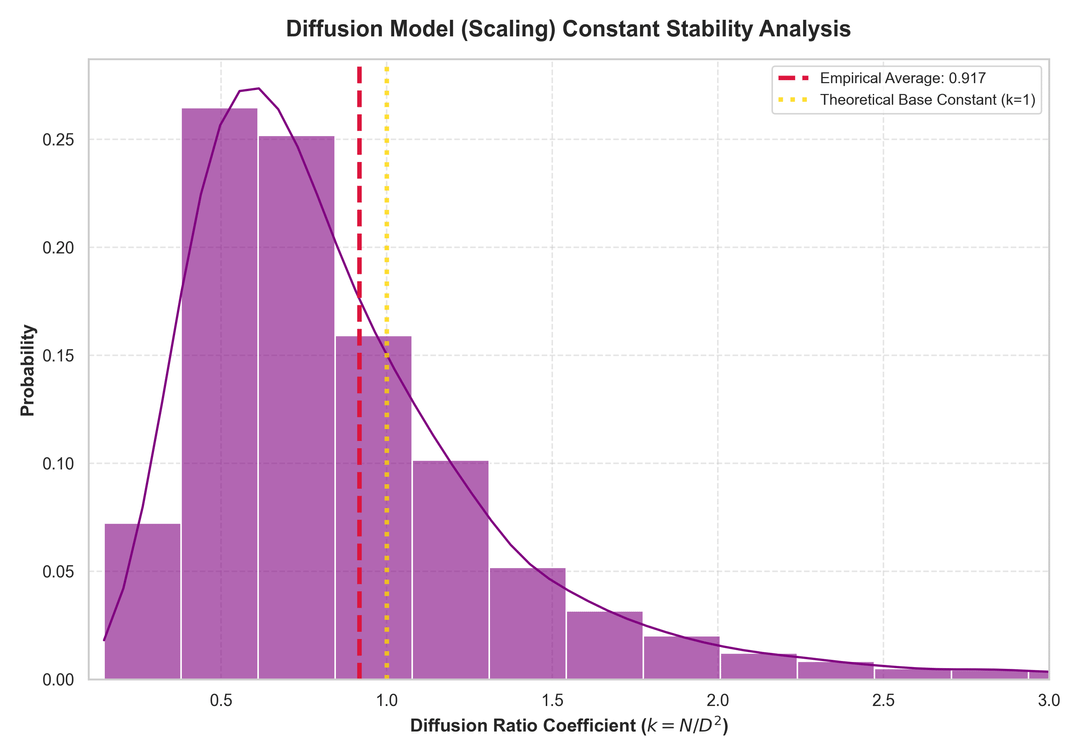
- Graph 4: Diffusion Constant Stability.
(Please check the top comment for the full breakdown of the data, the Node.js cryptographic buffer optimization that crunched this in 15 minutes, and the tools used!)
by NoRevolution6394
2 Comments
**Source:** Personal simulation. Data was generated by running a custom Node.js script simulating a 1D random walk (coin flips: Heads = +1, Tails = -1) until the score returned exactly to zero.
**Tools:**
* **Data Generation:** Node.js (Used `crypto.randomFillSync` with a 64KB buffer and bitwise operations to ensure unbiased, high-performance cryptographic randomness without standard RNG loops).
* **Analysis & Visualization:** Python, Pandas, Matplotlib, and Seaborn.
**Context & Findings:**
I simulated 60,000 rounds to visualize the heavy-tail nature of random walks. While mathematical theory guarantees a return to zero eventually, the expected waiting time is infinite. The data shows why:
* **The Median:** 50% of the rounds reached equilibrium in just 550 flips.
* **The Tail:** To guarantee a 99% completion rate, it took around 1,000,000 flips.
* **The Outlier:** The worst round (seen as the yellow dot) took *billions* of flips to reach equilibrium.
* **The Physics:** The relationship perfectly aligns with the theoretical variance scaling model: $N = D^2$ (Total Flips = Max Deviation squared).
That outlier is exactly why these simulations are fun. Most people intuitively expect “eventually” to mean “fairly soon,” then a random walk casually disappears for billions of flips. Heavy tails are brutal like that.