
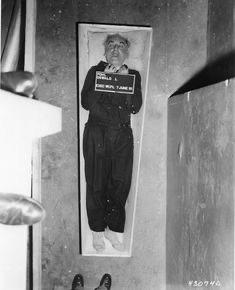
SS Lieutenant General Oswald Pohl started out as a paymaster in the Imperial German Navy during World War I, smart, organized, and good with money. After the war, like many veterans, he bought into the Dolchstoßlegende (the “stab-in-the-back” myth), blaming Germany’s defeat on politicians and Jews. He joined the Nazi Party and, in 1933, came under the influence of Heinrich Himmler.
Pohl’s administrative talent made him a key architect of the concentration camp system. In 1942, he became head of the SS Main Economic and Administrative Office (WVHA), putting him in charge of camp organization, forced labor, and SS economic operations. That same year, he oversaw the conversion of Castle Itter into a subcamp of Dachau Concentration Camp. Prisoners from Dachau, many already starved and brutalized, were forced to rebuild the castle into a functioning prison.
The system Pohl ran was anything but ordinary. Under his leadership, camps were integrated into a vast forced-labor economy built on what the Nazis called “extermination through labor.” Prisoners were quite literally treated as assets on a balance sheet.
Pohl’s office created calculations estimating the “value” of each prisoner: labor output minus the cost of food and clothing, plus the value of confiscated belongings, watches, cash, clothing, and even what could be recovered from their remains after death. The average inmate was given a life expectancy of about nine months and assigned a monetary value of roughly 1,630 Reichsmarks. Gold fillings, hair, clothing, and personal items, especially from Jewish victims, were systematically collected, cataloged, and sold.
By late 1944, hundreds of thousands of prisoners were being exploited as slave labor: over 250,000 in private industry, 170,000 in underground factories, and tens of thousands more clearing rubble from Allied bombing.
After the war, Pohl went into hiding as a farmhand near Bremen but was captured in 1946. He was tried in the fourth of the subsequent Nuremberg Trials. While not denying knowledge of mass murder, he portrayed himself as a bureaucrat simply following orders and accused the prosecution of acting out of revenge.
In prison, he supposedly returned to Catholicism and even published a book, with permission from the Carholic Church, Credo: My Way to God. He appealed his sentence multiple times, unsuccessfully. His final statement reflected the same defense he had relied on throughout: that he had simply carried out orders.
On June 7, 1951, Oswald Pohl was executed by hanging at Landsberg Prison, the same prison where Adolf Hitler had once been held and wrote Mein Kampf.
If you’re interested the story of Pohl and the prison he created, I cover it here: https://open.substack.com/pub/aid2000/p/hare-brained-history-vol-90-the-battle?r=4mmzre&utm_medium=ios
by aid2000iscool
2 Comments
Sorry to see he was afforded the dignity of a pine box and not shoveled naked into a shallow, muddy pit like so many far more honorable and innocent people who were victims of the crimes committed by his ilk.
It looks like he lived to be an old man.