Born in the 1590s in Manchester, he became an accomplished scholar and was deeply inspired by the Puritan movement of the time. Gorton believed that the Holy Spirit resided in all people which meant that no person was holier than any other in the eyes of God and that true salvation came from following one’s own conscience even if such actions went against the edicts of organized religion. He believed that the Church of England had been wholly corrupted by political interference and soon seized the opportunity to travel to the New World to live and worship as he pleased.
Upon landing in Boston he immediately began clashing with the local ministers and magistrates, who quickly expelled him to nearby Plymouth. Within a year his differences of religious opinion with his landlord resulted in him being kicked out of Plymouth to Portsmouth, Rhode Island. This didn’t fare much better and he was brought before a court whereupon he lashed out at the magistrates calling them “Asses”, “Saucy Boys” and “Jack-an-Apes” (Very strong language for the time). When Governor Coddington “called upon those loyal to the King to carry away Gorton and bring him to prison.” Gorton responded by “calling upon all those loyal to the King to carry Coddington away and bring him to prison.” This didn’t work and he was subsequently whipped before being exiled to Providence. His stay there was once again brief following disputes and he moved to a tract of land he purchased from the Narragansett along the banks of the Pawtuxet river, which he named Shawomet.
There he lived relatively peacefully until settlers in his area named William Arnold and his son, Benedict Arnold (great grandfather of THAT Benedict Arnold) called upon the Massachusetts Bay Colony to send soldiers to remove him. Eager to expand the territory of Massachusetts and establish a foothold along the Narragansett Bay, soldiers were sent from Boston to besiege the small settlement, exchanging gunfire with Gorton in a standoff that lasted several days before he was captured. Gorton was then brought in under the pretense of unfairly treating a local sachem though it quickly became apparent that was a lie when he was instead charged with heresy with all but three of the magistrates sentencing him to death for blasphemy. However, a majority of the deputies refused to carry out the sentence and opted to imprison him in chains instead. He was released less than a year later and ventured to England to secure protection for his settlement. In England he found the people far more receptive to his interpretations of Christianity than when he left and he gave many sermons to radical Puritans in London.
Upon returning to New England, the authorities of the Massachusetts Bay once again called for his arrest, however thanks to his letter of protection from Robert Rich, Second Earl of Warwick, he was allowed to return home in peace. In gratitude of his sponsor he renamed his settlement to Warwick, which is now the third largest city in Rhode Island. Due to his success in England he was elected to serve as the magistrate of Warwick, a position that he refused until he was fined. In 1652, during his time as magistrate, a statute was written that called for the end of slavery within the colony. Although the law failed to get enough agreement to be widely enforced, it is commonly believed that Gorton was its primary author making him personally responsible for the earliest piece of abolitionist legislation in North America.
His beliefs and teachings were considered extreme for his day, such as ministers and clergy not being the ultimate authority of biblical interpretation, churches should not be paid tithes by their congregation, nor should church attendance be a mandatory fineable offense as salvation can only come from those who freely choose it, all men are equal and that women possess an equal spirit to men in the eyes of God, infants should not be baptized as they don’t have the capacity to understand the concepts of Christianity, and that heaven and hell were states that exist within the hearts of people not an actual location of the afterlife.
While he was widely derided and even demonized in his day as an extremist; modern assessments tend to portray him as a man wholly consumed by his desire for personal and religious liberty and who gave others the same freedoms and considerations he sought for himself.
SaltEfan on
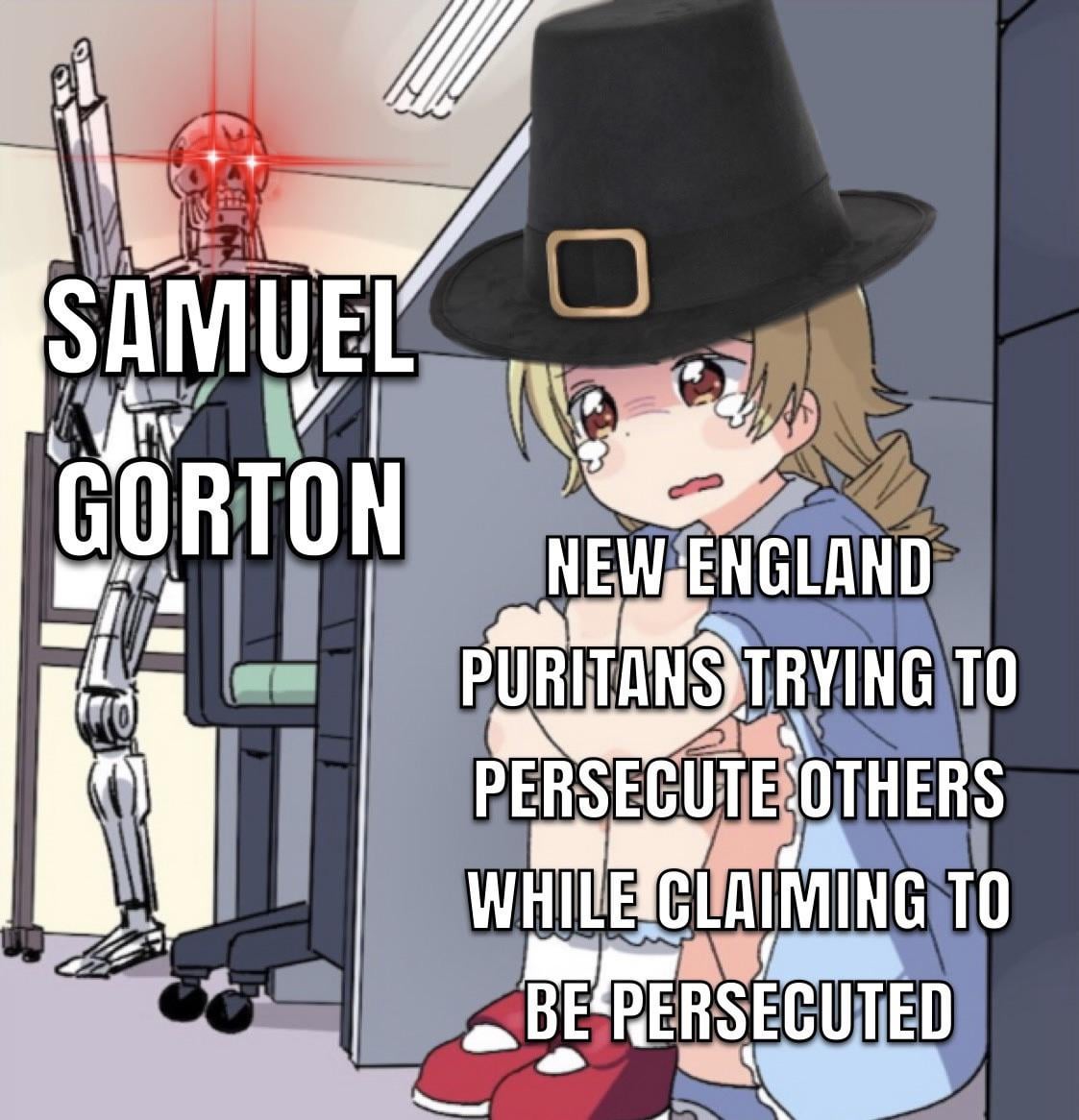
An old friend of mine used to say “christian minorities fled persecution so that they could be free to persecute.” (It flows better i my native tongue)
Puritans were indeed one of those groups.
PuritanSettler1620 on
This is FALSE!!! New England Puritans were not trying to persecute anyone! We merely sought to create a Godly Commonwealth where we might practice the true christian religion. Gorton was a HERETIC and an APOSTATE! His so called preachings violated the laws of our commonwealth and the sanctity of our communities. He was an agitator and a miscreant.

3 Comments
Born in the 1590s in Manchester, he became an accomplished scholar and was deeply inspired by the Puritan movement of the time. Gorton believed that the Holy Spirit resided in all people which meant that no person was holier than any other in the eyes of God and that true salvation came from following one’s own conscience even if such actions went against the edicts of organized religion. He believed that the Church of England had been wholly corrupted by political interference and soon seized the opportunity to travel to the New World to live and worship as he pleased.
Upon landing in Boston he immediately began clashing with the local ministers and magistrates, who quickly expelled him to nearby Plymouth. Within a year his differences of religious opinion with his landlord resulted in him being kicked out of Plymouth to Portsmouth, Rhode Island. This didn’t fare much better and he was brought before a court whereupon he lashed out at the magistrates calling them “Asses”, “Saucy Boys” and “Jack-an-Apes” (Very strong language for the time). When Governor Coddington “called upon those loyal to the King to carry away Gorton and bring him to prison.” Gorton responded by “calling upon all those loyal to the King to carry Coddington away and bring him to prison.” This didn’t work and he was subsequently whipped before being exiled to Providence. His stay there was once again brief following disputes and he moved to a tract of land he purchased from the Narragansett along the banks of the Pawtuxet river, which he named Shawomet.
There he lived relatively peacefully until settlers in his area named William Arnold and his son, Benedict Arnold (great grandfather of THAT Benedict Arnold) called upon the Massachusetts Bay Colony to send soldiers to remove him. Eager to expand the territory of Massachusetts and establish a foothold along the Narragansett Bay, soldiers were sent from Boston to besiege the small settlement, exchanging gunfire with Gorton in a standoff that lasted several days before he was captured. Gorton was then brought in under the pretense of unfairly treating a local sachem though it quickly became apparent that was a lie when he was instead charged with heresy with all but three of the magistrates sentencing him to death for blasphemy. However, a majority of the deputies refused to carry out the sentence and opted to imprison him in chains instead. He was released less than a year later and ventured to England to secure protection for his settlement. In England he found the people far more receptive to his interpretations of Christianity than when he left and he gave many sermons to radical Puritans in London.
Upon returning to New England, the authorities of the Massachusetts Bay once again called for his arrest, however thanks to his letter of protection from Robert Rich, Second Earl of Warwick, he was allowed to return home in peace. In gratitude of his sponsor he renamed his settlement to Warwick, which is now the third largest city in Rhode Island. Due to his success in England he was elected to serve as the magistrate of Warwick, a position that he refused until he was fined. In 1652, during his time as magistrate, a statute was written that called for the end of slavery within the colony. Although the law failed to get enough agreement to be widely enforced, it is commonly believed that Gorton was its primary author making him personally responsible for the earliest piece of abolitionist legislation in North America.
His beliefs and teachings were considered extreme for his day, such as ministers and clergy not being the ultimate authority of biblical interpretation, churches should not be paid tithes by their congregation, nor should church attendance be a mandatory fineable offense as salvation can only come from those who freely choose it, all men are equal and that women possess an equal spirit to men in the eyes of God, infants should not be baptized as they don’t have the capacity to understand the concepts of Christianity, and that heaven and hell were states that exist within the hearts of people not an actual location of the afterlife.
While he was widely derided and even demonized in his day as an extremist; modern assessments tend to portray him as a man wholly consumed by his desire for personal and religious liberty and who gave others the same freedoms and considerations he sought for himself.
An old friend of mine used to say “christian minorities fled persecution so that they could be free to persecute.” (It flows better i my native tongue)
Puritans were indeed one of those groups.
This is FALSE!!! New England Puritans were not trying to persecute anyone! We merely sought to create a Godly Commonwealth where we might practice the true christian religion. Gorton was a HERETIC and an APOSTATE! His so called preachings violated the laws of our commonwealth and the sanctity of our communities. He was an agitator and a miscreant.