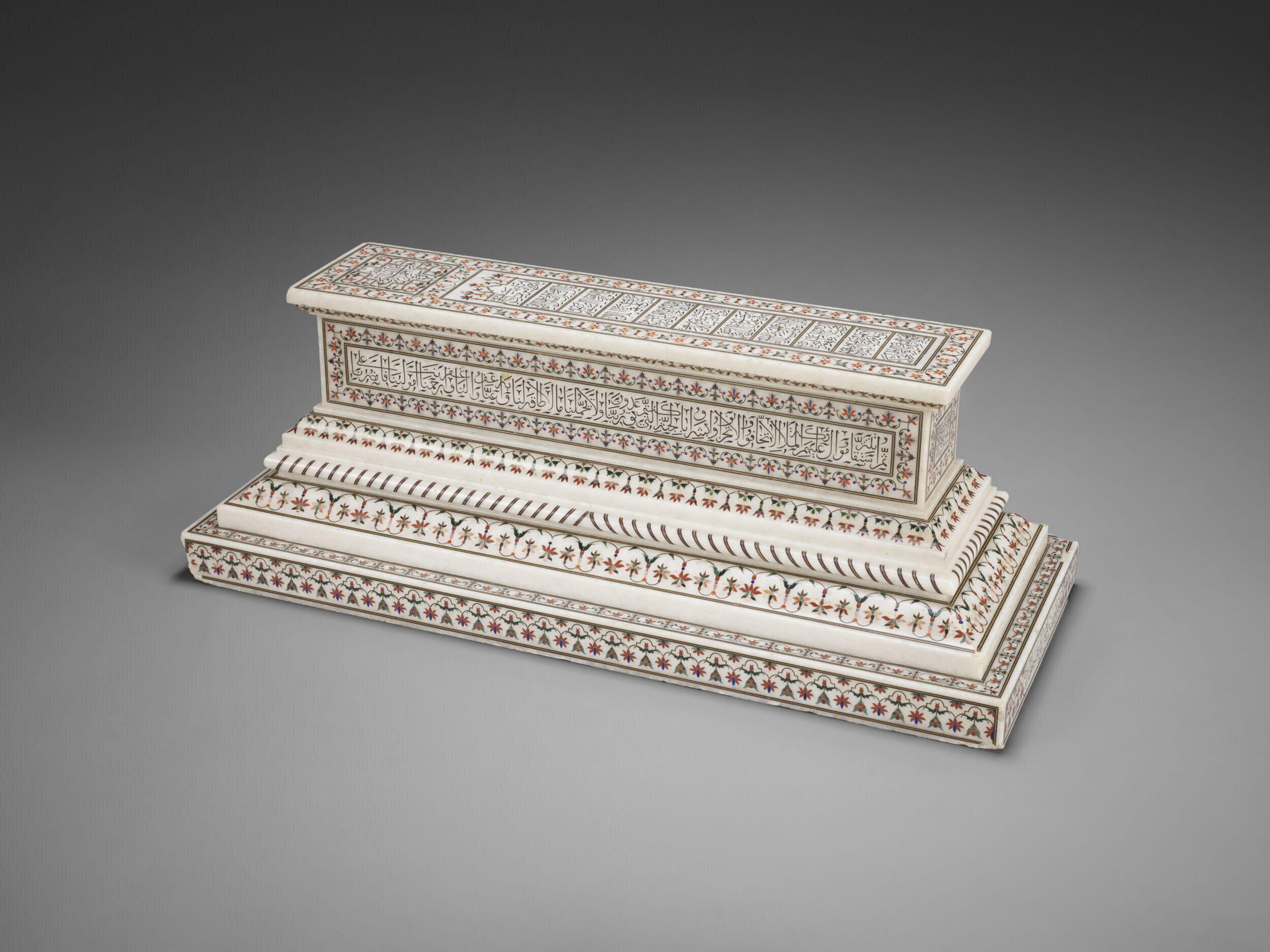
Fun fact: Far from being some random “souvenir”-esque *bric-à-brac* from the imperial colonies, the artefact’s dimensions are no passing joke:
* Depth: 220 mm
* Width: 544 mm
* Height: 191 mm
* Weight: 31 kg
Girderland on
A cenotaph is an empty grave. Sort of like a tomb, but without any body laid to rest, but rather built with the purpose to honor the deceased.
The most famous example is the Taj Mahal, but if I remember correctly the “Grave Of The Unknown Soldier” in Paris (?) is also a symbolic structure of this kind.

2 Comments
Currently part of the Rosalinde and Arthur Gilbert Collection of the V&A.
Artefact’s historical provenance (specifically the commissioner & the eventual owner/s prior to the Gilbert couple’s acquisition) remain unknown.
Meanwhile, further information regarding the artefact’s composition as well as the detail matching the original within the Taj Mahal’s central chamber are [in the artefact’s V&A link](http://collections.vam.ac.uk/item/O156429/historical-model-unknown/http://collections.vam.ac.uk/item/O156429/historical-model-unknown/).
Fun fact: Far from being some random “souvenir”-esque *bric-à-brac* from the imperial colonies, the artefact’s dimensions are no passing joke:
* Depth: 220 mm
* Width: 544 mm
* Height: 191 mm
* Weight: 31 kg
A cenotaph is an empty grave. Sort of like a tomb, but without any body laid to rest, but rather built with the purpose to honor the deceased.
The most famous example is the Taj Mahal, but if I remember correctly the “Grave Of The Unknown Soldier” in Paris (?) is also a symbolic structure of this kind.