
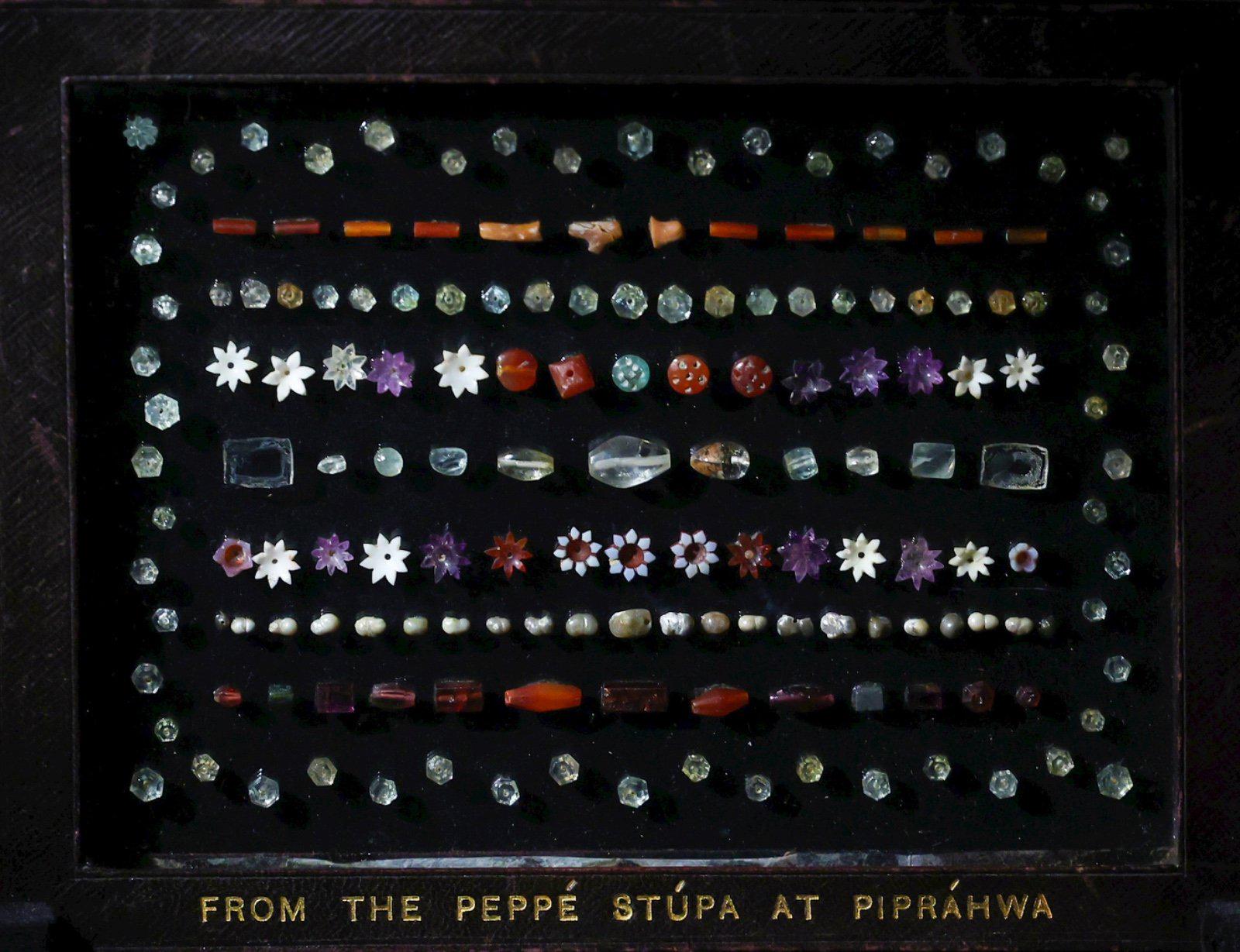
The caption at the bottom reads “FROM THE PEPPÉ STŪPA AT PIPRĀHWA,” referring to the stupa excavated at Piprahwa in present-day Siddharthnagar district, Uttar Pradesh, near the Nepal border. In 1898, W. C. Peppé excavated the mound and uncovered a stone coffer containing reliquary vessels, bone and ash fragments, and a large deposit of precious offerings.
These are relic offerings placed with the deposit: faceted beads, coral or carnelian-like rods, flower and star-shaped cut pieces, pearls, rock crystal elements, and other small worked ornaments. Museum descriptions identify the broader Piprahwa group as gold, semiprecious stones, rock crystal, pearls, and shell, dated roughly to ca. 240 to 200 BCE. The Met described one exhibited set as about 320 tiny objects arranged in framed ensembles.
Visually, the frame shows:
- the outer border dominated by small faceted crystal or stone pieces,
- upper rows with red cylindrical beads or cut segments,
- middle rows with floral rosettes, discs, and larger clear crystal pieces,
- lower rows with pearls and darker red beads,
- all mounted on black velvet to maximize contrast.
by Curious_Map6367