The real hero’s were the People of the Philippines but the church really did come in clutch
by Obscure_Occultist

The real hero’s were the People of the Philippines but the church really did come in clutch
by Obscure_Occultist
3 Comments
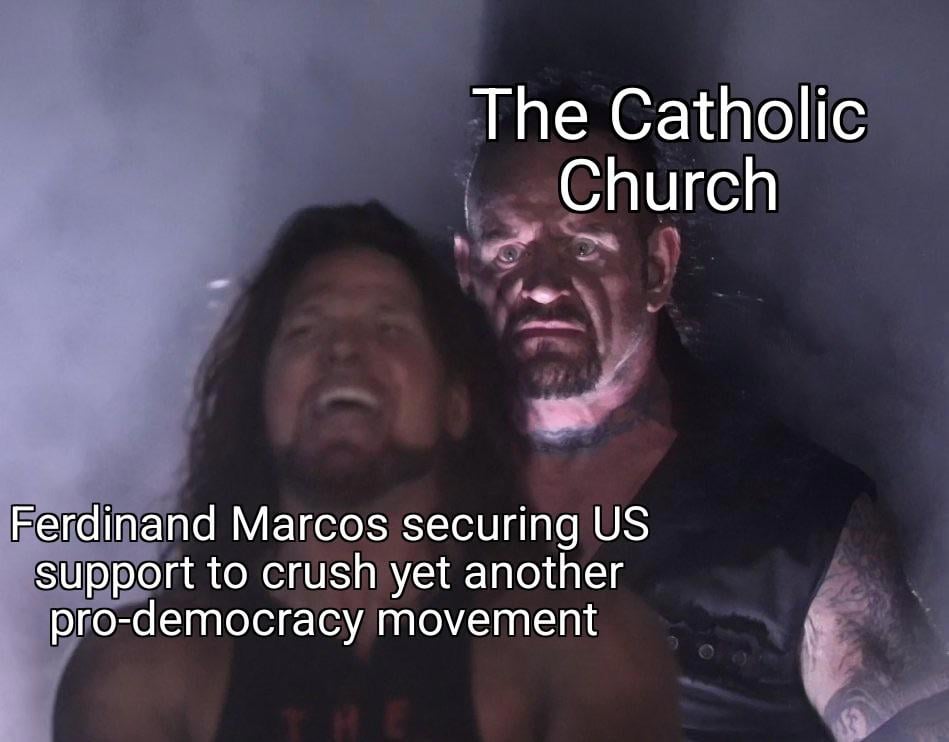
Context: Despite widespread warnings by both political opponents and members of the press. Ferdinand Marcos would win his second term following the 1969 Philippine general elections. By 1971, marines were shooting unarmed protesters. By 1972, citing growing unrest caused by widespread corruption and the constant murder of unarmed protesters, Marcos declared martial law. Starting nearly 20 years of his authoritarian dictatorship over the Philippines.
Marcos would manage to fend off multiple attempts to restore democracy, largely with american assistance for the next 20 years. However things changed in August 31, 1983, when prominent anti-Marcos opposition politician Ninoy Aquino was murdered after shortly returning from his exile. This would mark the turning point and the beginning of the end for the Marcos’
The murder of such a prominent critic of Marcos would trigger a new round of protests against the Marcos’. Which were made worse by worsening economic conditions which fuelled protests. In an effort to cement his rule with a veneer of legitimacy, Marcos called for snap elections in 1986, a full year before they were supposed to happen.
The election of 1986 would be dramatic to say the least. On the opposition side, it was led by Ninoy Aquino’s widow, Corazan Aquino who gathered popular support from across the political spectrum. Both sides would accuse each other of cheating, and both ultimately declared themselves the winner of the election. Despite overwhelming evidence that showed that it was the Marcos’ were the ones that cheated, things looked bleak. It looked like Ferdinand was about to call on US political support to crush yet another challenge to his power.
Then the Catholic Church intervened.
Well, specifically cardinal Jaime Sin, the Archbishop of Manila, and Cardinal Ricardo Vidal, the president of the catholic bishops conference of the Philippines. The two highest catholic authority figures in the Philippines, short of the pope himself.
On February 22, both Cardinals went on national TV and publicly declared that it was every faithful catholic moral and religious obligation to overthrow the Marcos regime. Marking the beginning of the people power revolution, also known the yellow ribbon revolution or the EDSA revolution. The declaration would energize a nation. Millions of Filipinos would flock to the streets in protest. The churches support wouldn’t wasn’t just limited to moral support. The catholic church lent tangible material support to the Revolution. Catholic radio stations coordinated protests, clergy led protesters, chaplains convinced military units to defect. In February 25, 3 days after the churches intervention. Ferdinand Marcos and his family would flee the nation. Ending 20 years of authoritarianism.
To this day one can still see priests and nuns protesting alongside leftist groups, they tend to be aligned except for topics like same sex marriage, divorce and abortion.
It was the evangelical protestants and cults that tend to be more conservative.
Never underestimate the soft power of Religion.