
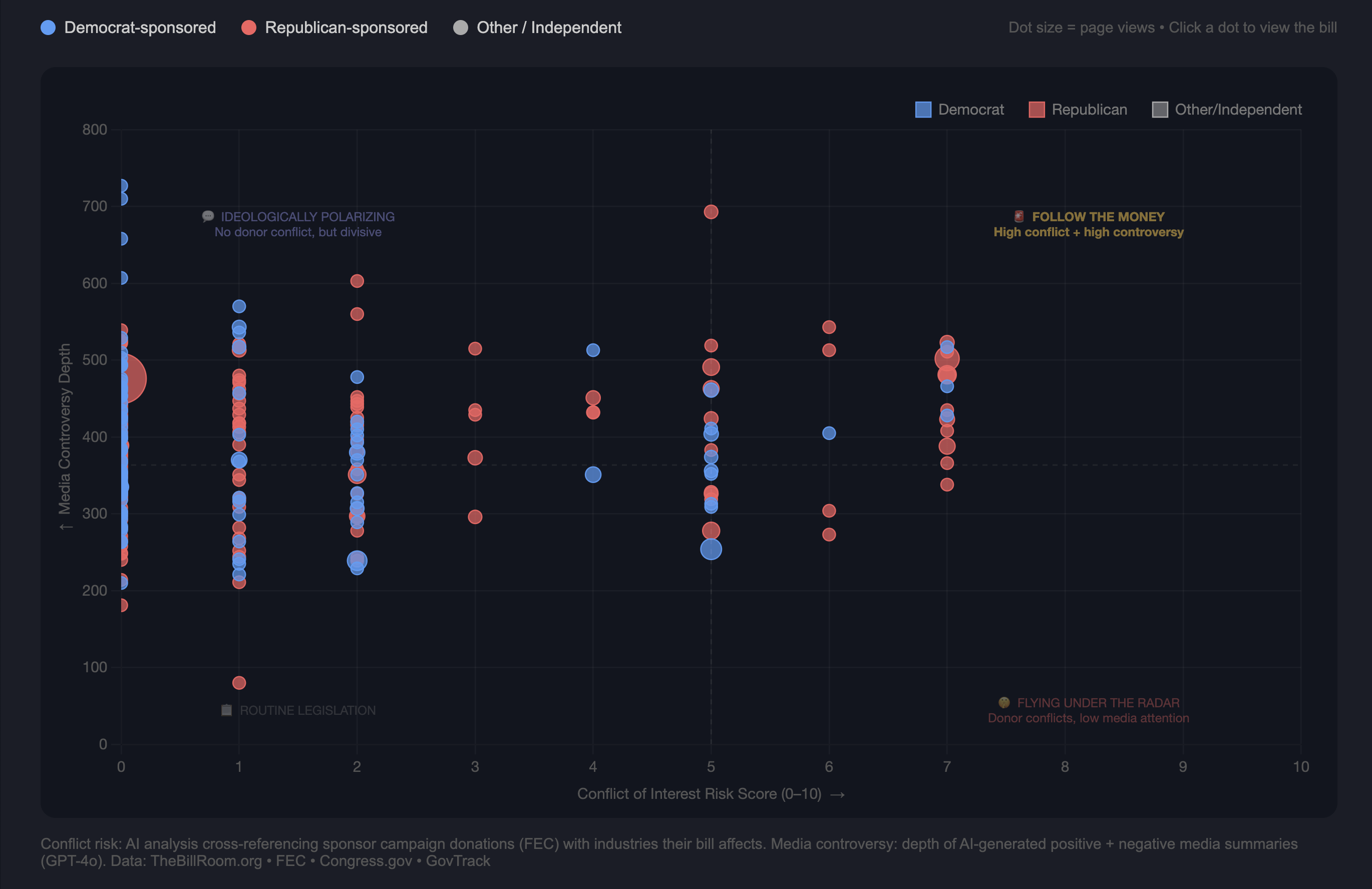
Conflict risk: AI analysis cross-referencing sponsor campaign donations (FEC) with industries their bill affects. Media controversy: depth of AI-generated positive + negative media summaries (GPT-4o). Data: TheBillRoom.org • FEC • Congress.gov • GovTrack
by TackleImaginary
3 Comments
Hey r/dataisbeautiful – I built [TheBillRoom.org](http://TheBillRoom.org) to make congressional legislation easier to understand. This chart is one of the more interesting things I’ve pulled from the data.
What you’re looking at:
X-axis – conflict-of-interest risk score (0–10). Calculated by cross-referencing each bill sponsor’s FEC campaign donors with the industries their bill would directly benefit or regulate.
Y-axis – media controversy depth. How much both sides of the media engaged with the bill, measured from AI-generated positive and negative coverage summaries.
Dot size – page views (public interest)
Color – sponsor’s party (blue = Democrat, red = Republican)
The top-right “Follow the Money” quadrant is the most interesting – bills where the sponsor’s donors had a financial stake AND the bill generated polarized media coverage on both sides.
Interactive version (hover for bill details, click to read the full AI analysis): [https://thebillroom.org/graphs/scatter_polarizing_bills.php](https://thebillroom.org/graphs/scatter_polarizing_bills.php)
Data sources: FEC Schedule A filings, [Congress.gov](http://Congress.gov), GovTrack, OpenAI GPT-4o for media framing analysis.
Happy to answer questions about methodology – this is an ongoing project and still improving.
Interesting that it gets worse the further right you go….
Now if only “AI-generated positive + negative media summaries (GPT-4o)” was a reproducible, scientific analysis strategy.