
On the eve of World War I, roughly two million Armenians lived within the Ottoman Empire. A predominantly Christian minority, most were rural peasants, but Armenians were also overrepresented in commerce and urban professions, making them economically important, yet resented. In the decades before the war, they had already endured repression, land seizures, and mass killings during the Hamidian Massacres.
During the Second Balkan War, Ottoman leadership expelled around 150,000 Greeks from Eastern Thrace through looting and intimidation, viewing it as a successful policy of “Turkification.” World War I provided a broader opportunity. Interior Minister Talaat Pasha later described it as a chance for a “definitive solution to the Armenian Question.”
Thousands of Armenians were conscripted into the Ottoman army, but Armenian civil servants were soon dismissed, and Armenian soldiers were disarmed and reassigned to labor battalions. After the disastrous defeat at Sarıkamış, Enver Pasha blamed Armenians for collaborating with Russia, claims that served as a convenient pretext.
On April 18, 1915, Armenians in Van were ordered to surrender their weapons, forcing an impossible choice: disarm and risk massacre, or resist. Many resisted, holding the city until Russian forces arrived. As the Russians advanced, they passed through villages filled with corpses.
Days later, on April 24, Armenian intellectuals and community leaders were arrested in Constantinople. That night, between 235 and 270 Armenians, priests, lawyers, doctors, and journalists were detained, most of whom had no involvement in nationalist movements. The discrepancy reflects poor record-keeping and indifference on the part of authorities. Political organizations were banned, and mass deportations began, marking the start of the Armenian Genocide, the systematic deportation and destruction of Armenians in the empire.
Government directives aimed to reduce the Armenian population to 5–10%, goals that could not be achieved without mass killing.
Framed as a wartime necessity, Talaat argued there could be no distinction between innocent and guilty. In reality, the deportations were death marches. Men and boys were often separated and killed early on; women and children were driven across mountains and deserts with little food or water. Many died along the way; others were killed by paramilitaries or succumbed to disease and starvation.
By late 1915, hundreds of thousands had reached camps in Syria and Mesopotamia, where conditions were so severe that some were later closed to prevent epidemics. Forced conversions, abductions, and the seizure of Armenian land and property were widespread. In desperation, some parents even sold their children, believing it might be their only chance at survival.
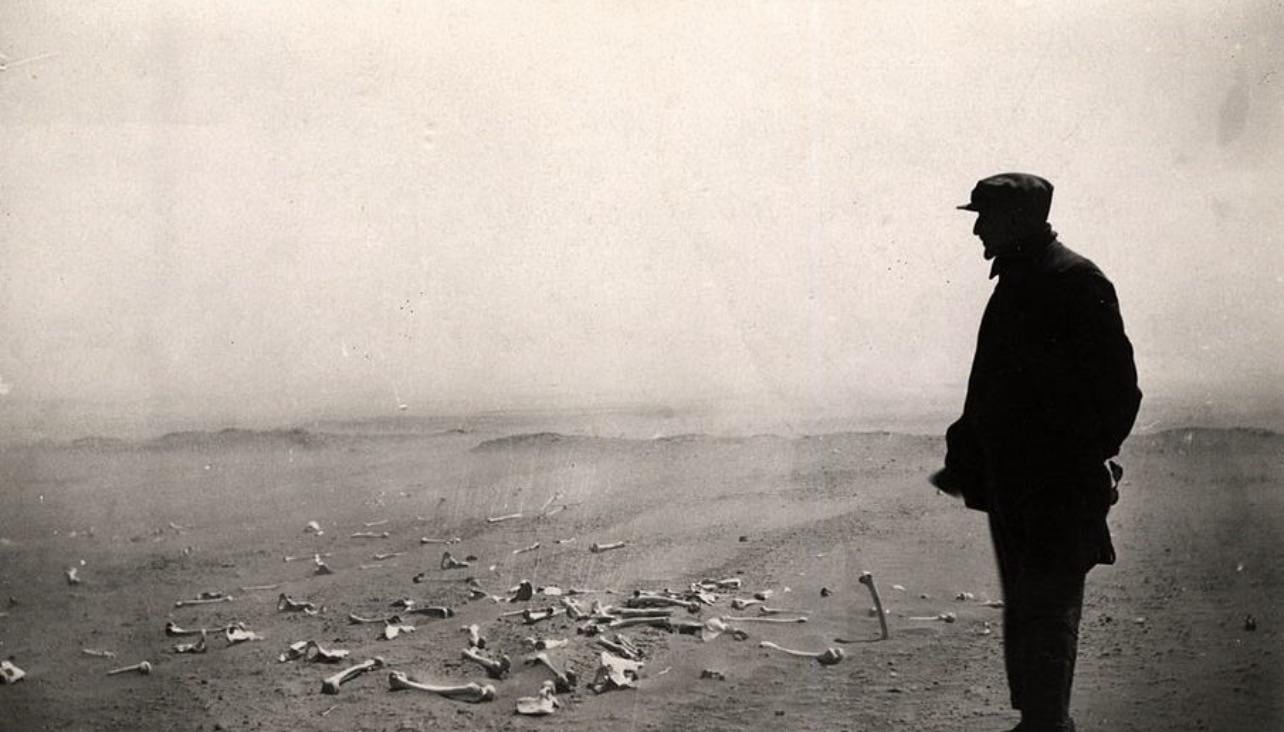
This photo shows Vrtanes Papazian, an Armenian writer, journalist, and teacher, who survived. His brother Nerses, a priest, did not.
If you’re interested, I cover the full event here: https://open.substack.com/pub/aid2000/p/hare-brained-history-vol-87-the-armenian?r=87j1c0&utm_campaign=post&utm_medium=web
by aid2000iscool
1 Comment
The crime of all crimes.