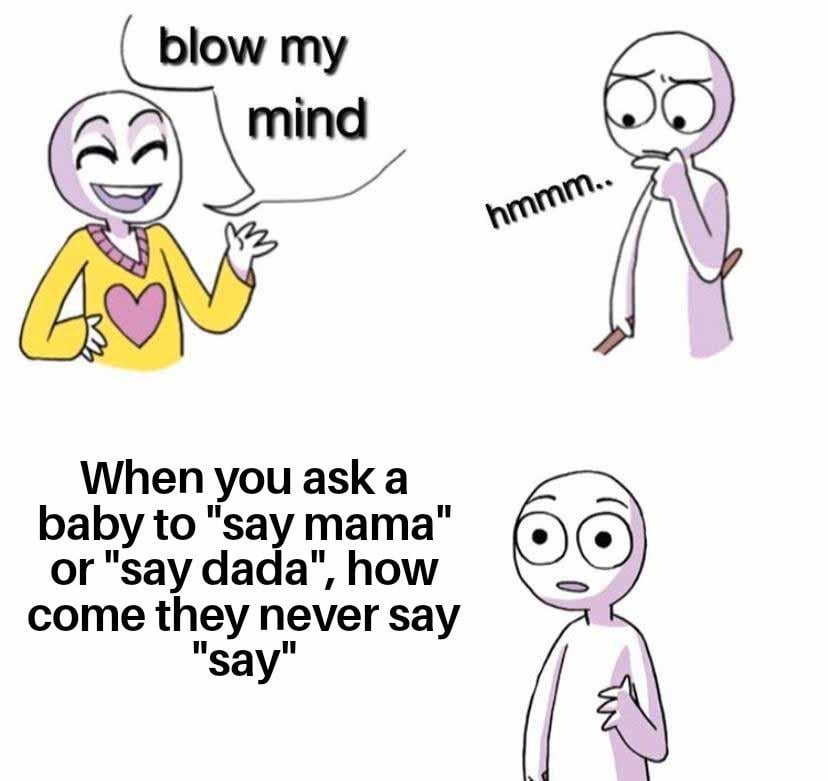
Babies are just natural born selective listeners. However, saying the letter “S” and “Y” is more complicated than the words “Mama and Papa”.
PM_ME_UR_0_DAY on
If this blows your mind, you might be a baby
Mirarexx on
It’s a glitch in the simulation. The devs forgot to map the “echo” function for that specific string.
Pitiful_Lie4818 on
“Mama” and “dada” are easier to say for the baby than “say”
Parents tend to put more emphasis on “mama” and “dada” than on “say”
Several-Midnight9188 on
Reminds me of the guy who tried to train the raven to say nevermore and the bird said both parts.
Remote-Tower-9316 on
mama and dada are just 2 sounds, its easier to say
Exoyotex on
Saidada and Saimama
Exzentrik on
Just on the off-chance that you (or anyone else) actually wonders: They never say “say” because they also don’t actually *say* “Mama”. They’re simply having fun making noise.
If you just breathe out through your mouth while opening and closing it, you automatically “say” Mama. That’s why it’s the universal term for mothers in pretty much every language, even those that sound nothing like English. Mothers just heard their babies make the Mama sound, and claimed it’s a word.
“Dada” is then the next step, when they learn to move their tongue.
Cypeq on
they heard you speak for a year more or less all the fuckin time if you ask it in Chinese it will not get it, and if it does it is probably solving linear equations already.
Thrakk223 on
I imagine it’s partly because when you’re speaking to them you put a lot more emphasis on “Mama” or “Papa” and people will often repeat just the word they want them to say “Say dada, dada, da-da, DA-DA”
redboi049 on
Context clues, probably.
North-Function995 on
Its usually “can you say mama? Mama? Mama? Mama? Mama. Ma-ma.” and so on.
Theres a lot of emphasis on mama obviously. End thread lmao
Beneficial-Gap6974 on
Babies learn basic grammar before they speak their first words. They legit understand what they’re saying and what you’re saying, at least on a basic level.
SemajLu_The_crusader on
you put emphasis on “mama” or “dada” and also babies can’t say “say” that shit’s hard
PixelPott on
My pediatrics prof showed the class a video of the treatment of a newborn (!) yesterday, and one of the first sounds the child made (after crying) sounded somewhat like “mama”.
I think it’s just an easy and instinctual sound to make.
That’s one of the reasons many languages have similar words for parents.
GenoCash on
You say, Say mama, Mama, Ma.. Ma.. so they focus on the Mama because you say mama more than say
Archie_cave_its on
First you understand language, then you use it. Not a mystery, lol.
Lordfruitsnack on
It’s the last thing they hear and they hear it a lot.
CompetitiveHouse2582 on
usually the ‘mama’ and ‘dada’ are emphasised
brandothesavage on
Did you know that humans have a base language? it’s weird. There’s just like certain sounds and words that we all know.
Drackzgull on
Babies start to understand some of the words they hear before they become able to say them. Especially words that are often reinforced to them like “mama” and “dada”. They may or may not understand what the word “say” means, but they understand that it’s a different concept from “mama” or “dada”, and they know who “mama” is and who “dada” is, so those are words they’ll want to say regardless.
Funandgeeky on
Oh, they know.
Liquidmetal7 on
They understand way before they speak, and you put emphasis on the word you’re teaching them.
qwelianiop on
My nephew was told to say hi to “tu tia” or say hi to “your aunt” so he says “hola tu tia”
56kul on
Well, you usually put the emphasis on the latter part of that sentence, right? Like: “say MAMA… MAMA!”, with a cute voice, and repeating mama/dada without repeating “say”.
It’s also phonetically simpler; ma-ma… da-da… whereas say is sort of like sa-ey, with a roll at the end.
somethingmcbob on
In addition to the pronunciation issues, we all hear what’s at the end of a sentence more than the beginning. So that’s what “sticks.” And, that’s what the parents will repeat, over and over. The rest of the sentence might change with various cajoling (can you say, please, come on, go ahead, etc) but mama and dada will be firmly repeated each time.
ExtremlyFastLinoone on
You know too much.
ItsZoner on
stop talking baby babble at them so they can learn to talk properly
Carrera_996 on
My daughter always added the “say.” It turns out she was non-verbal autistic. She echoed everything. She actually understands a few thousand words now and can make some short statements. Yay therapy!
Wahruz on
Broski asking the baby to enunciate the word ‘s’, that literal toungue muscle motor
SpicySchnitzell on
My sister did or at least tried. She managed to say “ey papa” prolly because “say” is harder for babies to pronounce than mama or papa.
Sadistik_S3earz107 on
Reminds me of when my niece was little. We always told her to “see” everything. “See mommy” “see the cat” etc. for a while I ended up being called see.
Personal_titi_doc on
The change in the inflection when saying those words probably make a difference.
pizzanotwar on
Not the same but a girl I worked with who had Autism would say, “say no thank you” instead of just saying, no thank you. She was in her 20s.
floopdyboop on
Because what they really is “say dada. Dada. Daadaaa. DaAdAa. Daaaadaaaaaaaaa. DADA. DADA. Say DADA. DAAADAAAAAAAA. DAAA. DAAA.” Repeat every meal, every time they have their kids attention.

36 Comments

Hmmm
Babies are just natural born selective listeners. However, saying the letter “S” and “Y” is more complicated than the words “Mama and Papa”.
If this blows your mind, you might be a baby
It’s a glitch in the simulation. The devs forgot to map the “echo” function for that specific string.
“Mama” and “dada” are easier to say for the baby than “say”
Parents tend to put more emphasis on “mama” and “dada” than on “say”
Reminds me of the guy who tried to train the raven to say nevermore and the bird said both parts.
mama and dada are just 2 sounds, its easier to say
Saidada and Saimama
Just on the off-chance that you (or anyone else) actually wonders: They never say “say” because they also don’t actually *say* “Mama”. They’re simply having fun making noise.
If you just breathe out through your mouth while opening and closing it, you automatically “say” Mama. That’s why it’s the universal term for mothers in pretty much every language, even those that sound nothing like English. Mothers just heard their babies make the Mama sound, and claimed it’s a word.
“Dada” is then the next step, when they learn to move their tongue.
they heard you speak for a year more or less all the fuckin time if you ask it in Chinese it will not get it, and if it does it is probably solving linear equations already.
I imagine it’s partly because when you’re speaking to them you put a lot more emphasis on “Mama” or “Papa” and people will often repeat just the word they want them to say “Say dada, dada, da-da, DA-DA”
Context clues, probably.
Its usually “can you say mama? Mama? Mama? Mama? Mama. Ma-ma.” and so on.
Theres a lot of emphasis on mama obviously. End thread lmao
Babies learn basic grammar before they speak their first words. They legit understand what they’re saying and what you’re saying, at least on a basic level.
you put emphasis on “mama” or “dada” and also babies can’t say “say” that shit’s hard
My pediatrics prof showed the class a video of the treatment of a newborn (!) yesterday, and one of the first sounds the child made (after crying) sounded somewhat like “mama”.
I think it’s just an easy and instinctual sound to make.
That’s one of the reasons many languages have similar words for parents.
You say, Say mama, Mama, Ma.. Ma.. so they focus on the Mama because you say mama more than say
First you understand language, then you use it. Not a mystery, lol.
It’s the last thing they hear and they hear it a lot.
usually the ‘mama’ and ‘dada’ are emphasised
Did you know that humans have a base language? it’s weird. There’s just like certain sounds and words that we all know.
Babies start to understand some of the words they hear before they become able to say them. Especially words that are often reinforced to them like “mama” and “dada”. They may or may not understand what the word “say” means, but they understand that it’s a different concept from “mama” or “dada”, and they know who “mama” is and who “dada” is, so those are words they’ll want to say regardless.
Oh, they know.
They understand way before they speak, and you put emphasis on the word you’re teaching them.
My nephew was told to say hi to “tu tia” or say hi to “your aunt” so he says “hola tu tia”
Well, you usually put the emphasis on the latter part of that sentence, right? Like: “say MAMA… MAMA!”, with a cute voice, and repeating mama/dada without repeating “say”.
It’s also phonetically simpler; ma-ma… da-da… whereas say is sort of like sa-ey, with a roll at the end.
In addition to the pronunciation issues, we all hear what’s at the end of a sentence more than the beginning. So that’s what “sticks.” And, that’s what the parents will repeat, over and over. The rest of the sentence might change with various cajoling (can you say, please, come on, go ahead, etc) but mama and dada will be firmly repeated each time.
You know too much.
stop talking baby babble at them so they can learn to talk properly
My daughter always added the “say.” It turns out she was non-verbal autistic. She echoed everything. She actually understands a few thousand words now and can make some short statements. Yay therapy!
Broski asking the baby to enunciate the word ‘s’, that literal toungue muscle motor
My sister did or at least tried. She managed to say “ey papa” prolly because “say” is harder for babies to pronounce than mama or papa.
Reminds me of when my niece was little. We always told her to “see” everything. “See mommy” “see the cat” etc. for a while I ended up being called see.
The change in the inflection when saying those words probably make a difference.
Not the same but a girl I worked with who had Autism would say, “say no thank you” instead of just saying, no thank you. She was in her 20s.
Because what they really is “say dada. Dada. Daadaaa. DaAdAa. Daaaadaaaaaaaaa. DADA. DADA. Say DADA. DAAADAAAAAAAA. DAAA. DAAA.” Repeat every meal, every time they have their kids attention.