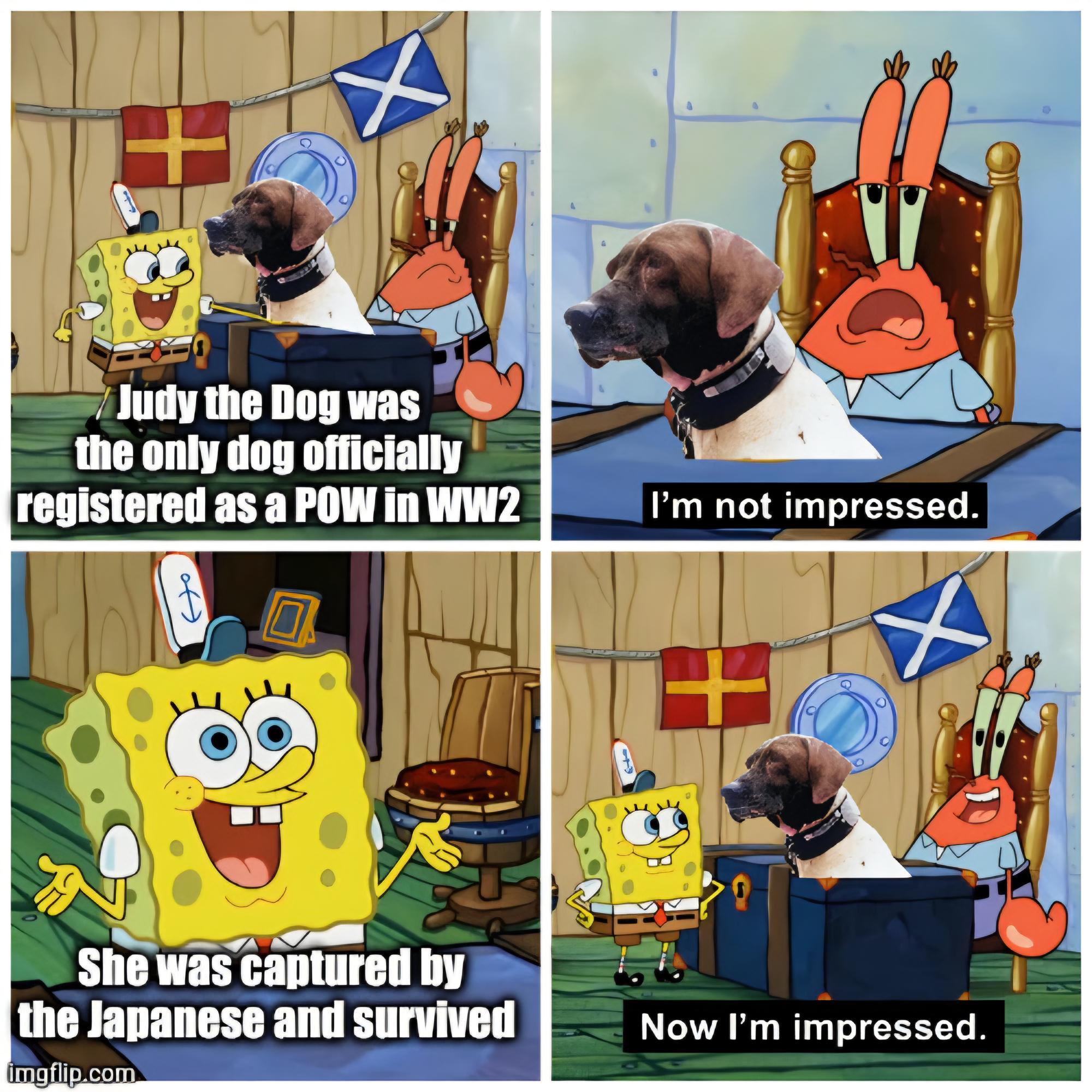
Judy was a Pointer born in Shangai in 1936. In 1939, she was adopted onto the British ship HMS Gnat as the ship’s mascot and at the outbreak of WW2 she was transferred to the HMS Grasshopper. On February 14, 1942, the HMS Grasshopper was sunk by Japanese ships. After evacuating the ship, the survivors found that Judy was not among them, but during a search of the still-floating ship she was found alive and well. After reaching shore, Judy would be credited with the survival of the crew after finding fresh water on the barren island they had landed on. The crew was rescued by Chinese tongkangs 5 days later.
Using the tongkanks to travel upriver as far as possible, as the survivors hoped to reach a point where they could be taken to Sri Lanka by British forces, the crew would eventually have to begin traveling on foot. For 200 miles. In the jungle. Judy would once again be credited with saving a crew member from a tiger attack and would herself be the survivor of a crocodile attack. The crew would eventually reach Padang but would learn that they had missed the final British Evac by 9 days and that the Japanese would be overrunning the area in mere moments. Judy and her crew would be taken in a POWs on March 14.
As a POW in Medan Judy would meet Leading Aircraftman Frank Williams, who would convince the camp commander to spare her life and officially register her as a POW (official number ’81A Gloegoer Medan’) in exchange for a puppy from a future litter. As a prisoner, Judy would often make excursions alone and return to Williams with rats and snakes. In June 1944, Williams was transferred to Singapore and would be transported on the SS Van Waerwijck and he would smuggle Judy out with him in a rice sack. The ship was sunk byt the HMS Truculent, and in an attempt to save Judy’s life Williams would push her out of a porthole despite there being a 15ft drop before hitting water. Of the 700 fellow prisoners on the ship, Judy and Williams were among the 200 survivors. Both would be recaptured by the Japanese and would remain in Sumatra until the end of the war, moving between several camps but never leaving each other.
Towards the end of the war, Judy was sentenced to death by the guards of the camp to control a lice outbreak. However, Judy disappeared for 3 days and only returned once Japanese forces abandoned the camp. **Judy had survived the war.**
After the war, Judy and Williams would travel to Liverpool, with Judy being moved to quarantine for 6 months where she would receive visits from fellow POWs that knew her from her camps in Asia. After quarantine, Judy would officially be awarded both the For Valor medal and the Dickin Medal, the animal equivalent to the Victoria Cross, and would be registered as the only canine member of the Returned British POW Association.
In 1948, 2 years after being demobilized, Frank and Judy would leave to work for the Tanganyika groundnut scheme. After 2 years working in Tanzania, it would be discovered that Judy had a mammary tumor; an operation removed the growth but an infection had set in. Judy would be euthanized on February 17, 1950. She was buried with her RAF jacket and several other awards. Frank Williams would spend 2 months building a granite and marble memorial to Judy for her grave in Nachingwea. Williams would keep her collar and Dicken Medal and both would be put on display at the Imperial War Museum in London as part of it’s “The Animal’s War” exhibition in 2006, with both being presented by Alan Williams, the son of Frank Williams. Judy’s story would be told in the 1973 book *The Judy Story: The Dog With Six Lives.*

2 Comments
Judy was a Pointer born in Shangai in 1936. In 1939, she was adopted onto the British ship HMS Gnat as the ship’s mascot and at the outbreak of WW2 she was transferred to the HMS Grasshopper. On February 14, 1942, the HMS Grasshopper was sunk by Japanese ships. After evacuating the ship, the survivors found that Judy was not among them, but during a search of the still-floating ship she was found alive and well. After reaching shore, Judy would be credited with the survival of the crew after finding fresh water on the barren island they had landed on. The crew was rescued by Chinese tongkangs 5 days later.
Using the tongkanks to travel upriver as far as possible, as the survivors hoped to reach a point where they could be taken to Sri Lanka by British forces, the crew would eventually have to begin traveling on foot. For 200 miles. In the jungle. Judy would once again be credited with saving a crew member from a tiger attack and would herself be the survivor of a crocodile attack. The crew would eventually reach Padang but would learn that they had missed the final British Evac by 9 days and that the Japanese would be overrunning the area in mere moments. Judy and her crew would be taken in a POWs on March 14.
As a POW in Medan Judy would meet Leading Aircraftman Frank Williams, who would convince the camp commander to spare her life and officially register her as a POW (official number ’81A Gloegoer Medan’) in exchange for a puppy from a future litter. As a prisoner, Judy would often make excursions alone and return to Williams with rats and snakes. In June 1944, Williams was transferred to Singapore and would be transported on the SS Van Waerwijck and he would smuggle Judy out with him in a rice sack. The ship was sunk byt the HMS Truculent, and in an attempt to save Judy’s life Williams would push her out of a porthole despite there being a 15ft drop before hitting water. Of the 700 fellow prisoners on the ship, Judy and Williams were among the 200 survivors. Both would be recaptured by the Japanese and would remain in Sumatra until the end of the war, moving between several camps but never leaving each other.
Towards the end of the war, Judy was sentenced to death by the guards of the camp to control a lice outbreak. However, Judy disappeared for 3 days and only returned once Japanese forces abandoned the camp. **Judy had survived the war.**
After the war, Judy and Williams would travel to Liverpool, with Judy being moved to quarantine for 6 months where she would receive visits from fellow POWs that knew her from her camps in Asia. After quarantine, Judy would officially be awarded both the For Valor medal and the Dickin Medal, the animal equivalent to the Victoria Cross, and would be registered as the only canine member of the Returned British POW Association.
In 1948, 2 years after being demobilized, Frank and Judy would leave to work for the Tanganyika groundnut scheme. After 2 years working in Tanzania, it would be discovered that Judy had a mammary tumor; an operation removed the growth but an infection had set in. Judy would be euthanized on February 17, 1950. She was buried with her RAF jacket and several other awards. Frank Williams would spend 2 months building a granite and marble memorial to Judy for her grave in Nachingwea. Williams would keep her collar and Dicken Medal and both would be put on display at the Imperial War Museum in London as part of it’s “The Animal’s War” exhibition in 2006, with both being presented by Alan Williams, the son of Frank Williams. Judy’s story would be told in the 1973 book *The Judy Story: The Dog With Six Lives.*
One badass pup, thanks for sharing.