
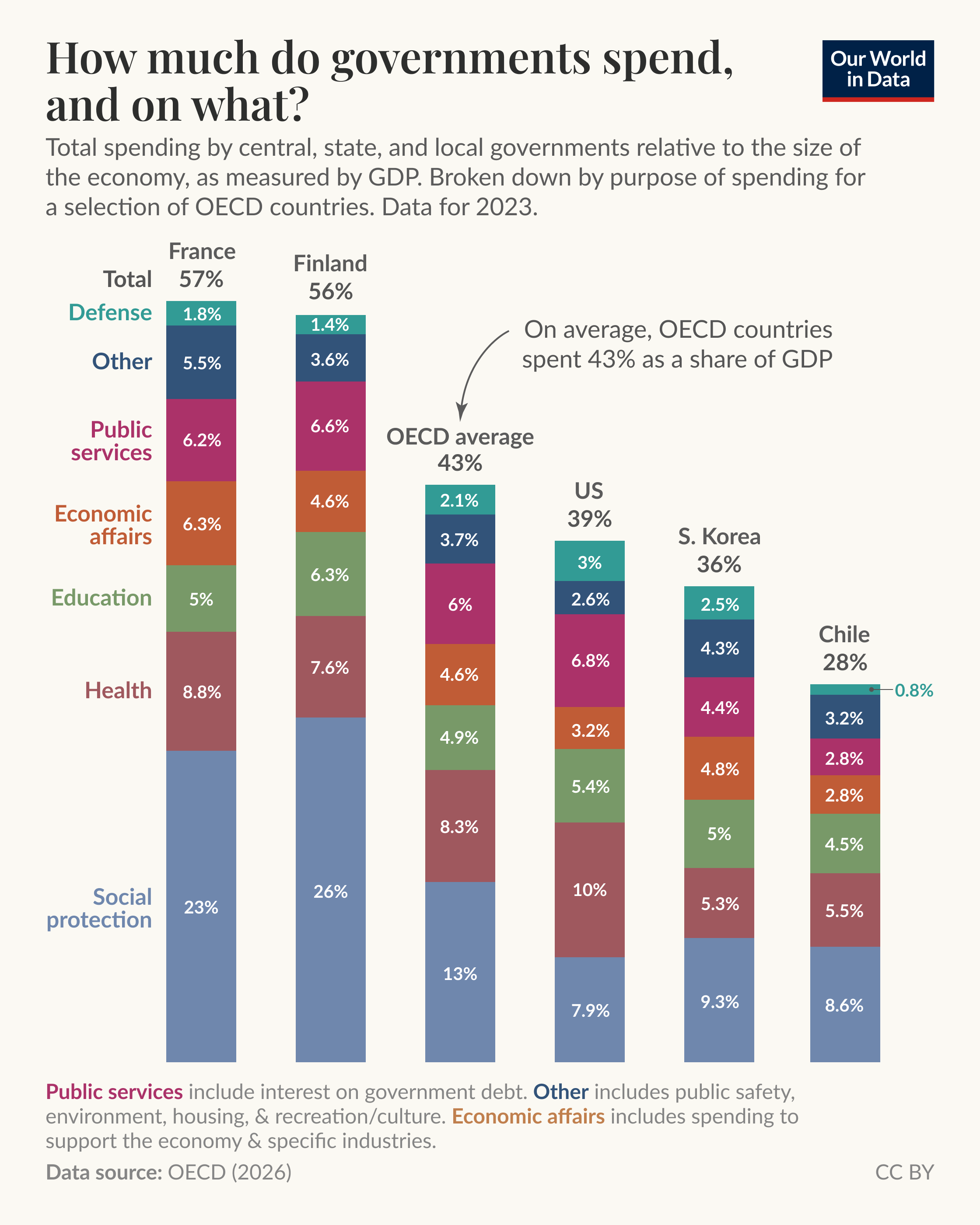
In the chart, we see total government spending broken down by purpose, such as health, education, and defense, relative to the size of the economy (as measured by GDP). This is shown for a selection of OECD countries.
How much governments spend varies quite a lot across OECD countries: in France it’s 57% of GDP, while in Chile it’s less than half that (28%).
Keep in mind that these are relative shares, not absolute amounts. GDP itself varies considerably across countries, so the same percentage can represent very different sums depending on the size of a country’s economy.
For some categories, such as social protection — which includes things like pensions, unemployment benefits, disability support, and other benefits — the difference across countries is relatively large. For example, it’s 26% in Finland compared to 7.9% in the US.
In other categories, such as public services — which include things like paying interest on government debt, the running of core government functions, and foreign aid — the share is more similar across countries.
This data comes from the OECD’s Government at a Glance dataset, which covers 47 countries. We recently updated this data on our website with the latest release.
by ourworldindata
10 Comments
**Data source:** [OECD Government at a Glance](https://www.oecd.org/en/publications/government-at-a-glance-2025_0efd0bcd-en.html) (2026)
**Tools used:** the OWID-Grapher with finishing in Figma
but i thought all our problems would be solved if we cut our defense spending?
It’s wild that USA government uses a larger % on health than Finland which has public healthcare.
EDIT: the 49% below is for DISCRETIONARY spending, the total of the whole budget is 13%
Just as a note, the US spends about 49% of its total federal budget on defense: https://www.usaspending.gov/agency/department-of-defense?fy=2026 but that’s different from GDP
What are the numbers for Germany?
US had higher GDP spending on health care and it’s PRIVATE?!?!??!
Whoa didn’t realize how big a difference the “social protection” category makes…
You specified that category includes unemployment benefits, which reminds me of a convo I had when I was grabbing coffee with a friend last month. She moved from Paris to NYC recently for a corporate marketing job. It was always a dream of hers to work in NYC (she was born in Norway), so she was ecstatic. I was pumped for her! She said she was settling into the new job fine BUT she was shocked by how “ungenerous” unemployment benefits are in the U.S. vs. France. I think in France you get a way higher replacement rate (of your prior salary, with caps of course) for a *way* longer duration (like ~2 years instead of ~6 months). So that was scary to her.
She was also shocked how little vacation time we get here. And how “taboo” it feels to actually *use* your PTO in America vs. in Europe where there’s no weird stigma. I was like, tell me about it, girl, welcome to America!
It would be useful to understand how much of the difference is made up by non-governmental spending on the same topics in the lower-government-spending countries.
Social “protection”? Let’s use the correct term “welfare”.
Would would India and China look like?