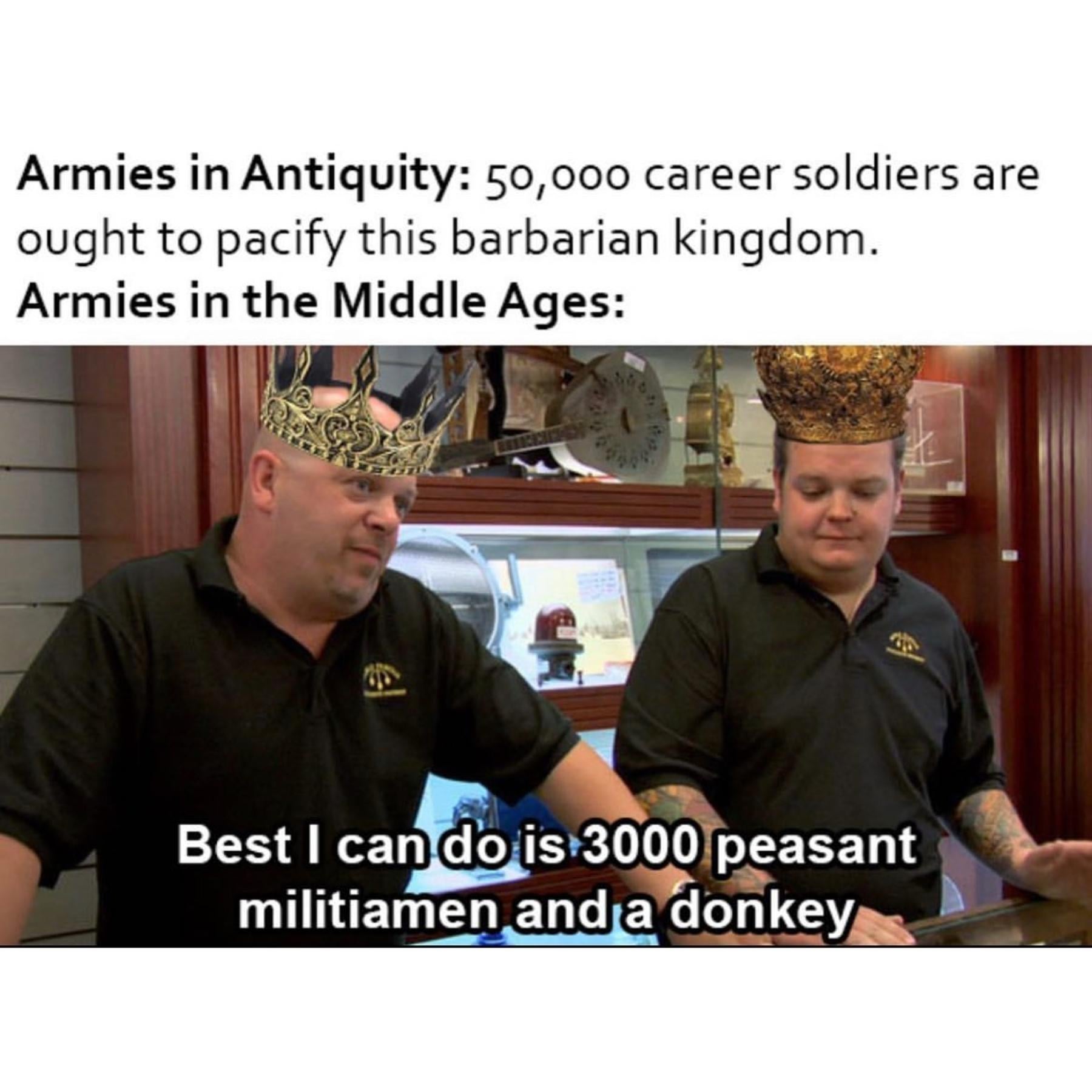
In antiquity, states such as Rome, Han China or Sassanid Persia often possessed the bureaucratic capacity to do wonderfully unglamorous things, which is to say the “boring” things that actually win wars.
That is, count taxpayers, store grain, pave roads, maintain arsenals, issue pay, and remember where they left 50,000 men.
When an emperor demanded an army, clerks sighed, warehouses opened, mules were loaded, and somewhere a provincial governor’s day was ruined.
By contrast, many medieval rulers governed through negotiated authority rather than direct state control. A king might technically command thousands, but in practice he was sending letters to nobles whose responses ranged from “certainly, my liege” to “my men are delayed”, “the bridge is out” or “harvest must come first”.
Thus, the royal host could become a fascinating collection of half-trained peasants, three competent knights, two cousins nobody trusts, and one donkey carrying the entire campaign.
Of course, historians would add nuance. Medieval armies were not universally pathetic. The Normans, Byzantines, Capetians, Plantagenets, Mamluks, and many others fielded formidable forces.
But the stereotype survives because there were indeed moments when a ruler envisioned being Julius Caesar and received only a village committee.
Pyrhan on
Could this be survivorship bias?
As in, smaller, local campaigns with fewer men that took place during Antiquity were largely forgotten, only the larger ones have surviving accounts?
Whereas surviving records for more recent campaigns during the middle ages would be more detailed and exhaustive, including the small stuff.
Beautiful-Loss7663 on
Forgot about Michael on his lame horse with a rock sling.
Danskoesterreich on
First crusade: Estimated at 130,000 to 160,000 on the crusaders side alone.
MessMaximum5493 on
Only in Europe. Japan was fighting Ming China and Joseon in the 1500s with at least 200k men on each side
EatLard on
Scribes in antiquity: “Our army of but 50,000 crushed the enemy army of 250,000 and then returned to bring in the harvest.”
Kings in antiquity: “Tell the scribes to add a couple of zeros to the enemy’s troop numbers to make this sound like a bigger victory. I’m the one paying them, after all.”
strong_division on
What the collapse of a centralized, bureaucratic super state does to a mf
That said, it is odd that this only really appears to be a western European thing. When China collapsed into a bunch of kingdoms and warring states, each one still had absolutely massive armies. The ability to raise and maintain large armies wasn’t lost the way it was in Europe after the Western Roman Empire gave way to a bunch of barbarian kingdoms.
White_C4 on
Antiquity overexaggerated the numbers, but what is true is that they still fielded larger armies than the medieval counterparts. A lot of that is thanks to the centralized bureaucratic state where it’s easier for the leadership to enlist thousands and hundreds of thousands soldiers in a relatively short period of time.

8 Comments
In antiquity, states such as Rome, Han China or Sassanid Persia often possessed the bureaucratic capacity to do wonderfully unglamorous things, which is to say the “boring” things that actually win wars.
That is, count taxpayers, store grain, pave roads, maintain arsenals, issue pay, and remember where they left 50,000 men.
When an emperor demanded an army, clerks sighed, warehouses opened, mules were loaded, and somewhere a provincial governor’s day was ruined.
By contrast, many medieval rulers governed through negotiated authority rather than direct state control. A king might technically command thousands, but in practice he was sending letters to nobles whose responses ranged from “certainly, my liege” to “my men are delayed”, “the bridge is out” or “harvest must come first”.
Thus, the royal host could become a fascinating collection of half-trained peasants, three competent knights, two cousins nobody trusts, and one donkey carrying the entire campaign.
Of course, historians would add nuance. Medieval armies were not universally pathetic. The Normans, Byzantines, Capetians, Plantagenets, Mamluks, and many others fielded formidable forces.
But the stereotype survives because there were indeed moments when a ruler envisioned being Julius Caesar and received only a village committee.
Could this be survivorship bias?
As in, smaller, local campaigns with fewer men that took place during Antiquity were largely forgotten, only the larger ones have surviving accounts?
Whereas surviving records for more recent campaigns during the middle ages would be more detailed and exhaustive, including the small stuff.
Forgot about Michael on his lame horse with a rock sling.
First crusade: Estimated at 130,000 to 160,000 on the crusaders side alone.
Only in Europe. Japan was fighting Ming China and Joseon in the 1500s with at least 200k men on each side
Scribes in antiquity: “Our army of but 50,000 crushed the enemy army of 250,000 and then returned to bring in the harvest.”
Kings in antiquity: “Tell the scribes to add a couple of zeros to the enemy’s troop numbers to make this sound like a bigger victory. I’m the one paying them, after all.”
What the collapse of a centralized, bureaucratic super state does to a mf
That said, it is odd that this only really appears to be a western European thing. When China collapsed into a bunch of kingdoms and warring states, each one still had absolutely massive armies. The ability to raise and maintain large armies wasn’t lost the way it was in Europe after the Western Roman Empire gave way to a bunch of barbarian kingdoms.
Antiquity overexaggerated the numbers, but what is true is that they still fielded larger armies than the medieval counterparts. A lot of that is thanks to the centralized bureaucratic state where it’s easier for the leadership to enlist thousands and hundreds of thousands soldiers in a relatively short period of time.