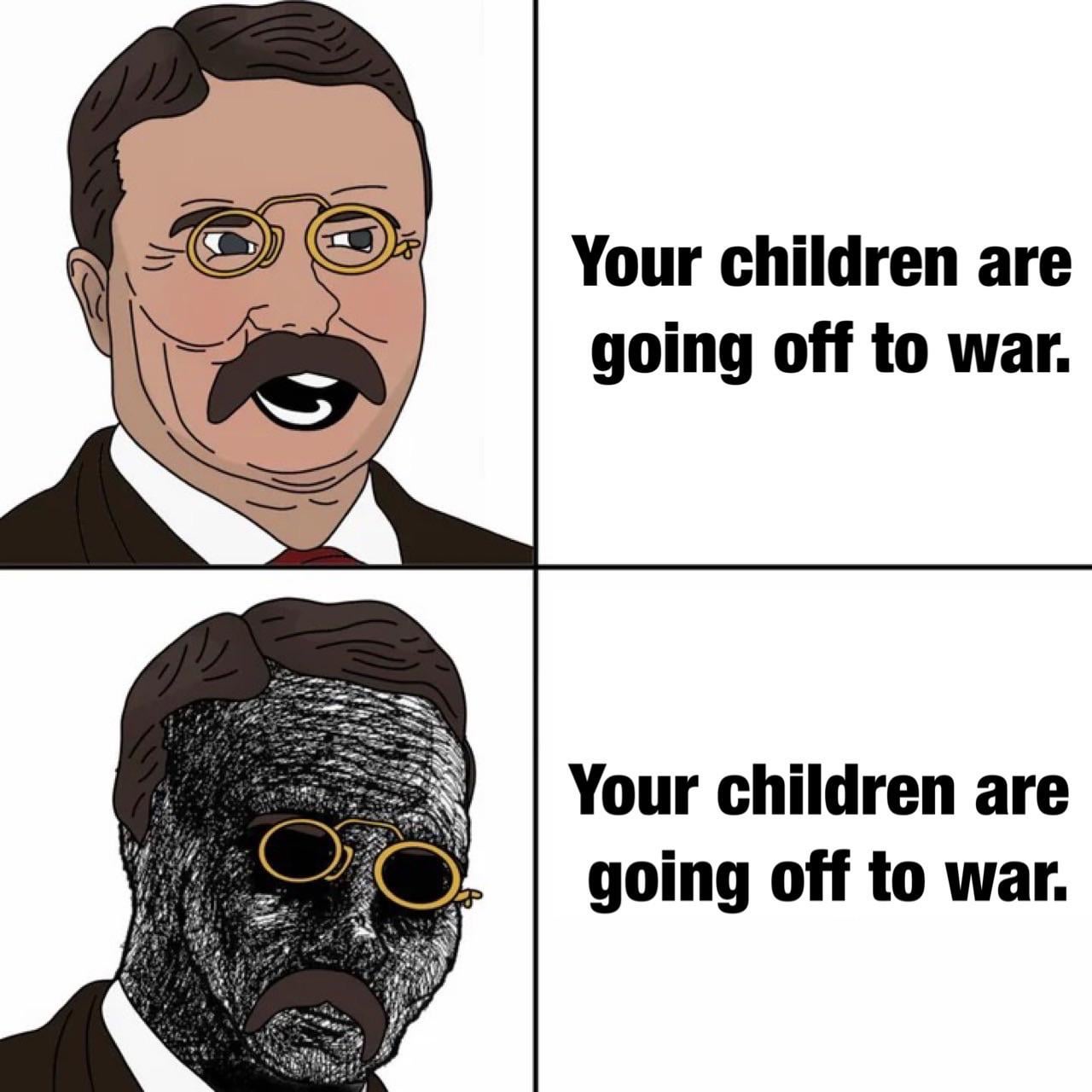
Roosevelt had enemies in the War Department but he also had allies, and he used every connection he had to get good assignments for his four sons. His task was facilitated by the fact that the kinds of posts he was seeking for them were not the ones every other influential parent had in mind. With their enthusiastic assent—in this regard, if not in all others, he had taught them well—he eschewed safe staff positions, aiming instead to place his boys precisely where he wanted to be: amid the fiercest fighting. His efforts, combined with the boys’ qualifications, succeeded. Ted and Archie joined General Pershing’s expeditionary force, eventually serving in the same infantry regiment. Kermit’s experiences in Africa and South America suited him for a more exotic assignment: with the British army fighting the Turks in Mesopotamia. Roosevelt had gone direct to the top for Kermit; he wrote British prime minister Lloyd George, declaring, “I pledge my honor that he will serve you honor ably and efficiently.” Quentin, the youngest and most forward-looking of the quartet, was fascinated by the military’s newest weapon: He enlisted in the army’s air squadron.
More than once while throwing his sons into death’s way, Roosevelt shuddered slightly at what he was doing. A letter from Ted contained a parable in which a big bear showed his two small offspring the ways of the world; Roosevelt responded in similar lan-guage, although more ambivalently: “The big bear was not, down at the bottom of his heart, any too happy at striving to get the two little bears where the danger is; elderly bears whose teeth and claws are blunted by age can far better be spared.” To Kermit he wrote, “I hate to feel that I am out of it, especially because I so strongly believe that where physical conditions will permit it is the old, the men whose life is behind them and who have drained the cup of joy and sorrow, of achievement and failure, who should be in the danger line, for the little sooner or the little later matters little to them.” After the boys were well on their way to battle, he confided to Quentin: “My disappointment at not going myself was down at bottom chiefly reluctance to see you four, in whom my heart was wrapped, exposed to danger while I stayed at home in do-nothing ease and safety.”
Yet Roosevelt knew his duty as a parent-or thought he did—as certainly as he had known his duty as a soldier. In the same letter to Quentin in which he described his fear for his sons, he went on to say,
“But the feeling has now been completely swallowed in my immense pride in all four of you.” Over and over during the months of fighting he told his sons how proud he was of them that they were taking a vital part in the great struggle of the epoch. To Archie he wrote, “I am more proud of you, and of the other three, than I can say. And every one who speaks to me of you boys does it with a look and in a tone that makes my heart swell.” He described to Kermit the fine times they would have when the war was over. “You will come back; and how much there will be to tell, as we sit before the great fire place in the north room.” To be sure, the war demanded sacrifices; that was in the nature of war. “It is a very hard thing on you four to go,” he wrote Archie. But the alternative was worse. “It would be infinitely harder not to go, not to have risen level to the supreme crisis in the world’s history, not to have won the right to stand with the mighty men of the mighty days.”
Source: T.R., The Last Romantic, pages 785-786
Successful_Gas_5122 on
“Quenty…”
carlsagerson on
Teddy would have been proud of Junior. Guy got a Medal of Honor for his actions and was the only general to land with his troops during D-Day. Even saying they would start the invasion there even after landing on the wrong part of the beach. Junior’s 3 sons were WW2 vets as well. With Quentin being part of the D-Day landings as part of the Big Red One on Omaha.
informaticstudent on
For those who don’t know, Roosevelt’s favorite son was a pilot who was shot down and killed during WWI. The Germans took a picture of his body lying amongst the wreckage and made it into a postcard.
Crazy-Rabbit-3811 on
“We’ll start the war from right here” – Theodore Roosevelt Jr. june 6th 1944, utah beach.
topicality on
Love Teddy but his unreflective attitude towards war is pretty big black mark tbh.
I just finished the chapter on San Juan Hill. And he seemed to really relish in combat. Not a “necessary evil way” but “Hell Yeah War!” kinda way

6 Comments
Roosevelt had enemies in the War Department but he also had allies, and he used every connection he had to get good assignments for his four sons. His task was facilitated by the fact that the kinds of posts he was seeking for them were not the ones every other influential parent had in mind. With their enthusiastic assent—in this regard, if not in all others, he had taught them well—he eschewed safe staff positions, aiming instead to place his boys precisely where he wanted to be: amid the fiercest fighting. His efforts, combined with the boys’ qualifications, succeeded. Ted and Archie joined General Pershing’s expeditionary force, eventually serving in the same infantry regiment. Kermit’s experiences in Africa and South America suited him for a more exotic assignment: with the British army fighting the Turks in Mesopotamia. Roosevelt had gone direct to the top for Kermit; he wrote British prime minister Lloyd George, declaring, “I pledge my honor that he will serve you honor ably and efficiently.” Quentin, the youngest and most forward-looking of the quartet, was fascinated by the military’s newest weapon: He enlisted in the army’s air squadron.
More than once while throwing his sons into death’s way, Roosevelt shuddered slightly at what he was doing. A letter from Ted contained a parable in which a big bear showed his two small offspring the ways of the world; Roosevelt responded in similar lan-guage, although more ambivalently: “The big bear was not, down at the bottom of his heart, any too happy at striving to get the two little bears where the danger is; elderly bears whose teeth and claws are blunted by age can far better be spared.” To Kermit he wrote, “I hate to feel that I am out of it, especially because I so strongly believe that where physical conditions will permit it is the old, the men whose life is behind them and who have drained the cup of joy and sorrow, of achievement and failure, who should be in the danger line, for the little sooner or the little later matters little to them.” After the boys were well on their way to battle, he confided to Quentin: “My disappointment at not going myself was down at bottom chiefly reluctance to see you four, in whom my heart was wrapped, exposed to danger while I stayed at home in do-nothing ease and safety.”
Yet Roosevelt knew his duty as a parent-or thought he did—as certainly as he had known his duty as a soldier. In the same letter to Quentin in which he described his fear for his sons, he went on to say,
“But the feeling has now been completely swallowed in my immense pride in all four of you.” Over and over during the months of fighting he told his sons how proud he was of them that they were taking a vital part in the great struggle of the epoch. To Archie he wrote, “I am more proud of you, and of the other three, than I can say. And every one who speaks to me of you boys does it with a look and in a tone that makes my heart swell.” He described to Kermit the fine times they would have when the war was over. “You will come back; and how much there will be to tell, as we sit before the great fire place in the north room.” To be sure, the war demanded sacrifices; that was in the nature of war. “It is a very hard thing on you four to go,” he wrote Archie. But the alternative was worse. “It would be infinitely harder not to go, not to have risen level to the supreme crisis in the world’s history, not to have won the right to stand with the mighty men of the mighty days.”
Source: T.R., The Last Romantic, pages 785-786
“Quenty…”
Teddy would have been proud of Junior. Guy got a Medal of Honor for his actions and was the only general to land with his troops during D-Day. Even saying they would start the invasion there even after landing on the wrong part of the beach. Junior’s 3 sons were WW2 vets as well. With Quentin being part of the D-Day landings as part of the Big Red One on Omaha.
For those who don’t know, Roosevelt’s favorite son was a pilot who was shot down and killed during WWI. The Germans took a picture of his body lying amongst the wreckage and made it into a postcard.
“We’ll start the war from right here” – Theodore Roosevelt Jr. june 6th 1944, utah beach.
Love Teddy but his unreflective attitude towards war is pretty big black mark tbh.
I just finished the chapter on San Juan Hill. And he seemed to really relish in combat. Not a “necessary evil way” but “Hell Yeah War!” kinda way