
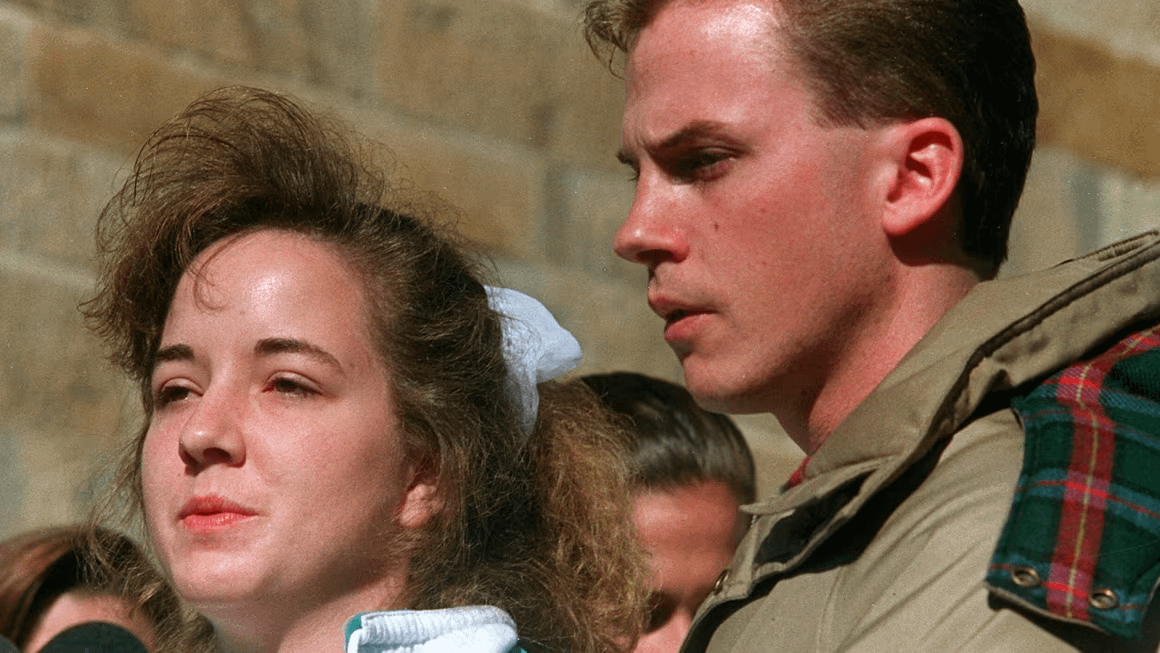
Susan Smith, 23, and her husband talk to the press after the disappearances of their two sons. She drove her car into a lake and left the boys there to drown. During the interview, Smith claimed that a phantom black male carjacker had kidnapped her sons (South Carolina, 1994) [1600 x 1277].
by lightiggy
1 Comment
Contrary to the beliefs of some, investigators in this case did not harass any innocent black people. That was a different case. In fact, the police saw suspected Smith almost immediately. The phantom black male defense is more common than folks think, but also less successful than some would expect, even historically. The results of the phantom black male defense vary widely, based on how racist and/or stupid the police are where they live.
Being racist does not mean that someone has to be willfully blind.
In 1903, Henry Seward murdered his wife in Indiana, then blamed it on a homeless black man. The police briefly detained several homeless black men for questioning, but let them go after finding no evidence against any of them. Two months later, Seward was arrested and charged with murder. He was convicted of manslaughter and sentenced to 2 to 21 years in prison.
In 1904, [James McCue](https://www.cvillepedia.org/J._Samuel_McCue), a wealthy white man and a former mayor, murdered his wife in Virginia, then attempted to frame a black stable boy. Deemed a liar, McCue was arrested the next day, convicted of first degree murder, and executed by hanging in 1905.
In 1913, [Samuel Spicer Jr.](https://miscreantsandmalcontents.com/2019/01/26/sam-spicer-alabama/), a white man, murdered his wife in Alabama, then led a lynch mob and killed Joe Green, a 16-year-old black boy accused of the murder. Green had been employed by the Spicers. Three months later, Spicer was charged with the murder of his wife for life insurance money. He was convicted of the murder. Whether this exonerates Green is unclear. Spicer was guilty, but laid out a convincing case that Green murdered his wife. Spicer was convicted of first degree murder and sentenced to life in prison after the state advanced two theories about Green.
Theory 1 is that Spicer used Joe Green to place the gun where it was later found outside of the front gate to his yard. Theory 2 is that Spicer had Green murder his wife, then lynched him to conceal his own involvement. Judging by Spicer’s appeals, I think it was the second theory. I am mentioning this case anyway since Spicer exploited historical racism to extrajudicially murder his accomplice in an attempt to conceal his involvement.
In 1935, A.L. Burton, a police chief, murdered a white woman, then murdered a black man whom he blamed for the first murder, in Florida. The mother of the woman had doubts and asked officials to further investigate the case. A secret follow-up investigation was conducted. Burton was arrested in 1936, convicted of two counts of first degree murder, and sentenced to life in prison. He was paroled in 1952.
In 1949, Dorothy Skeoch, a white woman in Chicago, strangled her six-day-old daughter to death, then ran out of her home screaming that her child had been murdered by a black burglar. Deemed a liar, Dorothy broke down sobbing and confessed after five hours of interrogation. She was convicted of murder and sentenced to 14 years. Her conviction was overturned due to concerns about her sanity in 1951. A neurologist and a psychiatrist had testified that Dorothy was insane as a result of postpartum psychosis. Shortly before giving birth, Dorothy wrote a letter to her parents, declaring, “Sometimes I feel like turning on the gas and forgetting everything.”
The police captain said he knew Dorothy had murdered her daughter when a search of her apartment uncovered her wristwatch, which she had claimed was stolen by the non-existent burglar, hidden in suitcase.
In 1958, Ethel Simpson, a white woman, shot and killed her husband in Texas, then claimed that a black man had robbed them, murdered her husband, and raped her. Ethel soon recanted her story and confessed to killing her husband. She was acquitted later that year on the grounds of self-defense. Her lawyer noted that Ethel was not on trial for lying, but for killing her husband. There was sufficient evidence to prove that Ethel’s husband was abusive; police had gotten calls to the home before. Furthermore, a knife was found next to the body of Ethel’s husband. Ethel died in a car accident in 1960.
In 1976, Tommy Zeigler, a wealthy white man, murdered his wife, his in-laws, and a black man at his store in Florida. Zeigler attempted to frame three black men, including the one whom he murdered and another whom he attempted to murder. He was deemed a liar and arrested at a hospital days later. After the two surviving black men testified against him at his trial, Zeigler was convicted of all four murders. It is possible that Zeigler had accomplices, but they have never been identified.
In 1989, Charles Stuart, a white man, murdered his pregnant wife, then shot himself and blamed the crime on a black man. The Boston Police Department effectively enacted martial law on the black community of Mission Hill. Police focused on a man named William Bennett. The media reported on Bennett as if his guilt was certain. The Boston Police Department planned to coerce several people to testify against him. However, Stuart’s brother finally confessed that Charles, who then killed himself, was the murderer.
Less people know that the two initial investigators in the Stuart case, Robert Ahearn and Robert Tinlin, IMMEDIATELY suspected Charles. The crime scene was suspiciously clean for a botched carjacking and there were inconsistencies in Charles’s story. Their superiors removed them from the case. This decision is very reflective on the Boston Police Department.