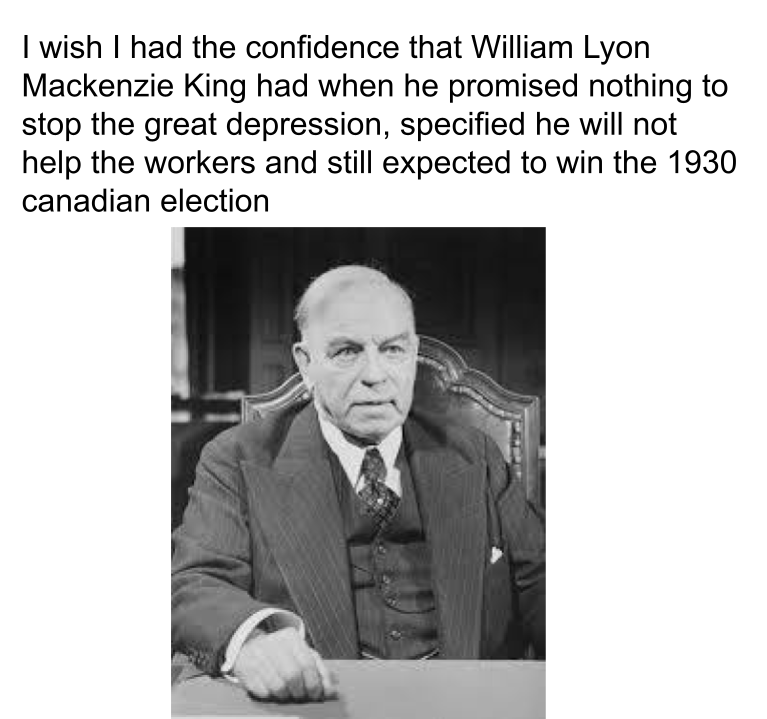
well to be fair, he promised nothing, and delivered on nothing, so he gave exactly what you said he would. That’s better than overselling and under-performing technically!
Dominarion on
That was still better than what the conservative had been doing since the beginning of the crisis.
FreshwaterViking on
I can understand his confidence. He lost, but still had 44% of the vote, which was less then 4% behind the winner.
KerbalSpaceAdmiral on
And yet his conservative successor R.B. Bennett faired even worse, managed to repell both the general Canadian public and his own party, lost almost 20% percentage points of the vote from 1930 losing the 1935 election, his legacy is generally the one associated with the failure to manage the depression, and rightly or wrongly he’s generally painted and caricatured as a pompous uncaring millionaire. Many depression Era hardships were mockingly named after him in Canada, like for example using a horse to pull a car because you have no money for gas was called a Bennett Buggy.
While King was reelected in 1935 and served until 1948, becoming the longest serving PM in Canadian history. His handling of the end of the depression and Canada’s involvement in the second world war was generally seen as positive. He’s credited with building the foundations of the Canadian welfare system. And was effective and popular enough to be reelected after the war which very few wartime governments can also claim. Of all the world leaders who were in power at the start of the war, only King and Stalin were still in power by the end of it. And we put him on the $50 bill.
In the end, I think King definitely won.
Far-Equivalent-9982 on
During the Bennett’s time in office, the liberal party would say “hey didn’t Bennett say he’s gonna do this thing, well he hasn’t!” and the Tories couldn’t do anything like that for King because he didn’t promise anything!
super__hoser on
He also was spiritual, in the weird way. He thought he could communicate to his dead mother and dogs.
1nhaleSatan on
What a tremendous bastard, in many ways. This is minor on the list
TheDickWolf on
The educational narrative of the Great Depression generally under emphasizes the class antagonism at play and causes of the crash or of vulnerability are generally given as a list of seeming equivalently weighted factors including actual major causes like their toxic gilded age derivatives markets , and factors like personal debt/buying luxuries on credit. Presenting them in thid way flattens that distribution of responsibility towards the individual, the consumer, the working classes anti historically.
As if the new deal and similar foreign policies didn’t represent a pretty explicit new class compromise, and a big of a big ol ‘mea culpa’
Edit: as well as those new deal policies being instrumental in beating the depression.

8 Comments
well to be fair, he promised nothing, and delivered on nothing, so he gave exactly what you said he would. That’s better than overselling and under-performing technically!
That was still better than what the conservative had been doing since the beginning of the crisis.
I can understand his confidence. He lost, but still had 44% of the vote, which was less then 4% behind the winner.
And yet his conservative successor R.B. Bennett faired even worse, managed to repell both the general Canadian public and his own party, lost almost 20% percentage points of the vote from 1930 losing the 1935 election, his legacy is generally the one associated with the failure to manage the depression, and rightly or wrongly he’s generally painted and caricatured as a pompous uncaring millionaire. Many depression Era hardships were mockingly named after him in Canada, like for example using a horse to pull a car because you have no money for gas was called a Bennett Buggy.
While King was reelected in 1935 and served until 1948, becoming the longest serving PM in Canadian history. His handling of the end of the depression and Canada’s involvement in the second world war was generally seen as positive. He’s credited with building the foundations of the Canadian welfare system. And was effective and popular enough to be reelected after the war which very few wartime governments can also claim. Of all the world leaders who were in power at the start of the war, only King and Stalin were still in power by the end of it. And we put him on the $50 bill.
In the end, I think King definitely won.
During the Bennett’s time in office, the liberal party would say “hey didn’t Bennett say he’s gonna do this thing, well he hasn’t!” and the Tories couldn’t do anything like that for King because he didn’t promise anything!
He also was spiritual, in the weird way. He thought he could communicate to his dead mother and dogs.
What a tremendous bastard, in many ways. This is minor on the list
The educational narrative of the Great Depression generally under emphasizes the class antagonism at play and causes of the crash or of vulnerability are generally given as a list of seeming equivalently weighted factors including actual major causes like their toxic gilded age derivatives markets , and factors like personal debt/buying luxuries on credit. Presenting them in thid way flattens that distribution of responsibility towards the individual, the consumer, the working classes anti historically.
As if the new deal and similar foreign policies didn’t represent a pretty explicit new class compromise, and a big of a big ol ‘mea culpa’
Edit: as well as those new deal policies being instrumental in beating the depression.