This is clearly a depiction of when Ammon met Lamoni after smiting off the arms of his opponents for scattering the flocks at the waters of Sebus.
i_have_the_tism04 on
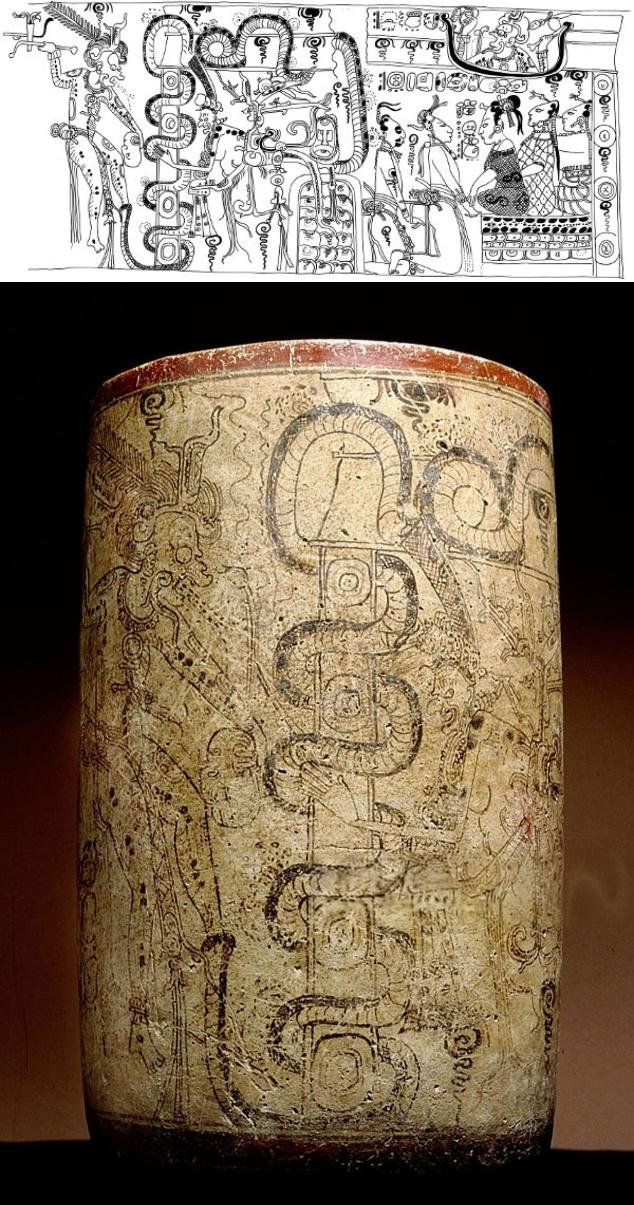
Is this Chak or K’awiil? The snake leg, head, and fire iconography on the axe all make me think this is more likely K’awiil. Picture resolution here isn’t high enough for any of the glyphic text to be fully legible to me, though from iconography alone, the figure shown and the events occurring all indicate that this is a lightning/storm deity (like K’awiil) instead of Chak. Judging from colonial era and modern ethnographies of the Maya, K’awiil’s serpent leg was probably seen partially as a visual metaphor for lightning; in this case, it would appear the temple was split by lightning at K’awiil’s command. I have seen other classic period Maya vases that show Chak using his axe to split buildings in similar scenes though, and the markings on the body and “catfish whisker” are more reminiscent of Chak. Beautiful regardless!

2 Comments
This is clearly a depiction of when Ammon met Lamoni after smiting off the arms of his opponents for scattering the flocks at the waters of Sebus.
Is this Chak or K’awiil? The snake leg, head, and fire iconography on the axe all make me think this is more likely K’awiil. Picture resolution here isn’t high enough for any of the glyphic text to be fully legible to me, though from iconography alone, the figure shown and the events occurring all indicate that this is a lightning/storm deity (like K’awiil) instead of Chak. Judging from colonial era and modern ethnographies of the Maya, K’awiil’s serpent leg was probably seen partially as a visual metaphor for lightning; in this case, it would appear the temple was split by lightning at K’awiil’s command. I have seen other classic period Maya vases that show Chak using his axe to split buildings in similar scenes though, and the markings on the body and “catfish whisker” are more reminiscent of Chak. Beautiful regardless!