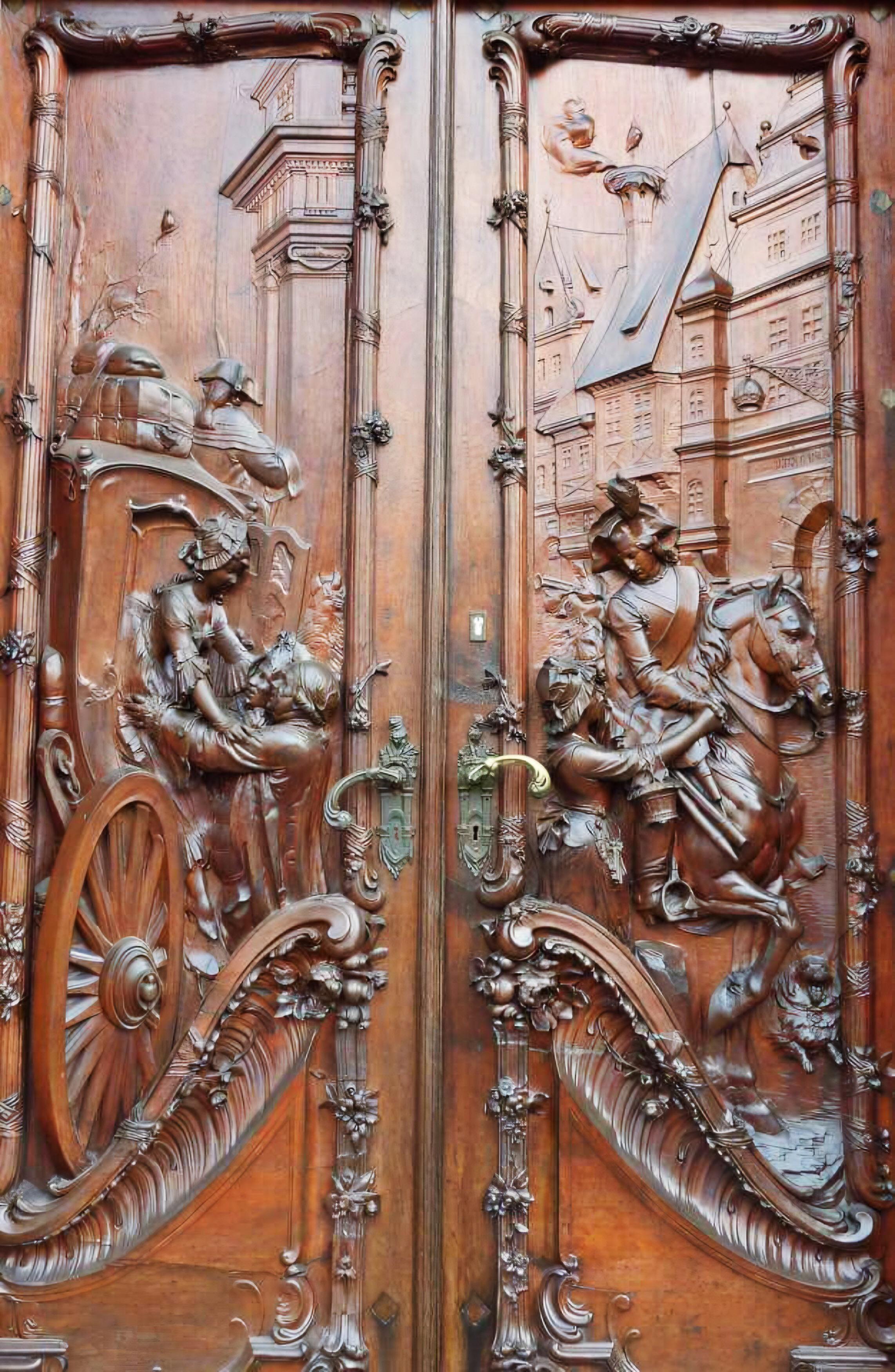
Intricately carved wooden door located at the entranceway to the Museum Kunsthaus Heylshof in Worms, Germany carved by sculptor Lorenz Gedon. It was built as the “Villa Heyl” between 1881 and 1884.[2284 x 3502]
Intricately carved wooden door located at the entranceway to the Museum Kunsthaus Heylshof in Worms, Germany carved by sculptor Lorenz Gedon. It was built as the “Villa Heyl” between 1881 and 1884.[2284 x 3502]
The Heylshof Museum in Worms, Germany, was built as the “Villa Heyl” between 1881 and 1884. Designed by architect Alfred Friedrich Bluntschli for leather industrialist Baron Cornelius Wilhelm von Heyl zu Herrnsheim, it was built in the neo-Baroque style is the former urban residence of the noble industrialist family von Heyl zu Herrnsheim. The building houses a high-caliber, diverse collection of art objects dating from the 14th to the 19th centuries. Since 1926, it has served as a publicly accessible museum known as the “Kunsthaus Heylshof.”
Thus, the Heylshof—built in 1884—was conceived as a prestigious urban residence intended to provide a suitably dignified setting for the Heyl family’s preeminent standing in Worms, extending far beyond the mere requirements of comfortable living. In this regard, the historical significance of the Cathedral precinct and the former Prince-Bishop’s garden, as well as the urban context, were decisive factors in determining the building’s form. The Heylshof—which was presumably intended from the outset to house its owners’ art collections as well—thus increasingly served as a guesthouse for the numerous artists and high-ranking dignitaries with whom the family associated. It provided a prestigious setting for the festive social occasions organized by Sophie von Heyl (née Stein). According to her husband’s diary entries, she played a pivotal role in the planning and furnishing of the Heylshof.
By commissioning Alfred Friedrich Bluntschli (1842–1930)—a former student of Semper—the clients secured the services of an architect who was intimately familiar with the formal vocabulary of the Renaissance and Baroque periods. Together with his partner, Karl Jonas Mylius (1839–1883), he had already constructed numerous Neo-Renaissance-style villas in Frankfurt and throughout southern Germany. He was involved in the renovations of Schloss Holzhausen near Marburg and designed the “Frankfurter Hof,” a renowned palatial hotel in Frankfurt am Main that remains in operation to this day.
For the interior outfitting and the decoration of parts of the exterior structure, the family commissioned Lorenz Gedon. The family became acquainted with this exhibition architect, festival decorator, and interior designer—who was renowned far beyond Munich’s artistic circles—through C.W. Heyl’s brother, Cavalry Captain Maximilian Heyl. The latter met Gedon at the 1879 Paris World’s Fair and engaged him to design the interiors of the Majorshof—a residence built by H. Pflaume in 1870 on the Lutherring in Worms—which no longer exists today. Maximilian Heyl was so satisfied with the artist’s work that he had the Majorshof replicated in Darmstadt as an exact copy, albeit in mirror image. During the 1870s, Gedon played a pivotal role in establishing the German Neo-Renaissance style. Around 1880—drawing stylistically upon South German Rococo and building upon local Munich traditions—he aligned himself with the Neo-Baroque movement. The Heyl family was likely motivated to engage Gedon by the fact that, as an exhibition architect and festival decorator, he possessed extensive experience in presenting artworks within luxurious settings. As both an antiquities collector and a manufacturer of decorative elements, Gedon was uniquely qualified to procure or fabricate pieces that catered to the tastes of his wealthy patrons. Gedon had likely already collaborated with Bluntschli during the renovation of Schloß Holzhausen.
Menethea on
Just further proof that Western culture, art and thought reached its apogee around the fin de siècle

2 Comments
The Heylshof Museum in Worms, Germany, was built as the “Villa Heyl” between 1881 and 1884. Designed by architect Alfred Friedrich Bluntschli for leather industrialist Baron Cornelius Wilhelm von Heyl zu Herrnsheim, it was built in the neo-Baroque style is the former urban residence of the noble industrialist family von Heyl zu Herrnsheim. The building houses a high-caliber, diverse collection of art objects dating from the 14th to the 19th centuries. Since 1926, it has served as a publicly accessible museum known as the “Kunsthaus Heylshof.”
Thus, the Heylshof—built in 1884—was conceived as a prestigious urban residence intended to provide a suitably dignified setting for the Heyl family’s preeminent standing in Worms, extending far beyond the mere requirements of comfortable living. In this regard, the historical significance of the Cathedral precinct and the former Prince-Bishop’s garden, as well as the urban context, were decisive factors in determining the building’s form. The Heylshof—which was presumably intended from the outset to house its owners’ art collections as well—thus increasingly served as a guesthouse for the numerous artists and high-ranking dignitaries with whom the family associated. It provided a prestigious setting for the festive social occasions organized by Sophie von Heyl (née Stein). According to her husband’s diary entries, she played a pivotal role in the planning and furnishing of the Heylshof.
By commissioning Alfred Friedrich Bluntschli (1842–1930)—a former student of Semper—the clients secured the services of an architect who was intimately familiar with the formal vocabulary of the Renaissance and Baroque periods. Together with his partner, Karl Jonas Mylius (1839–1883), he had already constructed numerous Neo-Renaissance-style villas in Frankfurt and throughout southern Germany. He was involved in the renovations of Schloss Holzhausen near Marburg and designed the “Frankfurter Hof,” a renowned palatial hotel in Frankfurt am Main that remains in operation to this day.
For the interior outfitting and the decoration of parts of the exterior structure, the family commissioned Lorenz Gedon. The family became acquainted with this exhibition architect, festival decorator, and interior designer—who was renowned far beyond Munich’s artistic circles—through C.W. Heyl’s brother, Cavalry Captain Maximilian Heyl. The latter met Gedon at the 1879 Paris World’s Fair and engaged him to design the interiors of the Majorshof—a residence built by H. Pflaume in 1870 on the Lutherring in Worms—which no longer exists today. Maximilian Heyl was so satisfied with the artist’s work that he had the Majorshof replicated in Darmstadt as an exact copy, albeit in mirror image. During the 1870s, Gedon played a pivotal role in establishing the German Neo-Renaissance style. Around 1880—drawing stylistically upon South German Rococo and building upon local Munich traditions—he aligned himself with the Neo-Baroque movement. The Heyl family was likely motivated to engage Gedon by the fact that, as an exhibition architect and festival decorator, he possessed extensive experience in presenting artworks within luxurious settings. As both an antiquities collector and a manufacturer of decorative elements, Gedon was uniquely qualified to procure or fabricate pieces that catered to the tastes of his wealthy patrons. Gedon had likely already collaborated with Bluntschli during the renovation of Schloß Holzhausen.
Just further proof that Western culture, art and thought reached its apogee around the fin de siècle