* **Source:** This data is provided by **SynMax** (https://hormuz.synmax.com/), using AIS (Automatic Identification System) maritime intelligence and the vessel_crossings database.
* **Tools:** The dashboard is built using **MapLibre** for geospatial visualization, with map tiles provided by **CARTO** and **OpenStreetMap**. Data analytics and time-series charts were generated via SynMax’s internal intelligence engine.
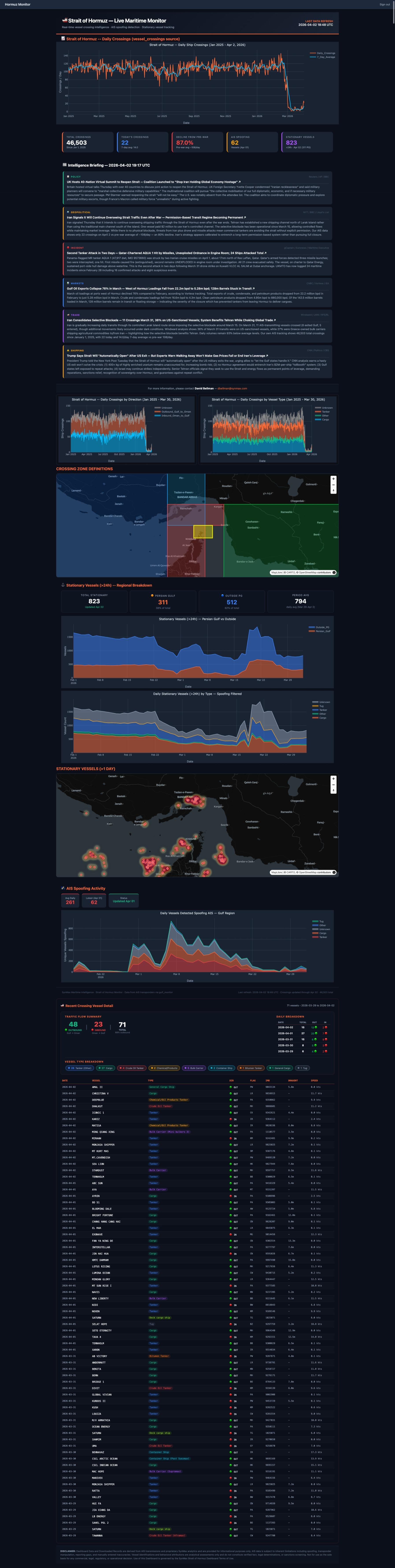
* **Key Metrics:**
* **Baseline:** The “pre-war” average was roughly 108 crossings per day.
* **Current State:** As of April 2, 2026, daily traffic has dropped to 22 crossings—an (87%) decline.
* **AIS Spoofing:** The dashboard identifies 62 vessels currently manipulating their AIS signals to obscure their true location or identity within the region.
* **Stationary Vessels:** There are currently 823 vessels that have been stationary for \(>24\) hours, signaling a massive backlog and regional blockade.

1 Comment
**Data Source & Methodology:**
* **Source:** This data is provided by **SynMax** (https://hormuz.synmax.com/), using AIS (Automatic Identification System) maritime intelligence and the vessel_crossings database.
* **Tools:** The dashboard is built using **MapLibre** for geospatial visualization, with map tiles provided by **CARTO** and **OpenStreetMap**. Data analytics and time-series charts were generated via SynMax’s internal intelligence engine.
* **Key Metrics:**
* **Baseline:** The “pre-war” average was roughly 108 crossings per day.
* **Current State:** As of April 2, 2026, daily traffic has dropped to 22 crossings—an (87%) decline.
* **AIS Spoofing:** The dashboard identifies 62 vessels currently manipulating their AIS signals to obscure their true location or identity within the region.
* **Stationary Vessels:** There are currently 823 vessels that have been stationary for \(>24\) hours, signaling a massive backlog and regional blockade.