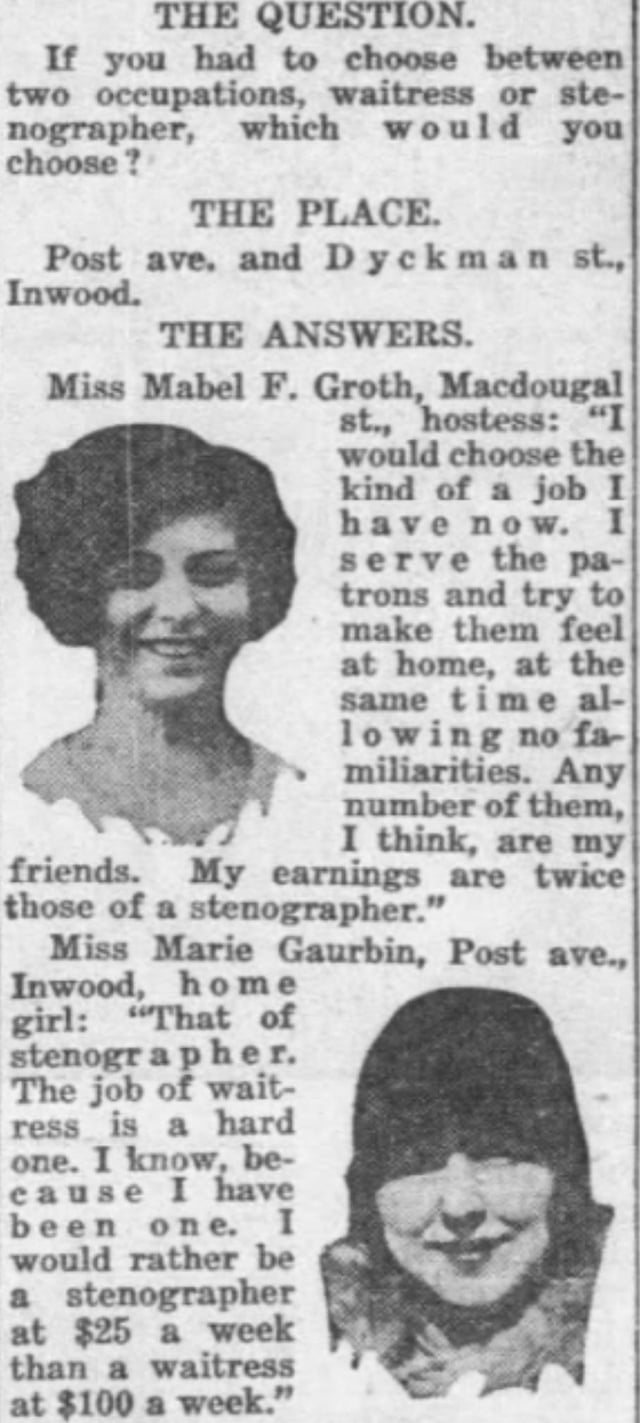
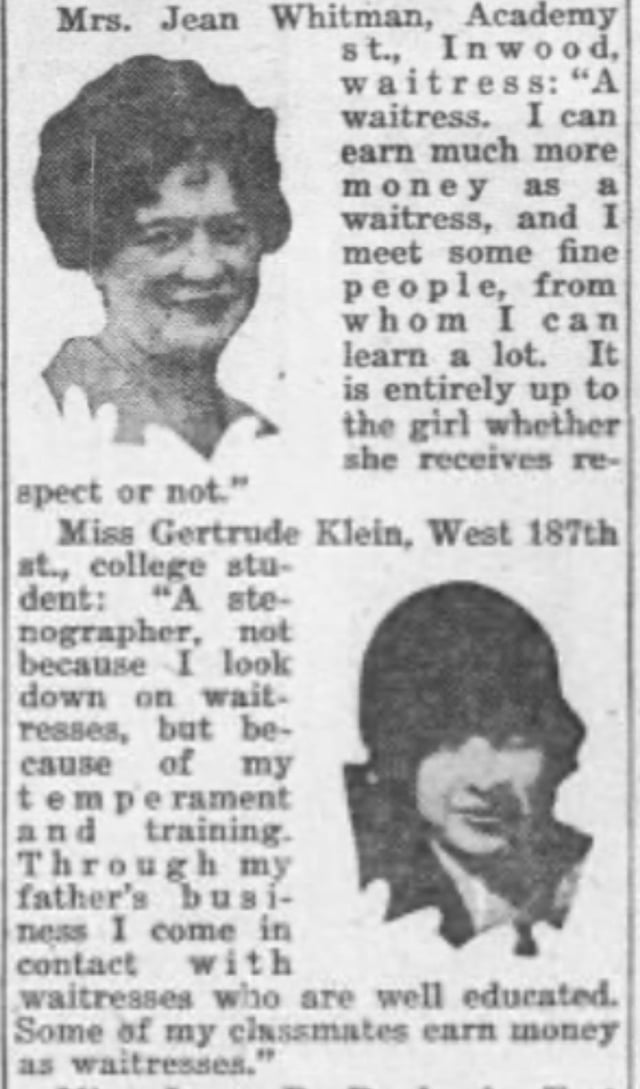
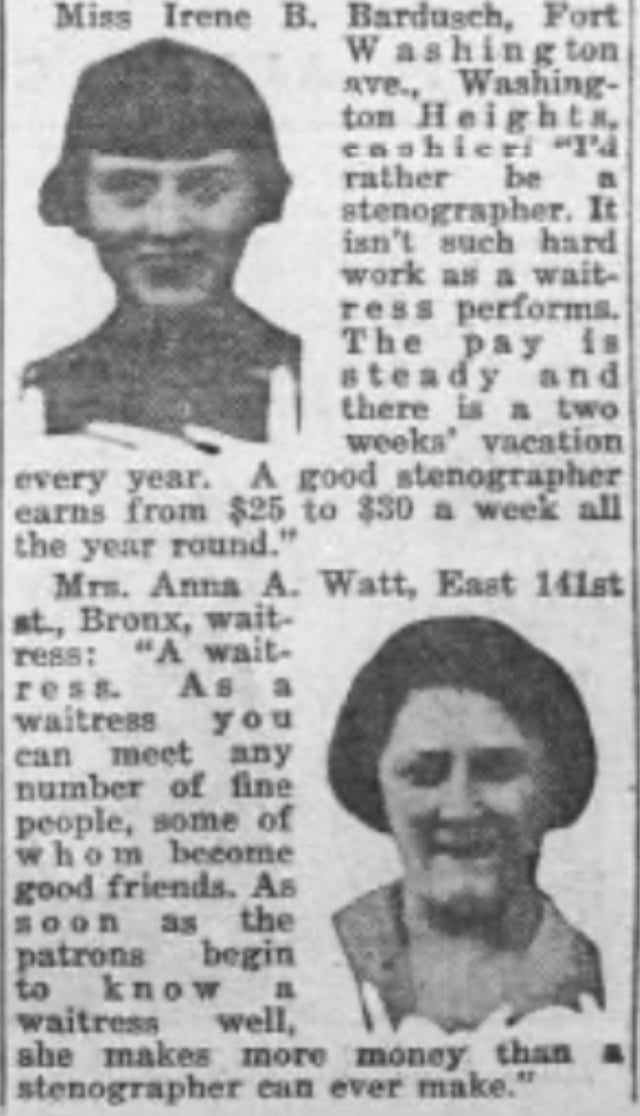
Love it. Those who chose waitressing generally only cared about the money & meeting people. Those who chose stenographer acknowledged it was less pay than waitressing but also wanted no part in doing such.
My own commentary is that the women who did not want to be waitresses also know that the job is generally garbage, it’s hard on your body, and you’re constantly judged by strangers, if not harassed/sexually assaulted….compared to a stenographer who at best may slightly go over “office hours” and for the most part their biggest job is accuracy.
I feel the same question could be asked today between the two and I think it’d still be nearly the same answers. Those who may think about earning upwards of $45-50k at a mid-scale restaurant vs $30k in a court room…but those who would rather take that $30k and have vacation/benefits vs someone who is constantly networking and frankly just tired
pourthebubbly on
I wonder how different a waitress job in 1927 was compared to now. Did they depend on tips them too or were they paid a wage? In my modern mind, I’ve never actually considered a waiting job being paid more than a stenographer, but that’s probably because our modern society doesn’t value service industries as much anymore. If we did, the minimum wage in the US would be higher.
ETA: I just looked it up and $100 a week in 1927 is nearly $1900 usd in today’s money! I’d be a waitress too lol
kevinsju on
She’s too young to be the Gertrude Klein, right?
Lady_Lance on
All very nice and well thought out answers except for victim blaming Jean Whitman there.
starfleetdropout6 on
I found out from the 1950 census that my grandmother had been a stenographer before she married. I had no idea; she passed in 2014. Ancestry research is fascinating.
justalapforcats on
Miss Marie Gaurbin, home girl 😹
Jazzlike-Coffee-6150 on
I mean, we all know those are the only 2 jobs a woman can have…
Jazzlike-Coffee-6150 on
Oh I know, I was just making a comment about the time period. I enjoy reading these but they are always a reminder of how little women were regarded back then.

9 Comments
Love it. Those who chose waitressing generally only cared about the money & meeting people. Those who chose stenographer acknowledged it was less pay than waitressing but also wanted no part in doing such.
My own commentary is that the women who did not want to be waitresses also know that the job is generally garbage, it’s hard on your body, and you’re constantly judged by strangers, if not harassed/sexually assaulted….compared to a stenographer who at best may slightly go over “office hours” and for the most part their biggest job is accuracy.
I feel the same question could be asked today between the two and I think it’d still be nearly the same answers. Those who may think about earning upwards of $45-50k at a mid-scale restaurant vs $30k in a court room…but those who would rather take that $30k and have vacation/benefits vs someone who is constantly networking and frankly just tired
I wonder how different a waitress job in 1927 was compared to now. Did they depend on tips them too or were they paid a wage? In my modern mind, I’ve never actually considered a waiting job being paid more than a stenographer, but that’s probably because our modern society doesn’t value service industries as much anymore. If we did, the minimum wage in the US would be higher.
ETA: I just looked it up and $100 a week in 1927 is nearly $1900 usd in today’s money! I’d be a waitress too lol
She’s too young to be the Gertrude Klein, right?
All very nice and well thought out answers except for victim blaming Jean Whitman there.
I found out from the 1950 census that my grandmother had been a stenographer before she married. I had no idea; she passed in 2014. Ancestry research is fascinating.
Miss Marie Gaurbin, home girl 😹
I mean, we all know those are the only 2 jobs a woman can have…
Oh I know, I was just making a comment about the time period. I enjoy reading these but they are always a reminder of how little women were regarded back then.
Marie is a homegirl!!!!