
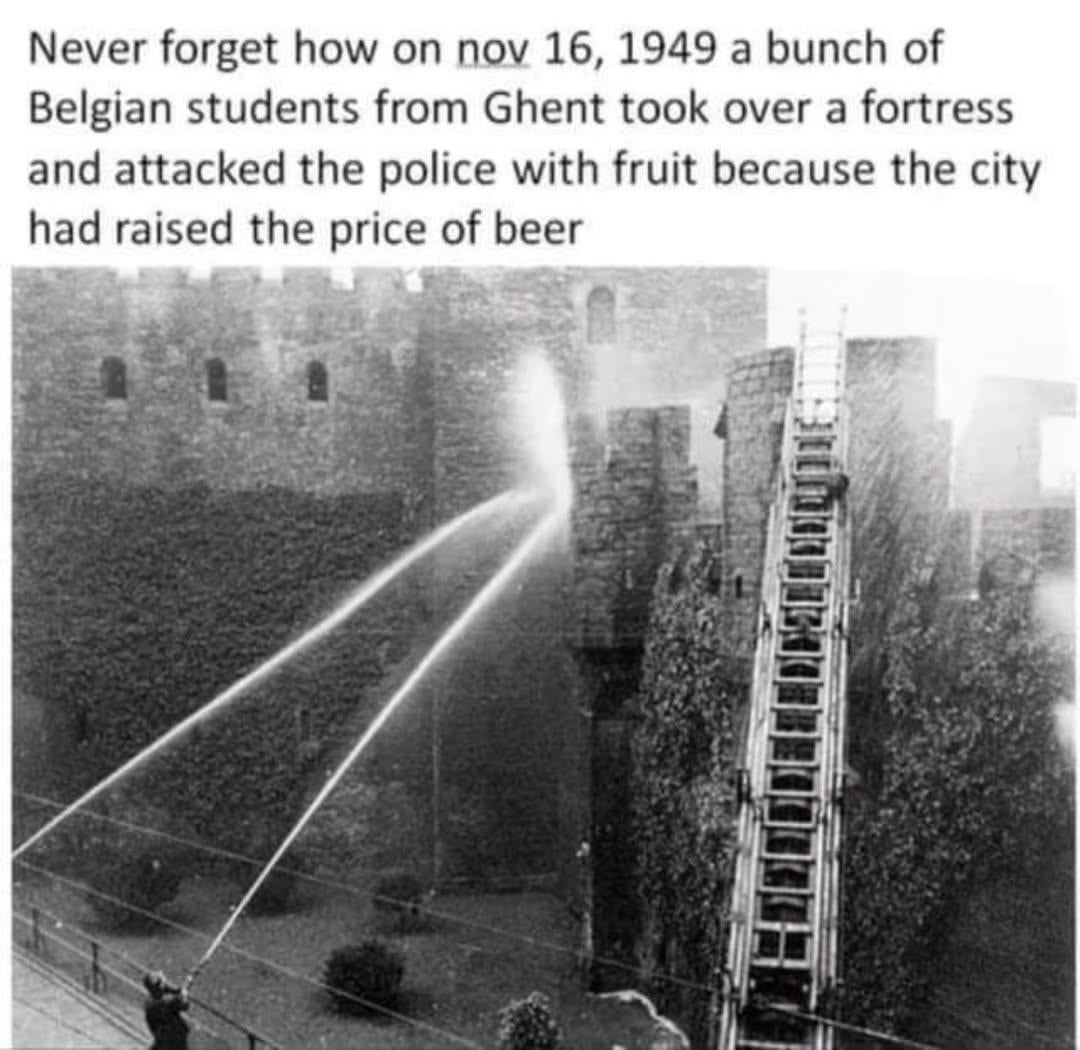
In 1949, Ghent witnessed one of history’s most eccentric protests, famously known as the "Battle of Gravensteen." Outraged by a significant hike in beer prices—from 3 to 4 Belgian francs—and a shift toward more restrictive policing, 138 students stormed the Gravensteen castle and occupied it as a fortress of defiance. Armed with little more than academic idealism and a surprising surplus of rotten fruit, the students pelted police officers from the battlements as authorities attempted to scale the walls with ladders and fire hoses. While the "siege" eventually ended in a peaceful surrender, the event became a legendary symbol of student activism and Belgian humor, proving that few things are as worth fighting for as the affordability of a local pint.
by Several_Sandwich_732
14 Comments
The government raised beer prices? Was this a higher tax?
(would piss me off too).
THERE GOES MY HERO!!!
Valid crashout tbh
Given how essential beer is to student culture, that’s an understandable reaction.
Glorious
In Görlitz gab es in den 1960er Jahren Auseinandersetzungen, die in der Presse als “Bierkrieg” bezeichnet wurden, als die Landskron-Brauerei Preiserhöhungen durchsetzen wollte.
They really refused to be drafted into paying higher prices.
That’s the most Belgian revolution ever. Not fighting for freedom or rights just the right to afford beer. Respect.
Thats a cause i will always support
*Now, go away, or I shall taunt you a second time*
Additional context for those interested. A secondary reason they protested was that the police were changing their uniforms, they removed their very recognizable white cap to something more subtle. So they would stand out less in public spaces.
Also, the ‘siege’lasted extra long because there was only one fire truck in Belgium at the time whose ladder was long enough to reach the battlements. This truck had to come from a different city.
Also also, not one person snitched about the instigators and so there were no arrests despite everyone being questioned
SPUITERS VAN VLAANDEREN
Not to mention the time they had a revolution over a particularly zesty opera
“Your mother was a hamster and your father smelt of elderberries!”