Long Context: After 20 years of nonstop Democratic control of the Executive, the Department of Agriculture went from a primarily advisory agency tasked with educating farmers on best practices to a large and bureaucratic organization tasked with managing the entire rural economy. The Roosevelt Administration used the department of agriculture as a rural welfare agency, creating generous price floors of 90% of the ‘parity’ price (an artificially high calculated baseline), forcing the government to buy the surplus, and providing heavy cash benefits for each bushel of product.
The only problem is that these programs (in many ways like modern subsidies) were both bad welfare programs and prohibitively expensive. The payouts were based on volume rather than need, so poor small farmers received a pittance and large businesses received the lion’s share of benefits. It gave to the rich and took from the poor. Furthermore, As mechanization, chemical fertilizers, and agricorps revolutionized American rural life, these programs forced the federal government to keep food prices high and subsidize large corporations with money from the productive and growing urban middle class. Therefore, when the Eisenhower Administration was elected in 1952, the deficit hawk Ike saw these programs as wasteful and destructive of the small farm life he had grown up in. However, with the rural population forming a large voting bloc and controlling 20+ senators, Eisenhower realized he needed a good agricultural secretary to get the job done. That’s where Ezra Taft Benson comes in.
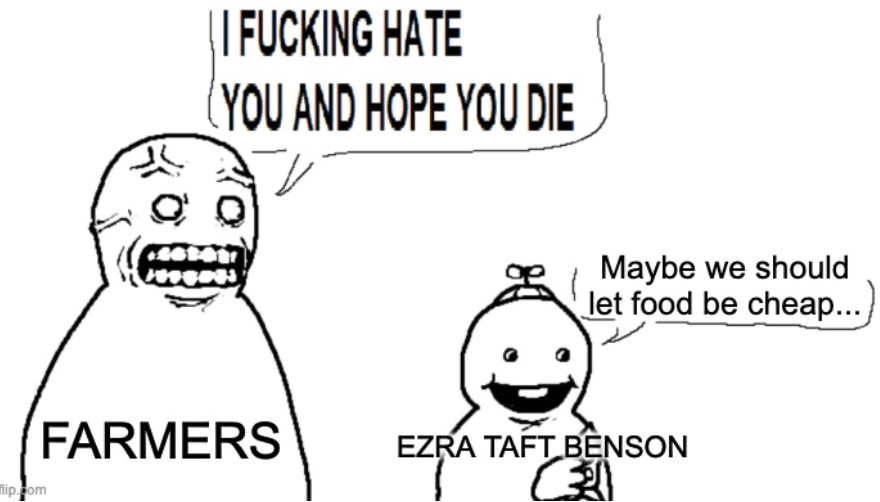
At first, Benson seemed like he would be a popular pick. A college-educated farmer from Idaho, he headed multiple agricultural cooperative organizations and was seen as a preeminent expert in the field. There were just two problems: Firstly, he was an apostle (a similar rank to Catholic Cardinals) of the Church of Jesus Christ of Latter Day Saints (aka the ‘Mormons’) and the first active clergyman in a cabinet position in 100 years. This immediately made him despised by the piously Protestant rural public, with Evangelicals comparing him unfavorably to a Pagan Priest. In a time before the uneasy marriage of Protestants and Mormons in the Republican Party, they were seen as ‘just as bad as’ Jews, Catholics, and other outside religious groups. This was only exacerbated by the second problem: Unlike most Agricultural Secretaries, who are more or less cheerleaders for rural interests and subsidies, Benson HATED government intervention in farming. Seeing it as un-American, Socialist, and a boon for large corporations, he became an emphatic crusader against farming spending. He originally didn’t even support Eisenhower’s nomination, instead supporting the more hardline Robert A. Taft (who was also a distant cousin of his). Even Benson himself was skeptical of the pick, needing Eisenhower to essentially beg him to take the role and explicit approval from the Mormon church before eventually acquiescing.
This, unsurprisingly, made Benson one of the most unpopular politicians in the history of rural America (except for Utah, where he was loved). He was egged in visits to farms around the country, disgruntled farmers left pig carcasses at his office, and Congressmen would constantly threaten him with impeachment and chew him out on the daily. Vice President Nixon would beg Eisenhower to fire Benson, who was seen as an electoral liability. However, despite all the pressure, Eisenhower always refused, and was oftentimes the only person who liked Benson at all. Himself a political outsider, Ike saw Benson as an incorruptible and morally honest man compared to the career politicians and big businessmen that made up the Republican political elite of the time. Eisenhower also secretly supported his reforms, seeing them as absolutely necessary to prevent government insolvency. He also liked how Benson was able to take all criticism of the Republican Party on a personal level, akin to a sacrificial lamb for Eisenhower’s popularity. Since Benson did not care for his political career either, he was more than willing to commit political suicide on most issues to let Eisenhower get out scott free. Because of all of that, Benson became a close ally and friend of Eisenhower, to the point that he was chosen as one of the Eisenhower Ten, a group poised to have complete control of the economy in case of a nuclear war.
Despite his almost demonic status among farmers of the time, Benson went about his attempts to reform American agriculture with a religious zeal. While the Department of Agriculture would grow due to the explosion of mechanization and chemical fertilizers, Benson’s reductions of the price floors helped ensure the coming Green Revolution didn’t bankrupt the Federal Government while lining the pockets of corporate agriculture. As a stopgap until the subsidies could be stopped entirely, Benson also established the Conservation Reserve, which created protected natural lands out of unused farmland. This land, which would eventually be as large as the state of Pennsylvania, helped repair the environment after the dust bowl, repopulate wildlife, and reduce chemical pollution of rivers. Finally, rather than keep bought grain in federal silos to rot, he and Eisenhower shipped it to developing countries at risk of starvation both to increase American influence in the decolonizing world and out of a shared Christian Piety to stop starvation. Benson nowadays receives high marks from both Historians and Economists for his reform efforts, even if he was seen as doing it in a divisive and politically insensible way.
sirguinneshad on
Interesting, I didn’t know that ETB had such a divisive political career. In “Mormon” terms he’s best remembered as reaching “pope” status, and not much else. Kimball was the first to open the preisthood to black heritage people, and it was controversial. Benson didn’t rock the boat much, and he was followed by Hunter who promptly died, then Hinkley who had a long career as a “gentle” grandfather figure, but make no doubt, he built his career as a pro Mormon propogandist before it.

2 Comments
Long Context: After 20 years of nonstop Democratic control of the Executive, the Department of Agriculture went from a primarily advisory agency tasked with educating farmers on best practices to a large and bureaucratic organization tasked with managing the entire rural economy. The Roosevelt Administration used the department of agriculture as a rural welfare agency, creating generous price floors of 90% of the ‘parity’ price (an artificially high calculated baseline), forcing the government to buy the surplus, and providing heavy cash benefits for each bushel of product.
The only problem is that these programs (in many ways like modern subsidies) were both bad welfare programs and prohibitively expensive. The payouts were based on volume rather than need, so poor small farmers received a pittance and large businesses received the lion’s share of benefits. It gave to the rich and took from the poor. Furthermore, As mechanization, chemical fertilizers, and agricorps revolutionized American rural life, these programs forced the federal government to keep food prices high and subsidize large corporations with money from the productive and growing urban middle class. Therefore, when the Eisenhower Administration was elected in 1952, the deficit hawk Ike saw these programs as wasteful and destructive of the small farm life he had grown up in. However, with the rural population forming a large voting bloc and controlling 20+ senators, Eisenhower realized he needed a good agricultural secretary to get the job done. That’s where Ezra Taft Benson comes in.
At first, Benson seemed like he would be a popular pick. A college-educated farmer from Idaho, he headed multiple agricultural cooperative organizations and was seen as a preeminent expert in the field. There were just two problems: Firstly, he was an apostle (a similar rank to Catholic Cardinals) of the Church of Jesus Christ of Latter Day Saints (aka the ‘Mormons’) and the first active clergyman in a cabinet position in 100 years. This immediately made him despised by the piously Protestant rural public, with Evangelicals comparing him unfavorably to a Pagan Priest. In a time before the uneasy marriage of Protestants and Mormons in the Republican Party, they were seen as ‘just as bad as’ Jews, Catholics, and other outside religious groups. This was only exacerbated by the second problem: Unlike most Agricultural Secretaries, who are more or less cheerleaders for rural interests and subsidies, Benson HATED government intervention in farming. Seeing it as un-American, Socialist, and a boon for large corporations, he became an emphatic crusader against farming spending. He originally didn’t even support Eisenhower’s nomination, instead supporting the more hardline Robert A. Taft (who was also a distant cousin of his). Even Benson himself was skeptical of the pick, needing Eisenhower to essentially beg him to take the role and explicit approval from the Mormon church before eventually acquiescing.
This, unsurprisingly, made Benson one of the most unpopular politicians in the history of rural America (except for Utah, where he was loved). He was egged in visits to farms around the country, disgruntled farmers left pig carcasses at his office, and Congressmen would constantly threaten him with impeachment and chew him out on the daily. Vice President Nixon would beg Eisenhower to fire Benson, who was seen as an electoral liability. However, despite all the pressure, Eisenhower always refused, and was oftentimes the only person who liked Benson at all. Himself a political outsider, Ike saw Benson as an incorruptible and morally honest man compared to the career politicians and big businessmen that made up the Republican political elite of the time. Eisenhower also secretly supported his reforms, seeing them as absolutely necessary to prevent government insolvency. He also liked how Benson was able to take all criticism of the Republican Party on a personal level, akin to a sacrificial lamb for Eisenhower’s popularity. Since Benson did not care for his political career either, he was more than willing to commit political suicide on most issues to let Eisenhower get out scott free. Because of all of that, Benson became a close ally and friend of Eisenhower, to the point that he was chosen as one of the Eisenhower Ten, a group poised to have complete control of the economy in case of a nuclear war.
Despite his almost demonic status among farmers of the time, Benson went about his attempts to reform American agriculture with a religious zeal. While the Department of Agriculture would grow due to the explosion of mechanization and chemical fertilizers, Benson’s reductions of the price floors helped ensure the coming Green Revolution didn’t bankrupt the Federal Government while lining the pockets of corporate agriculture. As a stopgap until the subsidies could be stopped entirely, Benson also established the Conservation Reserve, which created protected natural lands out of unused farmland. This land, which would eventually be as large as the state of Pennsylvania, helped repair the environment after the dust bowl, repopulate wildlife, and reduce chemical pollution of rivers. Finally, rather than keep bought grain in federal silos to rot, he and Eisenhower shipped it to developing countries at risk of starvation both to increase American influence in the decolonizing world and out of a shared Christian Piety to stop starvation. Benson nowadays receives high marks from both Historians and Economists for his reform efforts, even if he was seen as doing it in a divisive and politically insensible way.
Interesting, I didn’t know that ETB had such a divisive political career. In “Mormon” terms he’s best remembered as reaching “pope” status, and not much else. Kimball was the first to open the preisthood to black heritage people, and it was controversial. Benson didn’t rock the boat much, and he was followed by Hunter who promptly died, then Hinkley who had a long career as a “gentle” grandfather figure, but make no doubt, he built his career as a pro Mormon propogandist before it.