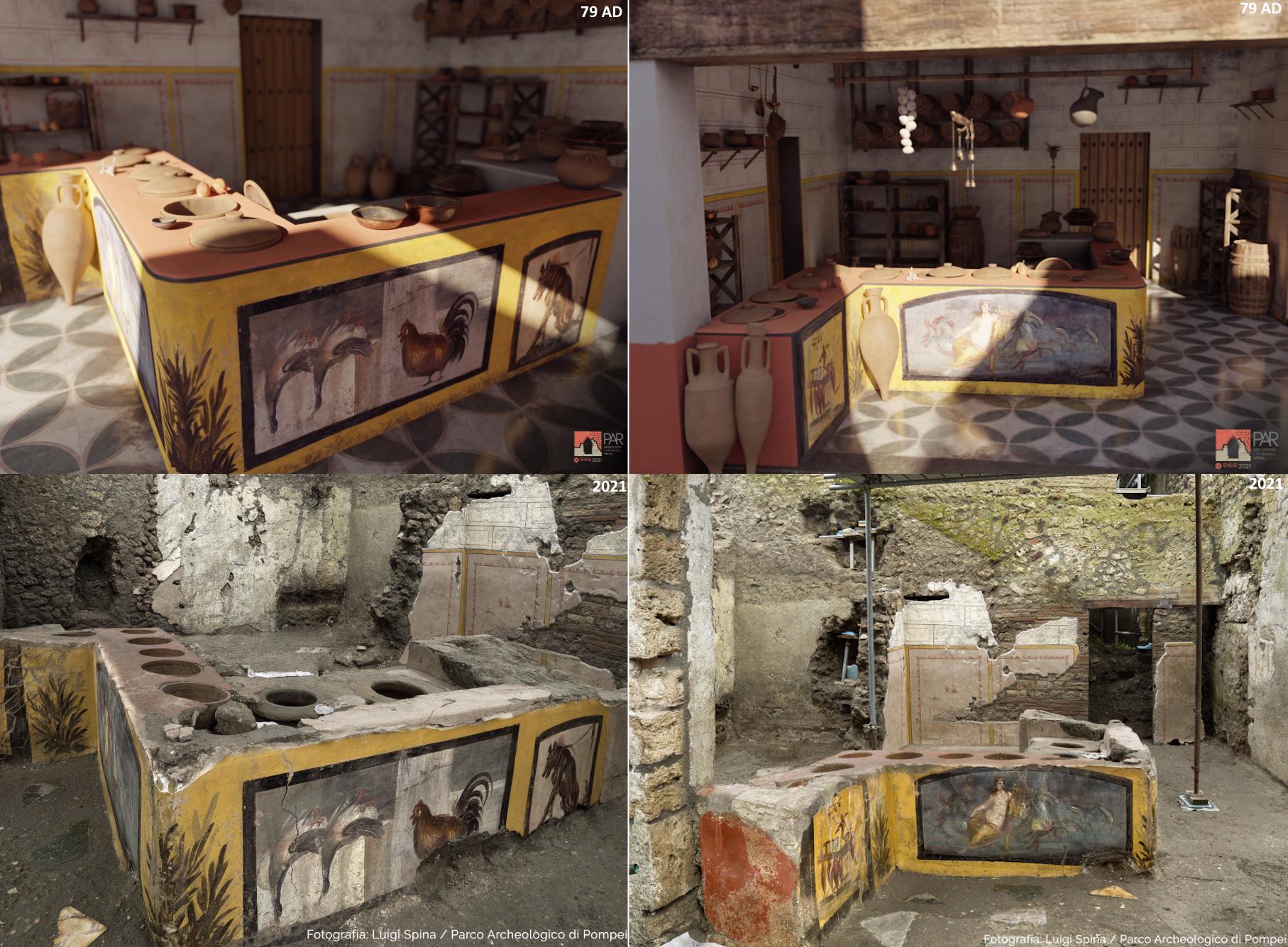
This is an approximate virtual reconstruction created on the basis of photographs of the *thermopolium* or *caupona* from Regio V in Pompeii. This Pompeian tavern was excavated during the 2019–2020 campaigns, and its photographs, taken by Luigi Spina, were shared with the press by the team of the Parco Archeologico di Pompei. This is not an exact virtual reconstruction, and some elements have not been recreated according to the reference material—for example, the pavement—since we did not have all the historical and archaeological data necessary to do so, and because our aim was not to produce an exact recreation of this specific Pompeian tavern.
However, this reconstruction allows us to understand what a Roman tavern (*caupona* or *thermopolium*) would have been like. These were establishments where food was taken away or consumed on the street, organized around a masonry counter fitted with various *dolia*, or containers with lids that made it easy to keep food warm. As in the case of the Regio V *caupona* in Pompeii, these counters could be decorated with rich paintings, some of which depict scenes set within the tavern itself. In such establishments, we also find amphorae and other ceramic containers, cups, plates, jugs, and foodstuffs, many of which would have been hung from wooden bars located in the upper part of the space.
The most interesting part is realizing people were absolutely regulars here. And none of them exists now
Spanarkonungur on
Mmm, the famous Pulli Fratres franchise
MonoMcFlury on
I would give anything to witness the Roman Empire at its peak. It must have been a vibrant and colorful era, perhaps even sharing some similarities with today. Think fast food, bathhouses, the Colosseum, theaters, the occasional barbarian pillage and only organic food.
KenseiHimura on
That feel when no tall (visa)goth GF to assertively tell them I had asked for no pickles.
Helenium_autumnale on
This is so cool. Iirc, most Roman apartments did not have cooking facilities/hearths/stoves; please correct me if I’m wrong. So tons of people would be buying street food every day to take home for meals. If that’s the case, what did they use for takeout containers? Would you take a pottery container from home, or would the food be served in a cheap disposable pottery container? I remember reading somewhere that there are remnants of literal hills of broken pottery shards around the ancient city limits. Also, I’m dying of curiosity to know which 9 foods were in those 9 warming vats. Do we know?Would the warming counter have something like banked coals within it?
daniel2hats on
Pompey
baIIern on
I don’t think they just leaned the amphora to that counter on floor tiles lol. Looks like it will slip and break on the slightest touch
big_johnny_bee on
Early Subway vibes!
OudSmoothie on
I’ve visited this exact spot. It’s pretty interesting to see irl.
Whoppertino on
Reminds me of fast food, like shwarma, places all over the Middle East.
Avril_14 on
If you can, go to Pompei once in your life.
I thought it was an archeological site like the others, some ruins here, some ruins there, but no.
It’s an almost perfectly conserved roman city, the size of it is incredible, you really get transported 2000 years in the past. You are walking down the streets and places like this in the picture are on your left and right, with the same mosaics, frescos and graffiti freezed from the eruption.
justahdewd on
Was watching a doc a few years back about Rome, they had a menu from a fast food place that served what was pretty much a hamburger.
COMM_NTARIAT on
So they served duck, chicken….and dog? Am I reading this menu right?
NWdabest on
I fell in love with the mosaic art in Pompeii. When I buy my next house I’m putting in a couple mosaics.
OrneryAttorney7508 on
Ummm, gimme a number IV and a XI, extra cheese. To go.
poxonallthehouses on
For a second I thought the hanging pots were overhanging track lighting
MagicalWhisk on
Interesting fact about Pompeii, because it was a key trade hub they had lots of different languages mixing together. This is why a lot of food shops had pictures so people like sailors (who could not afford a translator or guide) could know what food was being cooked and served.
Less fun fact. The brothels also had pictures of positions and sexual acts. People could walk in and point at a picture of what they wanted.
superpimp2g on
Still Has more personality than a modern McDonalds
La_Mandra on
I would certainly be a customer at a fast-food redesigned like this, if it were open for service. 🙂

23 Comments
[Author and source: Pablo Aparicio Resco](http://parpatrimonio.com/2021/03/11/reconstruccion-virtual-en-3d-de-un-thermopolium-de-pompeya/)**.** Info provided by the author (translated into English):
This is an approximate virtual reconstruction created on the basis of photographs of the *thermopolium* or *caupona* from Regio V in Pompeii. This Pompeian tavern was excavated during the 2019–2020 campaigns, and its photographs, taken by Luigi Spina, were shared with the press by the team of the Parco Archeologico di Pompei. This is not an exact virtual reconstruction, and some elements have not been recreated according to the reference material—for example, the pavement—since we did not have all the historical and archaeological data necessary to do so, and because our aim was not to produce an exact recreation of this specific Pompeian tavern.
However, this reconstruction allows us to understand what a Roman tavern (*caupona* or *thermopolium*) would have been like. These were establishments where food was taken away or consumed on the street, organized around a masonry counter fitted with various *dolia*, or containers with lids that made it easy to keep food warm. As in the case of the Regio V *caupona* in Pompeii, these counters could be decorated with rich paintings, some of which depict scenes set within the tavern itself. In such establishments, we also find amphorae and other ceramic containers, cups, plates, jugs, and foodstuffs, many of which would have been hung from wooden bars located in the upper part of the space.
Higher-resolution images of the 3D reconstruction available [here](https://www.artstation.com/artwork/68V8xW).
The most interesting part is realizing people were absolutely regulars here. And none of them exists now
Mmm, the famous Pulli Fratres franchise
I would give anything to witness the Roman Empire at its peak. It must have been a vibrant and colorful era, perhaps even sharing some similarities with today. Think fast food, bathhouses, the Colosseum, theaters, the occasional barbarian pillage and only organic food.
That feel when no tall (visa)goth GF to assertively tell them I had asked for no pickles.
This is so cool. Iirc, most Roman apartments did not have cooking facilities/hearths/stoves; please correct me if I’m wrong. So tons of people would be buying street food every day to take home for meals. If that’s the case, what did they use for takeout containers? Would you take a pottery container from home, or would the food be served in a cheap disposable pottery container? I remember reading somewhere that there are remnants of literal hills of broken pottery shards around the ancient city limits. Also, I’m dying of curiosity to know which 9 foods were in those 9 warming vats. Do we know?Would the warming counter have something like banked coals within it?
Pompey
I don’t think they just leaned the amphora to that counter on floor tiles lol. Looks like it will slip and break on the slightest touch
Early Subway vibes!
I’ve visited this exact spot. It’s pretty interesting to see irl.
Reminds me of fast food, like shwarma, places all over the Middle East.
If you can, go to Pompei once in your life.
I thought it was an archeological site like the others, some ruins here, some ruins there, but no.
It’s an almost perfectly conserved roman city, the size of it is incredible, you really get transported 2000 years in the past. You are walking down the streets and places like this in the picture are on your left and right, with the same mosaics, frescos and graffiti freezed from the eruption.
Was watching a doc a few years back about Rome, they had a menu from a fast food place that served what was pretty much a hamburger.
So they served duck, chicken….and dog? Am I reading this menu right?
I fell in love with the mosaic art in Pompeii. When I buy my next house I’m putting in a couple mosaics.
Ummm, gimme a number IV and a XI, extra cheese. To go.
For a second I thought the hanging pots were overhanging track lighting
Interesting fact about Pompeii, because it was a key trade hub they had lots of different languages mixing together. This is why a lot of food shops had pictures so people like sailors (who could not afford a translator or guide) could know what food was being cooked and served.
Less fun fact. The brothels also had pictures of positions and sexual acts. People could walk in and point at a picture of what they wanted.
Still Has more personality than a modern McDonalds
I would certainly be a customer at a fast-food redesigned like this, if it were open for service. 🙂
Behold! the original Taco Bell Cantina
Needs a refurb.
McDonatello’s