Lord Chelmsford was the twat in charge of the British 1879 invasion of Zululand, and i will not grace him with a dedicated section on his life.
On the morning of the 22nd of January, 1879, Chelsmford had left with most of his men to chase what he believed to be the main Zulu army. Little did he know, the main Zulu army had actually outflanked him, and was preparing to attack the little force that Chelmsford had left behind at Isandlwana.
After Durnford engaged the Zulu army, believing it to be an attempt by the Zulus to flank Chelmsford, the battle soon began and the defenders of Isandlwana were almost all wiped out.
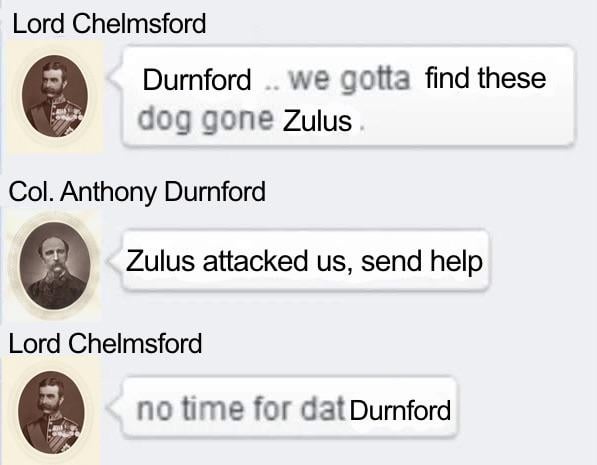
Even after numerous messengers from the camp at Isandlwana pleading for Chelmsford’s help, Chelmsford dragged his feet and arrived back at the camp too late to save the situation. After the devastating loss to a ‘native’ foe, Chelmsford moved the blame for the embarrassing situation onto Lt Col Anthony Durnford, claiming that he ordered Durnford to set up defensive positions at the camp (he didnt, nor would Durnford have had the time to).
As for Durnford, he was actually based asf.
Born an Irishman in a military family, Durnford received many postings, but in 1871, he was sent to what is today South Africa
In the years 1878 and 1879, Durnford was in charge of the Natal Native Contingent, a group of both black and white volunteers within the Natal protectorate.
> From his service in South Africa over a broken period of eight years, the impression which emerges of Anthony William Durnford is that of a colourful, yet controversial figure. Loved and esteemed by many, grossly maligned by others, his life-story reveals an intriguing mixture of happiness and sadness, of success and misfortune, of heroism and tragedy. He once described himself as ‘the best hated man in Natal’; but whereas some might curse and revile him, his personal attributes, his integrity and character remained unassailable.
Durnford was an experienced soldier, and this was shown by his left arm, which was carried in a sling, the arm having been permanently disabled in a previous engagement during a border conflict. He was unpopular with many of his white militia colleagues, as Durnford never held his tongue when criticising what he saw as cowardice. While unpopular with his white colleagues, his black subordinates thought very highly of Durnford, and through both letters as well as his actions, it is shown that Durnford thought similarly of his men.
When talking about black people during his time in Southern Africa, he said that:
> ″…they are at least honest, chivalrous and hospitable, true to their salt, although only primitive. They are fine men, very naked and all that sort of thing, but thoroughly good fellows.″
After an engagement during one of the many Border Conflicts within the region, Durnford buried two slain Hlubi men that he had killed, later writing that:
> ″I took his weapons, and raised a cairn high above his grave. In future days his friends will see that one Englishman, at least, can respect a brave man, even though he has a black skin.″
As the British invasion of Zululand drew near, Durnford asked for 3 regiments of Natal Native Contingent volunteers who he could lead. Due to his rank, he was granted 3 regiments, but was only allowed to be in command of the 1st Natal Native Contingent Regiment, the other two being led by men who had little love for the non-whites under their command. Durnford asked for red uniforms and modern equipment for his soldiers, but due to a mix of racism and a lack of funds, he was denied this request, his soldiers instead receiving red pieces of cloth and a mix of outdated rifles and traditional african weaponry. Before the invasion, Durnford hesitated to send his troops into Zululand, only sending them in after receiving a threatening dispatch from Lord Chelmsford.
Durnford and his troops were stationed at the side of a little mountain called Isandlwana. This was where Durnford would meet his end. On the 22nd of January, due to a mix of incompetence and arrogance from his british counterparts, and strategic cunning on the side of the Zulus, it was here at Isandlwana, where one of the worst defeats of the british army to a ‘native’ african army would take place.
> According to Jabez Molefe, who was one of the Basuto men within the Natal Native Contingent: ’The Colonel (Durnford) rode up and down our line continuously, encouraging us all, talking and even laughing with us – ‘Fire, my boys! ‘Well done, my boys!’ he cried. He was very calm and cheerful all the same time. There were not very many of us, but because of the way in which we were handled by our leader we were enough to stop the Zulus on that side for a long time. We could have carried him off with us safely enough at this time, [The] only [problem is that] we knew him too well to try. But we now say, ‘If we had known what would happen, we would have seized him and bound him, no matter if he had fought us for doing so, as he certainly would; no matter if he had killed some of us, we would have saved his life, for he was our master.’ Now we say that we will always remember him by his commanding voice, and the way in which he gave us some of his own spirit as he went along our line that day, and those amongst us who had not served under him before, as I have, say, ‘Why did we not know him sooner?’
Knowing that the Zulu would give no quarter, Durnford gave his horse to Simeon Kambule, another member of the Natal Native Contingent, and ordered Simeon and the rest of his native regiment to flee the battle in order to stay alive.
As his soldiers left, Durnford made it his duty to protect the only wagon trail out of camp, so that as many people who were able to flee the inevitable onslaught could. Here Anthony Durnford fell, surrounded by some 30 men of the 24th, 26 Natal Police and 14 Natal Carbineers. Zulu warriors testified in later days with great admiration to the incredible valour of these men and their tall officer who carried his left arm in a sling.
The Battle of Isandlwana is best remembered today as a horrific military defeat placed on the British army, and it is probably best known from (at least in South Africa) [Johnny Clegg’s song: ‘Impi’](https://youtu.be/CsA-ZD_VOXE?si=XE7OH6tF2QR1QfTq)
EnchantingBabe2 on
Lord Chelmsford really invented ‘I’m busy, can I call you back?’ before telephones were even a thing.
ClassicTable104 on
this is why you don’t mute your teammates
Diabolical_potplant on
It’s slightly unrelated, but it’s still kinda funny event that happened this excat day, the battle of Rorke’s Drift. On one section, you have the british army getting creamed due to incompetence. On the other hand, you have them absolutely creaming the Zulus

4 Comments
Lord Chelmsford was the twat in charge of the British 1879 invasion of Zululand, and i will not grace him with a dedicated section on his life.
On the morning of the 22nd of January, 1879, Chelsmford had left with most of his men to chase what he believed to be the main Zulu army. Little did he know, the main Zulu army had actually outflanked him, and was preparing to attack the little force that Chelmsford had left behind at Isandlwana.
After Durnford engaged the Zulu army, believing it to be an attempt by the Zulus to flank Chelmsford, the battle soon began and the defenders of Isandlwana were almost all wiped out.
Even after numerous messengers from the camp at Isandlwana pleading for Chelmsford’s help, Chelmsford dragged his feet and arrived back at the camp too late to save the situation. After the devastating loss to a ‘native’ foe, Chelmsford moved the blame for the embarrassing situation onto Lt Col Anthony Durnford, claiming that he ordered Durnford to set up defensive positions at the camp (he didnt, nor would Durnford have had the time to).
As for Durnford, he was actually based asf.
Born an Irishman in a military family, Durnford received many postings, but in 1871, he was sent to what is today South Africa
In the years 1878 and 1879, Durnford was in charge of the Natal Native Contingent, a group of both black and white volunteers within the Natal protectorate.
> From his service in South Africa over a broken period of eight years, the impression which emerges of Anthony William Durnford is that of a colourful, yet controversial figure. Loved and esteemed by many, grossly maligned by others, his life-story reveals an intriguing mixture of happiness and sadness, of success and misfortune, of heroism and tragedy. He once described himself as ‘the best hated man in Natal’; but whereas some might curse and revile him, his personal attributes, his integrity and character remained unassailable.
Durnford was an experienced soldier, and this was shown by his left arm, which was carried in a sling, the arm having been permanently disabled in a previous engagement during a border conflict. He was unpopular with many of his white militia colleagues, as Durnford never held his tongue when criticising what he saw as cowardice. While unpopular with his white colleagues, his black subordinates thought very highly of Durnford, and through both letters as well as his actions, it is shown that Durnford thought similarly of his men.
When talking about black people during his time in Southern Africa, he said that:
> ″…they are at least honest, chivalrous and hospitable, true to their salt, although only primitive. They are fine men, very naked and all that sort of thing, but thoroughly good fellows.″
After an engagement during one of the many Border Conflicts within the region, Durnford buried two slain Hlubi men that he had killed, later writing that:
> ″I took his weapons, and raised a cairn high above his grave. In future days his friends will see that one Englishman, at least, can respect a brave man, even though he has a black skin.″
As the British invasion of Zululand drew near, Durnford asked for 3 regiments of Natal Native Contingent volunteers who he could lead. Due to his rank, he was granted 3 regiments, but was only allowed to be in command of the 1st Natal Native Contingent Regiment, the other two being led by men who had little love for the non-whites under their command. Durnford asked for red uniforms and modern equipment for his soldiers, but due to a mix of racism and a lack of funds, he was denied this request, his soldiers instead receiving red pieces of cloth and a mix of outdated rifles and traditional african weaponry. Before the invasion, Durnford hesitated to send his troops into Zululand, only sending them in after receiving a threatening dispatch from Lord Chelmsford.
Durnford and his troops were stationed at the side of a little mountain called Isandlwana. This was where Durnford would meet his end. On the 22nd of January, due to a mix of incompetence and arrogance from his british counterparts, and strategic cunning on the side of the Zulus, it was here at Isandlwana, where one of the worst defeats of the british army to a ‘native’ african army would take place.
> According to Jabez Molefe, who was one of the Basuto men within the Natal Native Contingent: ’The Colonel (Durnford) rode up and down our line continuously, encouraging us all, talking and even laughing with us – ‘Fire, my boys! ‘Well done, my boys!’ he cried. He was very calm and cheerful all the same time. There were not very many of us, but because of the way in which we were handled by our leader we were enough to stop the Zulus on that side for a long time. We could have carried him off with us safely enough at this time, [The] only [problem is that] we knew him too well to try. But we now say, ‘If we had known what would happen, we would have seized him and bound him, no matter if he had fought us for doing so, as he certainly would; no matter if he had killed some of us, we would have saved his life, for he was our master.’ Now we say that we will always remember him by his commanding voice, and the way in which he gave us some of his own spirit as he went along our line that day, and those amongst us who had not served under him before, as I have, say, ‘Why did we not know him sooner?’
Knowing that the Zulu would give no quarter, Durnford gave his horse to Simeon Kambule, another member of the Natal Native Contingent, and ordered Simeon and the rest of his native regiment to flee the battle in order to stay alive.
As his soldiers left, Durnford made it his duty to protect the only wagon trail out of camp, so that as many people who were able to flee the inevitable onslaught could. Here Anthony Durnford fell, surrounded by some 30 men of the 24th, 26 Natal Police and 14 Natal Carbineers. Zulu warriors testified in later days with great admiration to the incredible valour of these men and their tall officer who carried his left arm in a sling.
The Battle of Isandlwana is best remembered today as a horrific military defeat placed on the British army, and it is probably best known from (at least in South Africa) [Johnny Clegg’s song: ‘Impi’](https://youtu.be/CsA-ZD_VOXE?si=XE7OH6tF2QR1QfTq)
Lord Chelmsford really invented ‘I’m busy, can I call you back?’ before telephones were even a thing.
this is why you don’t mute your teammates
It’s slightly unrelated, but it’s still kinda funny event that happened this excat day, the battle of Rorke’s Drift. On one section, you have the british army getting creamed due to incompetence. On the other hand, you have them absolutely creaming the Zulus