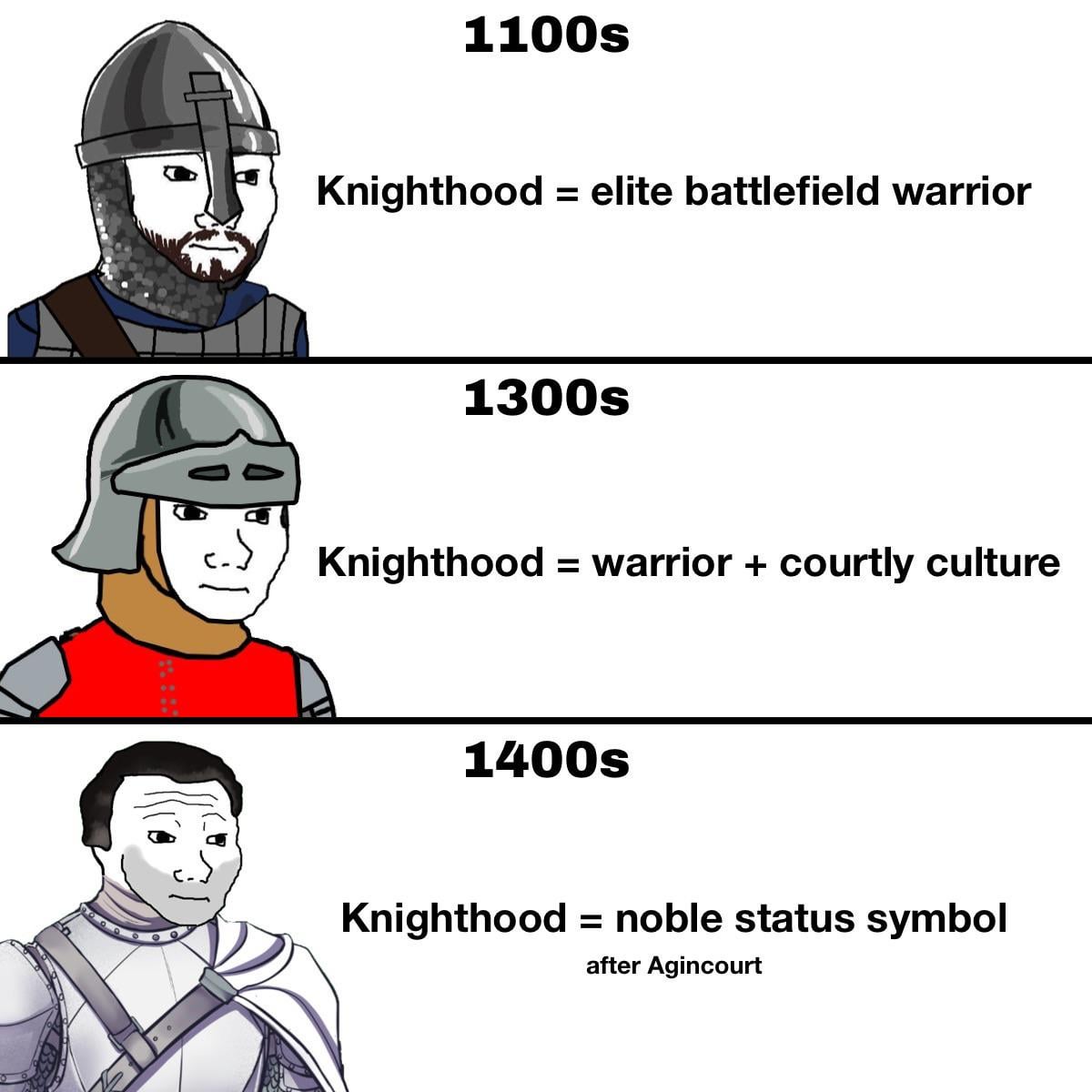
Agincourt was a strategic failing and I’m tired of people acting like it “ended” mounted warfare. Mounted cavalry was still very prevalent even 300 years after the battle. The winged hussars didn’t have their famous charge until 200 years after agincourt.
Woden-Wod on
I mean that noble status still conferred elite abilities of governance and rule in their time.
you have to remember else all things nobles stripped of their lands and titles are still trained from birth to fulfil their roles within society which at minimum would make them more suited to administration and governance then anyone else at the time.
verraeteros_ on
I know it’s a meme, but that helmet is 1400s
Lovablemiranda03 on
Just wait until the 1700s, when your primary weapon is a powdered wig and a very expensive toothpick.
Mecha_G on
Didn’t the same thing happen to samurai?
Drakoniid on
I, too, lived 300 years to see my profession shift
OnlyBath9046 on
Agincourt was essentially the moment knights realized they were the main characters in a show that just got canceled
monstrolegume90 on
Samurai went a similar path through the ages, becomingol a bureaucratic duty and a social position
Oddcannon on
Then in the 1600s only the most delusional person willing to be (play) one
thanasis87kav on
I think the official ending was battle of Pavia 1525.
Ok_Firefighter_3090 on
Most armchair historians somehow forget that England lost that war in the end and that French cavalry pummeled the English at Patay. Cavalry was far from outdone, but the days of mindless charging to win were gone with the infantry revolution which was gradual.
Sir-Toaster- on
Samurai were the reverse, a noble status symbol to becoming elite warriors
Goofcheese0623 on
Are you doubting the martial prowess of Sir Paul McCartney or Sir Elton John
chilling_hedgehog on
Man this post hurts. Welcome to history memes on reddit, where 14yo’s watched a ridley scott quality movie and post their thoughts about it
maxemile101 on
Maybe because a walking armoured tank was vanquished by firepower.
PadishaEmperor on
We also shouldn’t act like a Norman knight was the same as a Teutonic order knight or a Castilian knight. Culture, social status, class, armor and weapon usage differed greatly.
Sugar_Kowalczyk on
Knighthood 2026 – Status symbol that is regularly turned down by actors and others (John Oliver, for one) because it’s actually sort of an embarassment to be associated with the Monarchy.
Wizarmon on
2000s
knighthood = simping
mich160 on
2000s, WOW really?
ModeatelyIndependant on
Guns made knights in shining armor obsolete on the battlefield.
i_am_13_otters on
*laughs in educator*
funcancelledfornow on
The gentrification of knighthood.
YandereTeemo on
It was a combination of events and the sudden and drastic changes of military doctrine and technology that shaped knighthood as it is.
1. Gunpowder weapons: bombards smashed castles and arquebuses/muskets were more efficient units than knights ever were. Even if gunpowder did not exist, knights would simply phase out of combat simply because the time, effort, and resources it takes to train one simply isn’t cost effective. It’s better to use a mercenary, a militiaman with a pike or a crossbow, a man-at-arms, or lighter horsemen at half the efficiency but a lower cost. Pike and shot was king.
2. The Battle of Grunwald (1410): It was where the teutonic knights faced off against Poland and Lithuania. The knights lost so badly that it started their pivotal moment to change from a military to and administrative force. It was one of the moments in history that shattered the classical image of the knight, especially the warrior knight.
3. The Destruction of the Knights Templar (1314): King Philip IV was in debt to the Knights Templar after paying them to fight in the crusades. Instead of paying them, he accused the order of heresy and sodomy, by which the Catholic Church and the Knights Templar rounded up the Templar including Grandmaster Jacques de Molay, and burnt all of them at the stake.
There might be other factors here, but my point is that gunpowder was not the only thing that reduced the image of a knight from a warrior clad in steel into a ceremonial role.
beardingmesoftly on
It was always about being rich and connected for the most part
SE_prof on
Now put 2000: David Beckham
MonoRedPlayer on
This is so wrong it’s honestly insane.
blaze92x45 on
This also applies to the samurai as well I think
Though I think by the end they were more of a warrior bureaucracy
MikaelAdolfsson on
By the time of the roman republic, Togas were only worn specifically in the senate and senators hated wearing it since it was impractical AF.
Otherwise-Sun-3522 on
Bitch, ask Samurais
LoneBlack3hadow on
**2000s**
Knighthood = People just say “Sir” before your name
alphonsus90 on
This is just straight up wrong. Knights were still very much a thing throughout the 1400s and into the early 1500s
SuperiorLaw on
Should have had 1900s/2000s Knighthood = popular musician/actor
Vaeon on
1900s = Entertainers can be Knights because WTFN
Separate-Courage9235 on
Fun fact, even in 1300s, people were larping 1100s knights, saying that knighthood was dying and not honorable enough. Kings started to create knight orders to “revive” knighthood.
Largeitude on
Knighthood was earned by monetary ability to afford the elite gear and training. It was always a wealth based class, even in other cultures.

36 Comments
longbows really ended a whole career path
Agincourt was a strategic failing and I’m tired of people acting like it “ended” mounted warfare. Mounted cavalry was still very prevalent even 300 years after the battle. The winged hussars didn’t have their famous charge until 200 years after agincourt.
I mean that noble status still conferred elite abilities of governance and rule in their time.
you have to remember else all things nobles stripped of their lands and titles are still trained from birth to fulfil their roles within society which at minimum would make them more suited to administration and governance then anyone else at the time.
I know it’s a meme, but that helmet is 1400s
Just wait until the 1700s, when your primary weapon is a powdered wig and a very expensive toothpick.
Didn’t the same thing happen to samurai?
I, too, lived 300 years to see my profession shift
Agincourt was essentially the moment knights realized they were the main characters in a show that just got canceled
Samurai went a similar path through the ages, becomingol a bureaucratic duty and a social position
Then in the 1600s only the most delusional person willing to be (play) one
I think the official ending was battle of Pavia 1525.
Most armchair historians somehow forget that England lost that war in the end and that French cavalry pummeled the English at Patay. Cavalry was far from outdone, but the days of mindless charging to win were gone with the infantry revolution which was gradual.
Samurai were the reverse, a noble status symbol to becoming elite warriors
Are you doubting the martial prowess of Sir Paul McCartney or Sir Elton John
Man this post hurts. Welcome to history memes on reddit, where 14yo’s watched a ridley scott quality movie and post their thoughts about it
Maybe because a walking armoured tank was vanquished by firepower.
We also shouldn’t act like a Norman knight was the same as a Teutonic order knight or a Castilian knight. Culture, social status, class, armor and weapon usage differed greatly.
Knighthood 2026 – Status symbol that is regularly turned down by actors and others (John Oliver, for one) because it’s actually sort of an embarassment to be associated with the Monarchy.
2000s
knighthood = simping
2000s, WOW really?
Guns made knights in shining armor obsolete on the battlefield.
*laughs in educator*
The gentrification of knighthood.
It was a combination of events and the sudden and drastic changes of military doctrine and technology that shaped knighthood as it is.
1. Gunpowder weapons: bombards smashed castles and arquebuses/muskets were more efficient units than knights ever were. Even if gunpowder did not exist, knights would simply phase out of combat simply because the time, effort, and resources it takes to train one simply isn’t cost effective. It’s better to use a mercenary, a militiaman with a pike or a crossbow, a man-at-arms, or lighter horsemen at half the efficiency but a lower cost. Pike and shot was king.
2. The Battle of Grunwald (1410): It was where the teutonic knights faced off against Poland and Lithuania. The knights lost so badly that it started their pivotal moment to change from a military to and administrative force. It was one of the moments in history that shattered the classical image of the knight, especially the warrior knight.
3. The Destruction of the Knights Templar (1314): King Philip IV was in debt to the Knights Templar after paying them to fight in the crusades. Instead of paying them, he accused the order of heresy and sodomy, by which the Catholic Church and the Knights Templar rounded up the Templar including Grandmaster Jacques de Molay, and burnt all of them at the stake.
There might be other factors here, but my point is that gunpowder was not the only thing that reduced the image of a knight from a warrior clad in steel into a ceremonial role.
It was always about being rich and connected for the most part
Now put 2000: David Beckham
This is so wrong it’s honestly insane.
This also applies to the samurai as well I think
Though I think by the end they were more of a warrior bureaucracy
By the time of the roman republic, Togas were only worn specifically in the senate and senators hated wearing it since it was impractical AF.
Bitch, ask Samurais
**2000s**
Knighthood = People just say “Sir” before your name
This is just straight up wrong. Knights were still very much a thing throughout the 1400s and into the early 1500s
Should have had 1900s/2000s Knighthood = popular musician/actor
1900s = Entertainers can be Knights because WTFN
Fun fact, even in 1300s, people were larping 1100s knights, saying that knighthood was dying and not honorable enough. Kings started to create knight orders to “revive” knighthood.
Knighthood was earned by monetary ability to afford the elite gear and training. It was always a wealth based class, even in other cultures.