>Both former presidents George W. Bush and Barack Obama regularly expressed frustration with NATO member governments for not spending more of their domestic budgets on defense.
>Two years later, he used his final NATO summit to do the same thing. “At this summit, I will encourage our European partners to increase their defense investments to support both NATO and EU operations,” Bush said at the opening of the 2008 summit in Bucharest, Romania. “America believes if Europeans invest in their own defense, they will also be stronger and more capable when we deploy together,” he said.
>And despite the many differences between Bush’s foreign policy and that of Obama, his successor, one thing the two leaders agreed upon was the need for more defense spending from NATO allies.
>For Obama, the issue of NATO defense spending became especially important during his second term, when Russia’s arming of separatists in Ukraine and subsequent annexation of Crimea in 2014 stunned the West.
>“If we’ve got collective defense, it means that everybody’s got to chip in, and I have had some concerns about a diminished level of defense spending among some of our partners in NATO. Not all, but many,” Obama said at a press conference in Brussels in March 2014, less than a week after Russia declared that Crimea was now a Russian state.
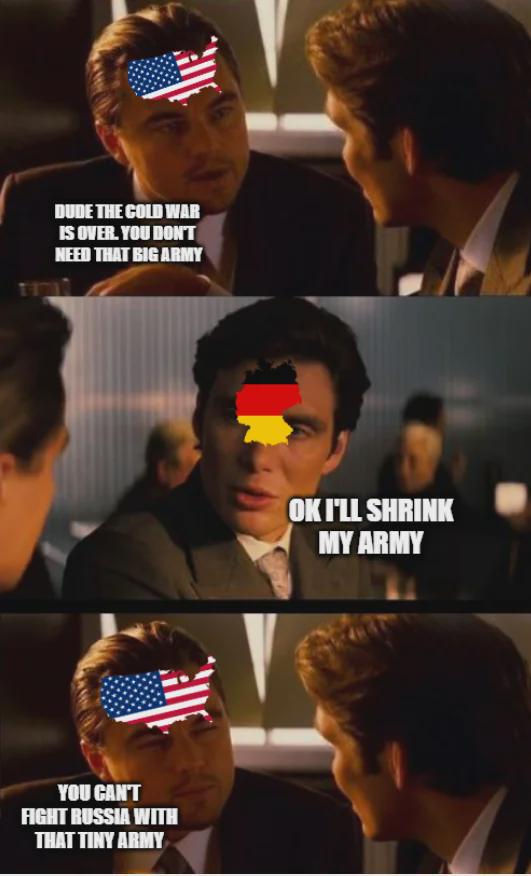
Germany didn’t shrink it’s army because it was told. It shrank because it couldn’t afford it.
Norse_By_North_West on
The US just wants nato nations to spend money on American equipment. They don’t care about the actual militaries.
Based on how Ukraine has gone, I don’t think the actual nato military leaders are all that worried about a Russia confrontation.
jaehaerys48 on
This happened big-time with Japan. The US was very enthusiastic to see a totally disarmed Japan following WWII. While the concept for Article 9 of the constitution (the one prohibiting maintaining war-making potential) may have been the idea of Prime Minister Shidehara, it was very readily accepted by the American occupation authorities, who basically were the ones responsible for the creation of the modern Japanese constitution (the Japanese originally tried getting away with one that was much more similar to the pre-existing constitution).
Fast forward a few years and the KMT is booted out of mainland China, the Soviets are detonating nukes, and then North Korea invades the South. Suddenly the US wants Japan to have a big army, ASAP. The predecessor to the Ground Self-Defense Forces – the euphemistically named “National Police Reserve*” – was set up to replace the American troops who were sent to Korea. It’s around 75,000 men originally but soon the Americans want it to become bigger and bigger. The US was pushing for 300,000+ whereas the Japanese were now the reluctant ones. There were even people in the US military who wanted Japan to contribute troops to the war in Korea – a terrible idea for reasons that don’t really have to be explained. MacArthur’s chief of intelligence – his “pet fascist” Charles Willoughby – wanted to just put a bunch of old IJA guys in charge of the new defense forces – another terrible idea!
Prime Minister Yoshida Shigeru wanted to focus on economic redevelopment, and thus basically followed a policy of expanding Japan’s military capabilities by the bare minimum necessary to keep the US happy. He even told the Americans that they simply did too good of a job of dissuading Japan from militarism for him to then go and make a big military. Only recently has public support for enlarging the SDF started to rise.
*The book *An Inoffensive Rearmament* by Colonel Frank Kowalski provides some good information and funny stories about the early days of the post-war Japanese defense forces. Like how the Japanese had to come up with new ways of referring to what was obviously military equipment and tactics. Kowalski was one of the Americans involved in organizing the National Police Reserve. Another good book is *Creating Japan’s Ground Self-Defense Force* by David Hunter-Chester – lots of information on the politics between the US and Japan.
Malvastor on
We’re talking about an almost 40 year stretch here.
In 1999 when the Soviet Union was recently collapsed, Russia was seemingly friendly (and also incredibly broke), and Germany needed money to integrate East Germany, military downsizing probably made a lot of sense.
In 2009 when Russia was beginning to reassert itself and had just waged a war against Georgia, military downsizing made a lot less sense.
By 2019 when Russia was growing increasingly hostile, had annexed a large part of Ukraine and was running an unlabeled war there, was making a habit of sending assassins to whack people it didn’t like on European turf, etc, a continued policy of minimal armament and maximal business integration with Russia starts to look suicidally insane.

7 Comments
100% true but I do want to point out that it was different people making those deals.
A major factor was that Germany needed to invest a LOT of money into east Germany and they cutting the military was the only way to do it.
That’s literally the opposite of what happened after Clinton. [The US had been begging them to spend more on defense for decades and has been said out loud since at least 2000.](https://www.theguardian.com/world/2000/jun/07/uselections2000.usa)
>Both former presidents George W. Bush and Barack Obama regularly expressed frustration with NATO member governments for not spending more of their domestic budgets on defense.
>In 2006, then-president Bush used a NATO summit in Latvia to [pressure allies](http://www.foxnews.com/story/2006/11/27/bush-to-press-allies-for-more-defense-spending-at-nato-summit.html) to increase their defense spending at the height of the U.S.-led NATO military campaign in Afghanistan.
>Two years later, he used his final NATO summit to do the same thing. “At this summit, I will encourage our European partners to increase their defense investments to support both NATO and EU operations,” Bush said at the opening of the 2008 summit in Bucharest, Romania. “America believes if Europeans invest in their own defense, they will also be stronger and more capable when we deploy together,” he said.
>And despite the many differences between Bush’s foreign policy and that of Obama, his successor, one thing the two leaders agreed upon was the need for more defense spending from NATO allies.
>For Obama, the issue of NATO defense spending became especially important during his second term, when Russia’s arming of separatists in Ukraine and subsequent annexation of Crimea in 2014 stunned the West.
>“If we’ve got collective defense, it means that everybody’s got to chip in, and I have had some concerns about a diminished level of defense spending among some of our partners in NATO. Not all, but many,” Obama said at a press conference in Brussels in March 2014, less than a week after Russia declared that Crimea was now a Russian state.
[Trump is pushing NATO allies to spend more on defense. But so did Obama and Bush](https://www.cnbc.com/2018/07/11/obama-and-bush-also-pressed-nato-allies-to-spend-more-on-defense.html)
Germany didn’t shrink it’s army because it was told. It shrank because it couldn’t afford it.
The US just wants nato nations to spend money on American equipment. They don’t care about the actual militaries.
Based on how Ukraine has gone, I don’t think the actual nato military leaders are all that worried about a Russia confrontation.
This happened big-time with Japan. The US was very enthusiastic to see a totally disarmed Japan following WWII. While the concept for Article 9 of the constitution (the one prohibiting maintaining war-making potential) may have been the idea of Prime Minister Shidehara, it was very readily accepted by the American occupation authorities, who basically were the ones responsible for the creation of the modern Japanese constitution (the Japanese originally tried getting away with one that was much more similar to the pre-existing constitution).
Fast forward a few years and the KMT is booted out of mainland China, the Soviets are detonating nukes, and then North Korea invades the South. Suddenly the US wants Japan to have a big army, ASAP. The predecessor to the Ground Self-Defense Forces – the euphemistically named “National Police Reserve*” – was set up to replace the American troops who were sent to Korea. It’s around 75,000 men originally but soon the Americans want it to become bigger and bigger. The US was pushing for 300,000+ whereas the Japanese were now the reluctant ones. There were even people in the US military who wanted Japan to contribute troops to the war in Korea – a terrible idea for reasons that don’t really have to be explained. MacArthur’s chief of intelligence – his “pet fascist” Charles Willoughby – wanted to just put a bunch of old IJA guys in charge of the new defense forces – another terrible idea!
Prime Minister Yoshida Shigeru wanted to focus on economic redevelopment, and thus basically followed a policy of expanding Japan’s military capabilities by the bare minimum necessary to keep the US happy. He even told the Americans that they simply did too good of a job of dissuading Japan from militarism for him to then go and make a big military. Only recently has public support for enlarging the SDF started to rise.
*The book *An Inoffensive Rearmament* by Colonel Frank Kowalski provides some good information and funny stories about the early days of the post-war Japanese defense forces. Like how the Japanese had to come up with new ways of referring to what was obviously military equipment and tactics. Kowalski was one of the Americans involved in organizing the National Police Reserve. Another good book is *Creating Japan’s Ground Self-Defense Force* by David Hunter-Chester – lots of information on the politics between the US and Japan.
We’re talking about an almost 40 year stretch here.
In 1999 when the Soviet Union was recently collapsed, Russia was seemingly friendly (and also incredibly broke), and Germany needed money to integrate East Germany, military downsizing probably made a lot of sense.
In 2009 when Russia was beginning to reassert itself and had just waged a war against Georgia, military downsizing made a lot less sense.
By 2019 when Russia was growing increasingly hostile, had annexed a large part of Ukraine and was running an unlabeled war there, was making a habit of sending assassins to whack people it didn’t like on European turf, etc, a continued policy of minimal armament and maximal business integration with Russia starts to look suicidally insane.