
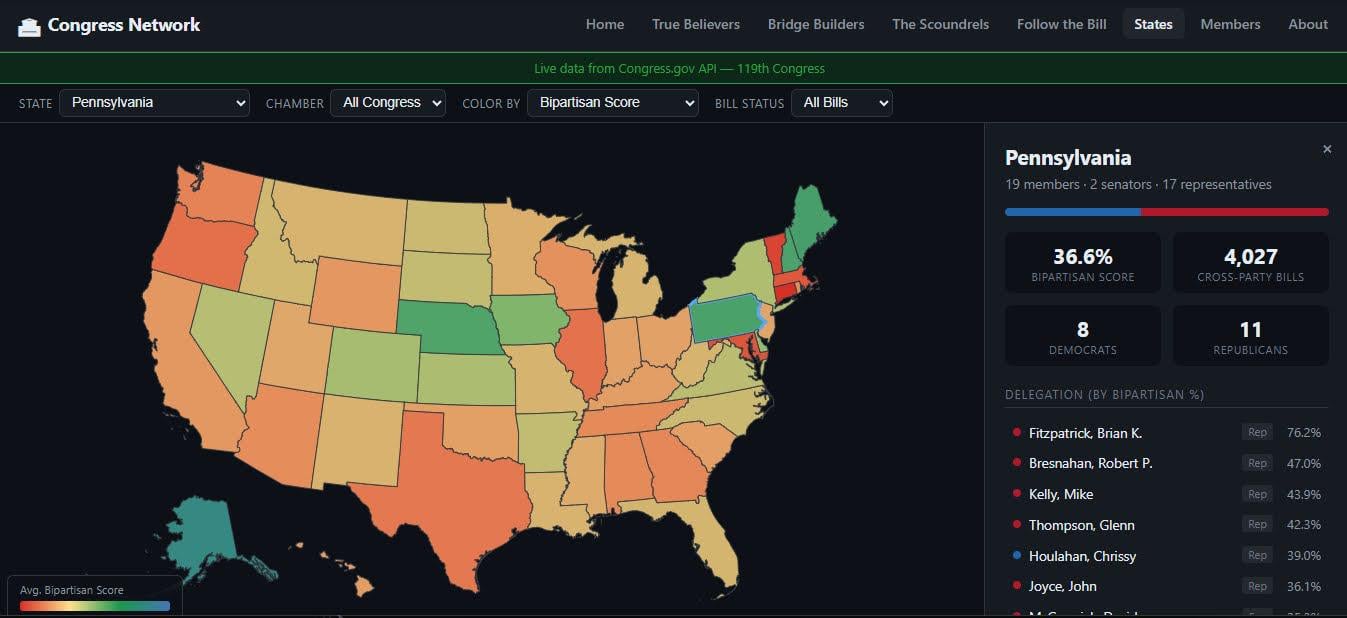
Was curious whether the bipartisanship story in Congress was as bleak as it seems, so I pulled every bill cosponsorship from the Congress.gov API and built this.
Turns out there's more going on than you'd expect. Brian Fitzpatrick (R-PA) cosponsors 76% of his bills with Democrats — more than with his own party. There are 18 members total who cross the aisle more often than they stay on their side. And there are 24 who are basically at zero.
You can explore by state, by policy topic, or look up any individual member. The "Follow the Bill" section ranks every policy area by how bipartisan it actually is.
https://congress.litigatech.com
Built with D3.js and the Congress.gov public API. All 119th Congress, updated live.
by Numerous-Impact-434
10 Comments
Built with D3.js and the Congress.gov public API. All 119th Congress, updated live.
It’s easy to cosponsor bills that have no chance of passing a chamber vote though. It’s one of the easiest ways politicians can say “I work across the aisle” when a majority of these cosponsored bills aren’t ever going to get through
And senators like Fetterman (D-PA) are effectively republicans in hiding, at least based on his track record since his brain injury. And the Democrats have more of these not-really-liberal representatives than conservatives seem to have. So those may account for the congresspeople who work across the aisle more than with their own party. They’re not compromising- they’re just fake party members.
What’s so great about working across the aisle?
What’s the benefit of working across the aisle? Do the ones who do it her their bills passed more often?
Surprised my state (CT) is the least bipartisan. (Based on this map), especially considering that my rep (Courtney) is known for being a bipartisan.
Was this, by any chance, made with Claude? Vibe coded an applicaiton recently, and the feature layout and aesthetic look remarkably similar.
This is a super cool tool.
Thank you so much for making it! I’ve bookmarked it. I love that it’s go drill-able data where you can not only dig into networks, but link to the actual substance of what’s been proposed.
I’ve been looking for something like this, thanks for sharing. I’ve been interested in tracking bipartisan efforts in Congress and this tool could be really useful for that. I’d love to see some analysis on the most collaborative lawmakers and what issues they’re working together on.
All the comments questioning the value of the information are missing the point. Maybe it is useless data, maybe it’s the key to unifying the country. Either way it’s well laid out, interesting and relevant. What you take away from it is up to you, not everything needs to be unambiguous. This is dataisbeautiful, not conclusionisbeautiful
Nebraska is probably because 1 of their 5 congresspeople (Don Bacon) is a moderate Republican and one of very very few republicans remaining in a district that Kamala won
Then also Nebraska is surprisingly liberal in some areas? It has a $15 an hour minimum wage