
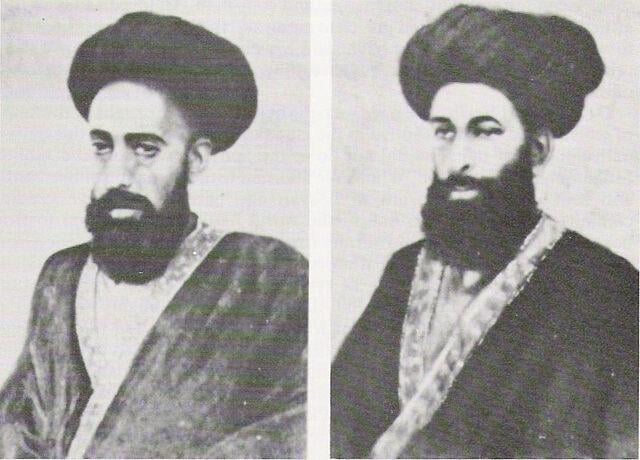
Edit: executed because of Baha’i belief
Left: Mírzá Muḥammad-Ḥasan (Sultánu’sh-Shuhadá, “King of Martyrs”)
Right: Mírzá Muḥammad-Ḥusayn (Mahbúbu’sh-Shuhadá, “Beloved of Martyrs”)
These are later archival reproductions of original portraits likely taken in the 1870s, before the brothers’ execution. The two were among the most prominent merchants in Isfahan, possessing significant wealth and wide commercial reach within the bazaar networks that shaped Qajar Iran’s economy. Both contemporary and historical accounts describe them as highly trusted industry figures in Iran’s mercantile economy, mainly know for their honesty, reliability, and strong standing among both merchants and local elites.
They were imprisoned, pressured to recant, stripped of their property, and ultimately executed by beheading after refusing to renounce their Baha’i Faith. Their arrest and execution used religion as a cover for debt, greed, and the systemic corruption of clerical power in Qajar Persia. At the center of it was Imam-Jum‘ih Mírzá Muḥammad-Báqir, who owed the brothers a substantial sum and is widely described in historical accounts as turning accusations of heresy into a tool to have them eliminated and their wealth absorbed.
It was common at the time to weaponize religious authority to settle financial disputes or remove those who stood in the way. What makes this case especially stark is that the brothers were not marginal figures, they were among the most established and respected merchants in Isfahan and greater Iran, and even that offered no protection.
The brothers’ info
Sources: Edward G. Browne, Materials for the Study of the Bábí Religion (Cambridge University Press, 1918)
Moojan Momen, The Bábí and Bahá’í Religions, 1844–1944: Some Contemporary Western Accounts (George Ronald, 1981)
Mangol Bayat, Mysticism and Dissent: Socioreligious Thought in Qajar Iran (Syracuse University Press, 1982)
Willem Floor, Studies on the Economy of Qajar Iran (Mage Publishers)
by Golegoldoone
3 Comments
The man [responsible](https://upload.wikimedia.org/wikipedia/commons/thumb/4/41/Shaykhmuhammadbaqir.jpg/250px-Shaykhmuhammadbaqir.jpg).
Were they Baha’i? You haven’t made it very clear what faith they were refusing to recant.
He looks like Jeeves from men in black mixed with Jabba the Hutt