
Hello again, everyone!
Yours truly is here once again, this time with a guest contribution by one of our interns, Alexia, who is hard at work cataloguing Greek coins and who aspires to work in the trade!
So, here goes:
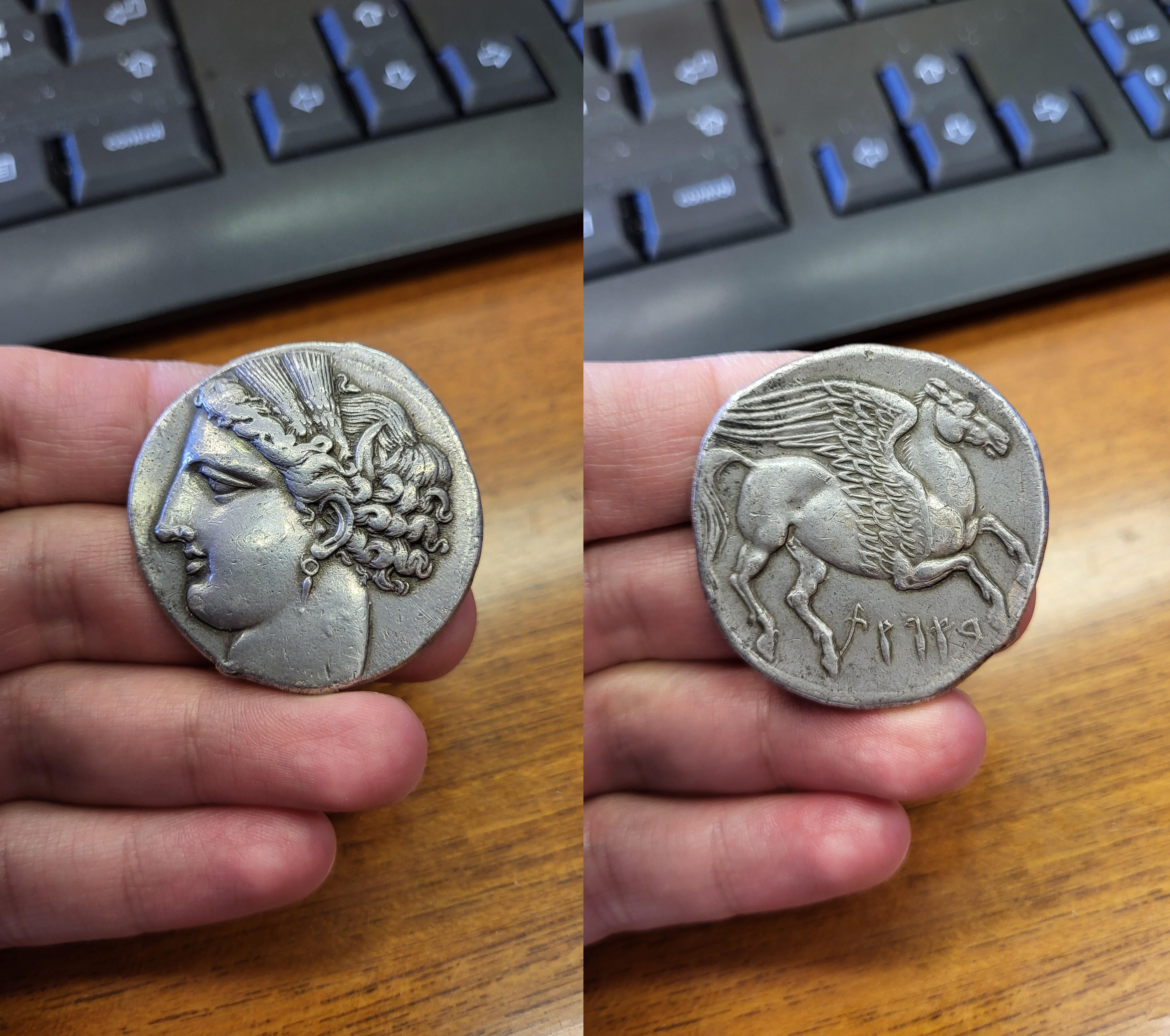
"Today, we’ll look at an exceptional example of wartime coinage This beautiful silver decadrachm was issued circa 264-260 BC, during the early phase of the First Punic War (264-241 BC), by Carthage on Sicily. It is one of the largest and heaviest coins struck in ancient times depicting Pegasus (40 mm, 37.58 g). The exact location of the mint remains uncertain, but it was most likely the Punic stronghold of Panormos on Sicily’s northern coast.
In the 5th century BC, the Punic empire became an important maritime power and trading centre in the Mediterranean, with the city of Carthage as the capital. Between 500 and 264 BC, Carthage dominated the Mediterranean, while Rome was beginning its regional expansion. Early relations between Carthage and Rome were friendly: Carthage had free rein in the Western Mediterranean, while Rome was granted immunity for a possible conflict, allowing centuries of peaceful coexistence. By the 3rd century BC, Rome developed growing interest in Magna Graecia, inevitably leading to the First Punic War, the first of three violent wars between Rome and Carthage.
The war began in 264 BC, when Mamertine mercenaries in Messana sought help from both Carthage and Rome against Hieron II of Syracuse (270-216 BC). Carthage acted first, forcing Syracuse to withdraw and establishing a Punic presence in Messana. But Rome soon intervened, supporting the Mamertines and expelling Carthage. In 262 BC, Carthage invaded Sicily, securing control over the whole island. To pay their largely mercenary army troops, good coin was required. Rome tried to challenge the Punic dominance in 260 BC but failed to take the island. In the mid 250s BC, the war extended to North Africa with Roman forces occupying Tunis, but their campaign ended disastrously with the annihilation of their army (not in the least due to the use of elephants by Carthage). The war continued on both on land and sea until 241 BC, when a Roman fleet of about 200 warships gained control of Sicily, ending the Punic presence there. A year later the war officially ended with Carthage’s surrender. As a result, Rome annexed Sicily, Corsica and the Lipari islands and received a compensation of 3200 talents over the following decade. However, Carthage still kept their sovereignty, for now, at least.
This coin was struck circa 264-260 BC and was issued following the Punic weight standard, equivalent to a silver five-shekel piece. The observe of the coin shows a beautiful head of Tanit, the most important goddess in the Punic religion and consort to the upper-deity, Baal Hammon. She was associated with the heavens and fertility and worshipped alongside Baal Harmon. In iconography, she is often accompanied by symbols of fertility and horses. The reverse illustrates one of the most well-known mythical creatures, the Pegasus. The reverse may have been inspired by the iconography of a stater issued by Agathocles, king of Syracuse (317-289 BC), or by coins from Corinth and its colonies. In Greek mythology, the winged horse symbolized peace and his flight was believed to be an allegory of the immortality of the human soul. Pegasus is still visible as a constellation in the night sky. In modern times, he appears in poetry, popular culture (in the Disney movie Hercules) and as a widely recognized corporate logo. On the reverse we can read the Punic inscription ‘B’RST’, meaning ‘in the land’ or ‘in the territories’, perhaps referring to Sicily.
Why was this coin important during the First Punic War? And how does iconography relate to the Punic presence in Sicily? The silver decadrachm illustrates Carthage’s efforts to assert authority and establish control over the island, both by connecting with and influencing the Greek city-states. In doing so, Carthage opposed and challenged Roman authority in Sicily. The coin combines Punic and Greek elements. The obverse features Tanit, a clear imposition of Punic tradition in Sicily. The reverse shows Pegasus, which shows Greek influence from cities like Syracuse and Corinth. The Punic tradition of depicting horses is adapted here to include a Greek mythical element. The inscription, ‘B’RST’, may have reinforced Carthage’s claim as the rightful occupant of Sicily. By blending Punic and Greek iconographic elements, the coin serves multiple purposes: It reinforced Carthage’s presence and traditions, while creating a sense of familiarity for the Greek city-states. The decadrachm demonstrates how coins were not just currency, but also tools of cultural integration and propaganda."
Hope you all have a great weekend!
by KBRCoinCabinet