* Supply chain mapping and product classification: Veridion supply chain intelligence platform (1M+ products queried, billions of company metadata data points analysed)
* Energy transit volumes: International Energy Agency (IEA) — open summary data
* Aluminium production & mineral trade: U.S. Geological Survey (USGS) Mineral Commodity Summaries, International Aluminium Institute
* Textile fibre production: Textile Exchange Materials Market Report 2025 (free download)
* Automotive plastics data: Plastics Europe — “Plastics — the Facts” annual report
* Pharmaceutical supply chain: WHO Essential Medicines List, U.S. Pharmacopeia Medicine Supply Map
* Gulf fertilizer exports & Hormuz transit share: IEA, CNBC reporting on Kpler data
**Methodology:**
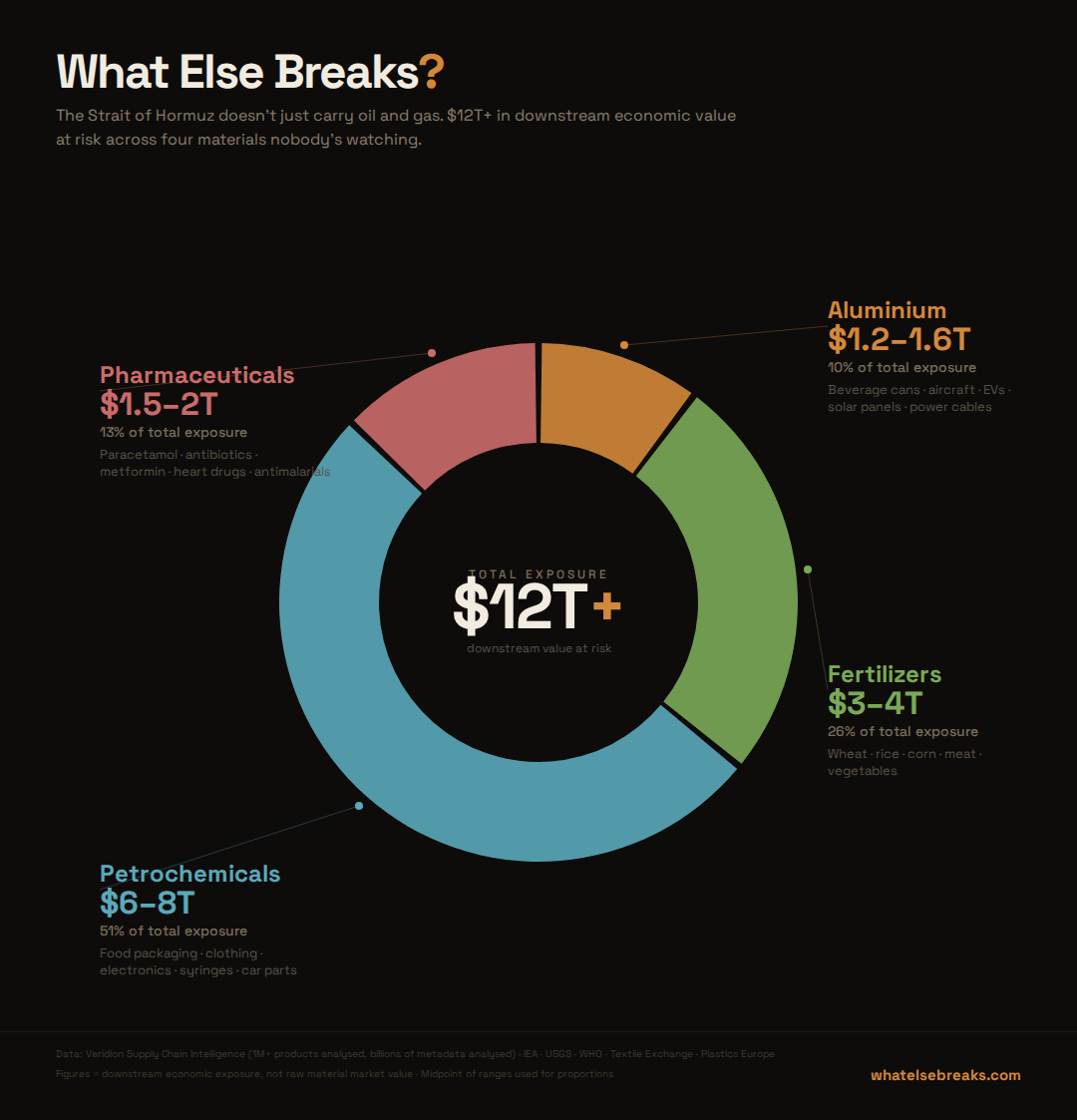
When the Hormuz crisis hit, everyone focused on oil. I queried Veridion’s product and company universe to identify non-energy supply chains with material exposure to Strait of Hormuz transit, then traced each material downstream to end products and estimated the economic exposure at each stage using the institutional sources above. The $12T+ figure is the combined downstream economic value at risk across all four materials, not the raw material market size.
**Tools:**
HTML/CSS/JS for the visualization. Map image is a stylised rendering of the Strait of Hormuz.
I also built a full interactive version that walks through each material’s supply chain step by step: [whatelsebreaks.com](https://whatelsebreaks.com)
Amphiitrion on
Sometimes simpler is better. All this AI slop just makes it extremely annoying and disgusting to see.
jh937hfiu3hrhv9 on
It would be interesting to include crude, LNG and such.
comnul on
The critical part here isn’t even the money lost.
Most Asian countries rely on fertilizers from the Gulf region to maintain their agriculture output, its physically impossible to diversify these imports.
If the strait remains closed, Asia is going to face an unprecedented hunger crisis.
InvisibleBlueUnicorn on
Looks like India is ahead of the game asking China for urea.
JMJimmy on
Canada is uniquely positioned to fill the gap on both aluminium & fertilizer. Unfortunately, for the US they have tariffs on Canadian aluminium.

6 Comments
**Sources:**
* Supply chain mapping and product classification: Veridion supply chain intelligence platform (1M+ products queried, billions of company metadata data points analysed)
* Energy transit volumes: International Energy Agency (IEA) — open summary data
* Aluminium production & mineral trade: U.S. Geological Survey (USGS) Mineral Commodity Summaries, International Aluminium Institute
* Textile fibre production: Textile Exchange Materials Market Report 2025 (free download)
* Automotive plastics data: Plastics Europe — “Plastics — the Facts” annual report
* Pharmaceutical supply chain: WHO Essential Medicines List, U.S. Pharmacopeia Medicine Supply Map
* Gulf fertilizer exports & Hormuz transit share: IEA, CNBC reporting on Kpler data
**Methodology:**
When the Hormuz crisis hit, everyone focused on oil. I queried Veridion’s product and company universe to identify non-energy supply chains with material exposure to Strait of Hormuz transit, then traced each material downstream to end products and estimated the economic exposure at each stage using the institutional sources above. The $12T+ figure is the combined downstream economic value at risk across all four materials, not the raw material market size.
**Tools:**
HTML/CSS/JS for the visualization. Map image is a stylised rendering of the Strait of Hormuz.
I also built a full interactive version that walks through each material’s supply chain step by step: [whatelsebreaks.com](https://whatelsebreaks.com)
Sometimes simpler is better. All this AI slop just makes it extremely annoying and disgusting to see.
It would be interesting to include crude, LNG and such.
The critical part here isn’t even the money lost.
Most Asian countries rely on fertilizers from the Gulf region to maintain their agriculture output, its physically impossible to diversify these imports.
If the strait remains closed, Asia is going to face an unprecedented hunger crisis.
Looks like India is ahead of the game asking China for urea.
Canada is uniquely positioned to fill the gap on both aluminium & fertilizer. Unfortunately, for the US they have tariffs on Canadian aluminium.