
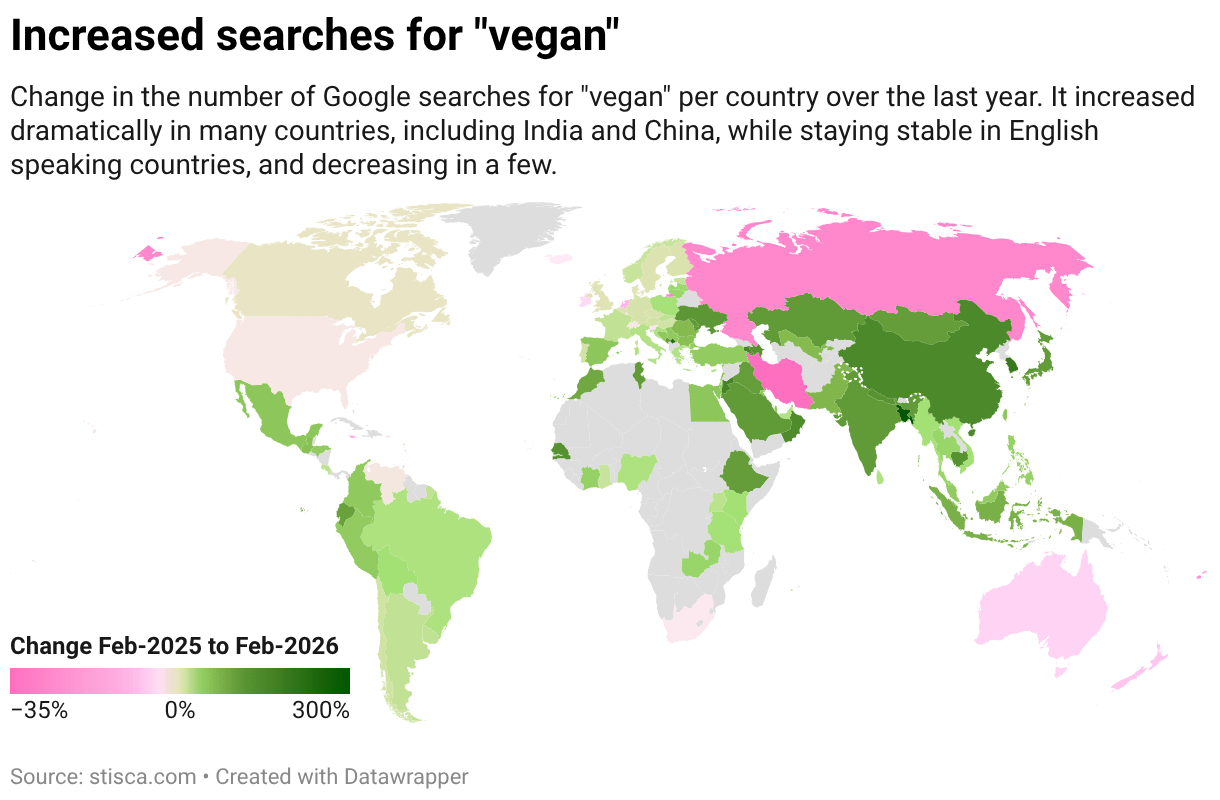
Data from Google Trends, retrieved via Python and SerpAPI.
Data visualisation using datawrapper.de
Full details and more: https://www.stisca.com/blog/veganpopularity/
by stan-k
Data from Google Trends, retrieved via Python and SerpAPI.
Data visualisation using datawrapper.de
Full details and more: https://www.stisca.com/blog/veganpopularity/
by stan-k
13 Comments
I think this is really only a shock to people that have no idea what the diet in parts of Asia is like.
I most certainly don’t think of North America or Europe when I think of hardcore vegans.
Data retrieved from Google Trends, using Python and SerpAPI.
Visualisation using datawrapper.de
Method, source code, analysis, and more data on https://www.stisca.com/blog/veganpopularity/
Considering that Google is banned in China, the increase is likely from 1 to 3 searches (the +200% in the map).
Jokes aside, the searches come from (Western) tourists, since they can use Google.
A vegan in China really has hard times (and in Asia in general, since they use fishsauce instead of salt in most dishes).
It is interesting, however, I also think Asian tourism is ever so rising with vegetarian travelers erring on the side of caution searching for ‘vegan’ instead of vegetarian in fear of some inconsistencies.
I for one am going vegetarian. Just doing my part. I have to admit I actually like soybean burgers, seven layer bean and rice burritos, vegi-tostadas, noodles and scrambled tofu, salads, fruits and nuts, pancakes and waffles. Perhaps I’m being too lax but I also allow eggs and dairy milk, butter and God bless cheese. I figured out if I had to kill an animal to eat its meat I wouldn’t do it so I had to switch. I will milk a cow or a goat and take an egg and I have.
Why would you search for “vegan” in India where most of population don’t eat meat?
chinese government is encouraging the population to consume less meat for health reasons, and pushing plant based products to meet climate goals and achieve food security. it’s a rational approach, they don’t try to turn vegan, it’s a side effect
search for: “Big Food Strategy”, “Dietary Guidelines for chinese residents”
Was this done with the English word “vegan” or the local equivalent?
Cause simply using the English word “vegan” will just show that English-speaking immigrants/expats/tourists just searched more when in that country.
Sorry, but the data about Brazil is wrong. Just checked on google trends. Same period. It´s stable.
Vegan is actually pretty common is Asia. its part of the general diet. Meat is mostly a side and milk products are used less in asian dishes.
This doesnt paint an accurate picture of who is vegan/ accessibility of plant-based alternatives.
I am a vegetarian, and my partner is Mexican, so we are living in Mexico for a year or two. Mexico is extremely difficult to live in as a vegetarian. Theres almost no plant based alternatives available. Restaurants rarely sell vegan options. In Canada however, almost every restaurant will have a vegan and vegetarian option, and every grocery store will have a ton of plant based options.
So while google searches might be higher in Mexico than Canada, the reality is different. Based on my experience that is.
I think it’s also a matter of language at times, the Dutch may use the word “vegan” less these days because “plantaardig” (plant-based, but more friendly, literally) covers the load and has less of the nuisance factor as a word in our language.
In the same year in Russia and Iran there was a spike of “cheap food” searches