
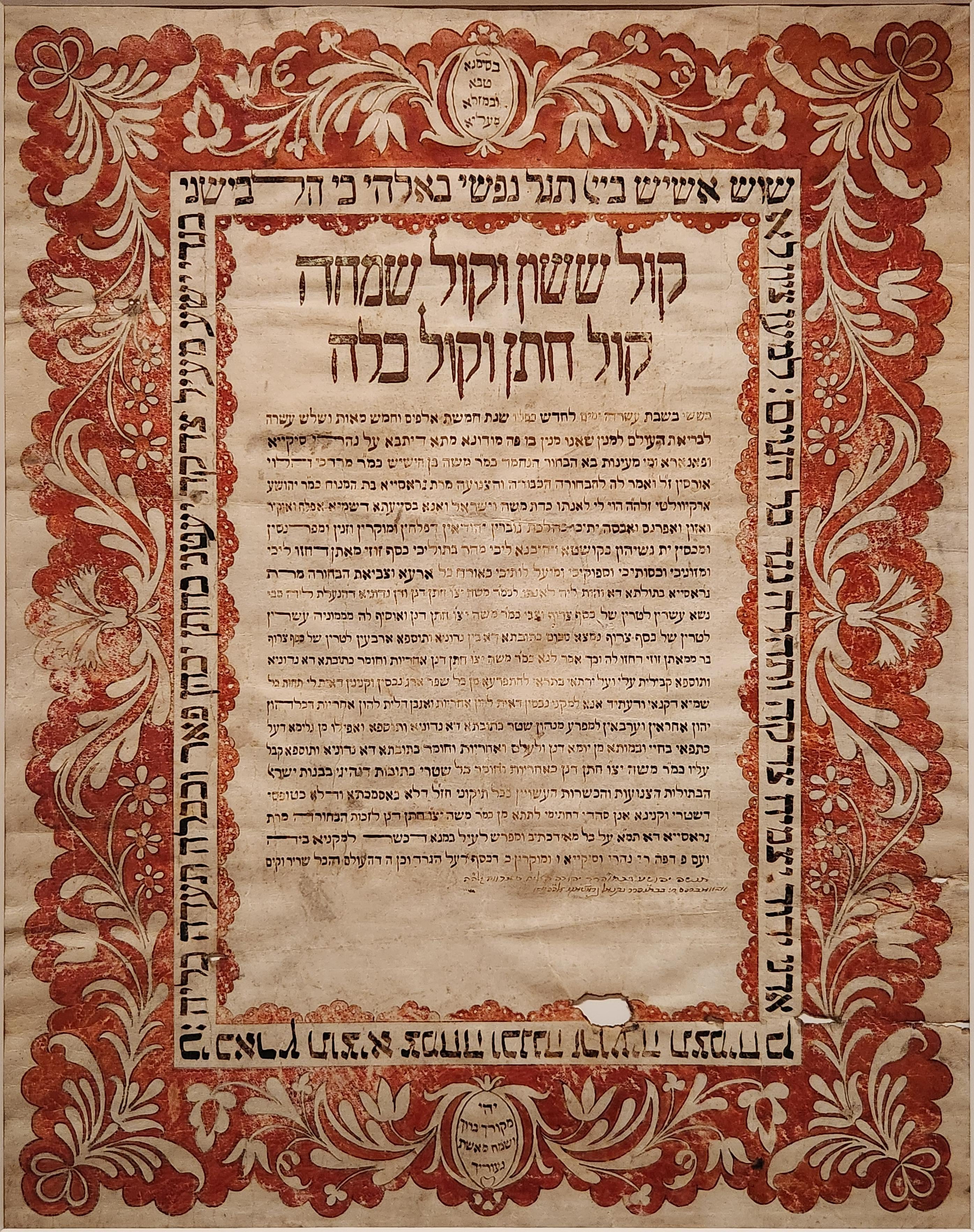
Ketubbah (Jewish wedding contract) for the marriage of Grazia Archivolti and Mosè Orsin, Modena, Italy, 1752. New York Public Library collection [2790×3530] [OC]
by oldspice75
Ketubbah (Jewish wedding contract) for the marriage of Grazia Archivolti and Mosè Orsin, Modena, Italy, 1752. New York Public Library collection [2790×3530] [OC]
by oldspice75
3 Comments
https://digitalcollections.nypl.org/items/b7fcfef0-c6b5-012f-83a6-3c075448cc4b
[display description](https://i.ibb.co/1fvCfGMx/20240702-160938-ed.jpg)
[Ketubbah
1752
Dorot Jewish Division
The ketubbah, the Jewish wedding contract, outlines the legal and financial responsibilities of a husband to his wife. Signed by witnesses, the document is typically hung prominently in a couple’s home, since Jewish law forbids a couple from cohabitating if their ketubbah is lost or destroyed. This particular contract between a bride named Grasya bat Yehoshua Arkivolti (Grazia Archivolti) and a groom, Mosheh ben Mordekhai ha-Levi Orsin (Mosè Orsin), was signed on Friday, 10 Kislev, 5513 (November 17, 1752) in the city of Modena, Italy. It included a dowry of 20 litrin (small coins) of pure silver, with a supplement of 20 litrin. The Renaissance floral design of this ketubbah does not carry any traditional Jewish iconography. Instead it features the traditional blessings and superscriptions at the top of the document, preceding its text: “Kol sason ve-kol simkhah, kol hatan ve-kol kalah” (“Voice of joy and voice of gladness, voice of groom and voice of bride”). The text of the ketubbah is framed by lettering featuring quotations from the Book of Isaiah 61:10-11 and 62:1 that glorify God, including one describing Him wrapping Isaiah “in a robe of victory, like a bridegroom adorned with a turban, like a bride bedecked with her finery.”]
Wedding contract since 1752… No trust, whatsoever, since…ever!
Kislev