
Between 1845 and 1852, the Great Famine devastated Ireland. Over one million people died from starvation and disease, and millions more fled the country.
By the mid-1840s, Ireland was impoverished and heavily overpopulated, locked into a rigid landlord-tenant system under British rule. Most rural families survived on small plots of land and depended almost entirely on a single crop: the potato. When the blight, Phytophthora infestans, struck and the harvest blackened in the ground, that fragile system collapsed almost overnight.
As hunger deepened, starvation became visible everywhere. Children were often the first to suffer, their limbs thin while their bellies swelled from malnutrition. The elderly weakened quickly, and even healthy adults found themselves exhausted by the simplest tasks. Disease soon followed. Typhus, cholera, and dysentery spread rapidly through weakened populations and overcrowded workhouses.
The British government’s response helped shape how the crisis unfolded. Officials largely adhered to laissez-faire economic ideas, believing markets should correct shortages with minimal government interference. Relief was pushed onto the Irish Poor Law system and its workhouses, which quickly became overcrowded and deadly. Some viewed the famine as an opportunity to restructure Irish agriculture. One senior administrator, Charles Trevelyan, privately wrote that the disappearance of small farmers might lead to a more “satisfactory settlement of the country.”
Relief also poured in from abroad. Irish communities overseas and wealthy donors raised large sums, and English Protestants outside Ireland donated more to famine relief than any other group abroad. Early international campaigns were organized by the Boston Repeal Association and the Catholic Church. U.S. President James K. Polkdonated $50 (about $1,700 today), while freshman congressman Abraham Lincoln contributed $10.
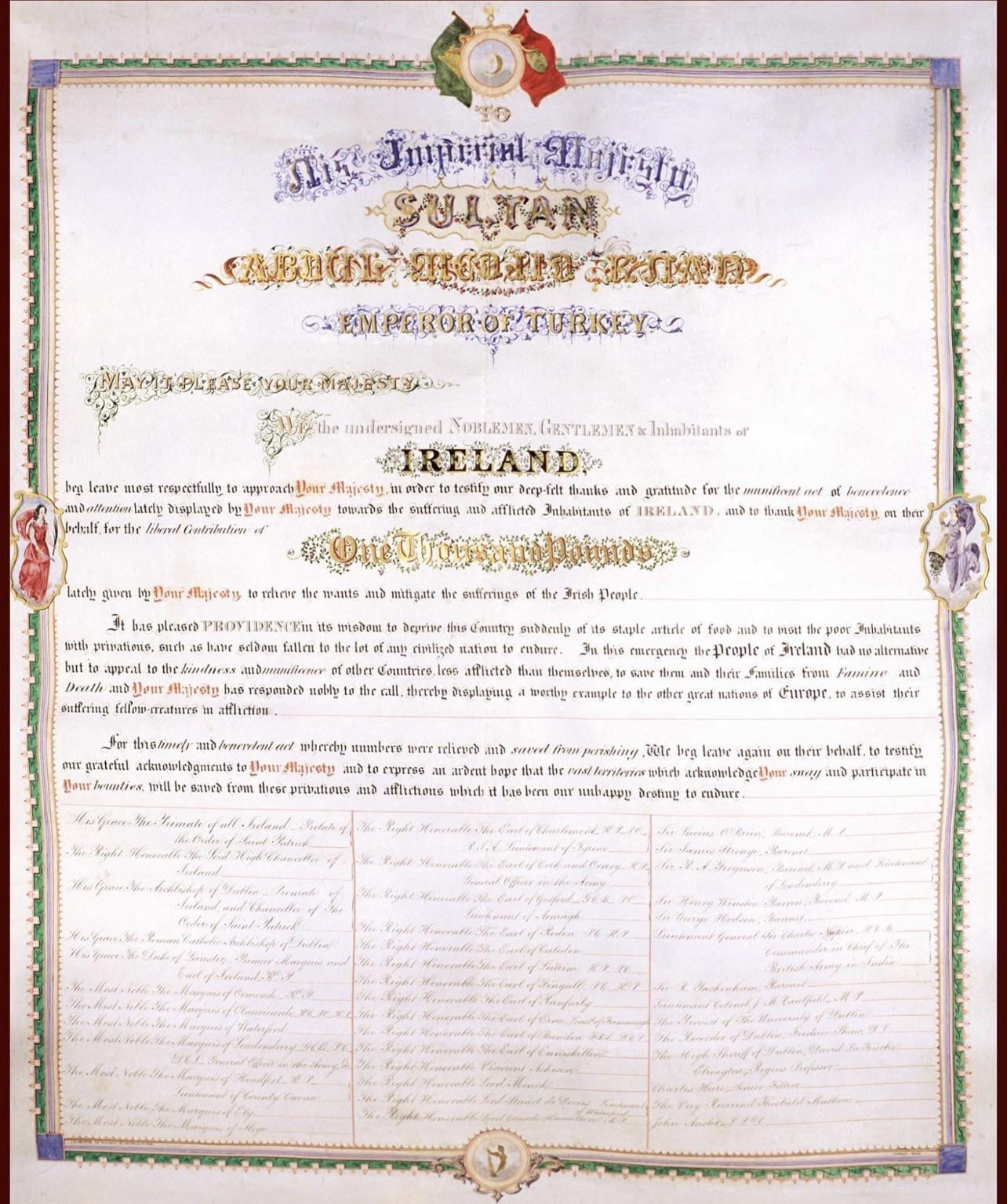
According to a popular story, the young Ottoman Sultan Abdülmecid I intended to donate £10,000 but was persuaded by British diplomats to reduce the amount to £1,000 so as not to exceed Queen Victoria’s contribution. While that part of the story may be apocryphal, the £1,000 donation itself was real.
By 1852, the worst of the famine had passed, but the consequences endured. Ireland’s population fell from over 8 million in 1841 to about 6.5 million in 1851, and it continued to decline for more than a century as emigration became a defining feature of Irish life.
The exact death toll is still debated, but historians generally estimate over one million people died from starvation and the diseases that accompanied it.
If you're interested, I wrote a longer piece on the famine here:
https://open.substack.com/pub/aid2000/p/hare-brained-history-volume-74-the?r=4mmzre&utm\_medium=ios
by aid2000iscool