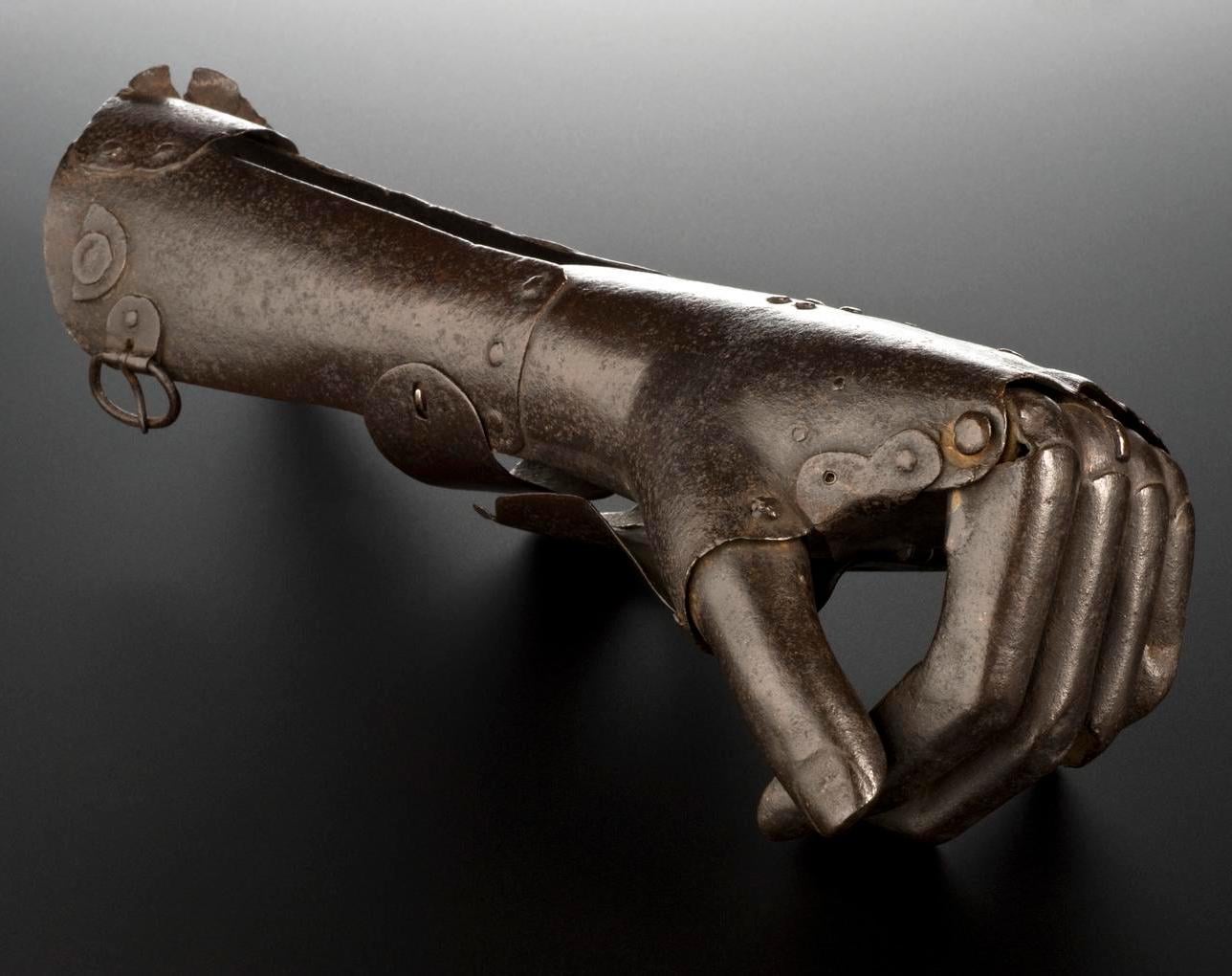
[Museum](https://collection.sciencemuseumgroup.org.uk/objects/co127206/artificial-left-hand-and-forearm-europe-1501-1600). This artificial hand dates from the 1500s. Most limbs were amputated in this era due to war injuries or accidents. It consists of a metal casing. This wrapped around the forearm stump and was secured by metal or leather straps. An internal mechanical structure (now missing) may have allowed the fingers basic movement. The fingers were created as a solid mass. However, they can flex at the largest knuckle joint.

3 Comments
[Museum](https://collection.sciencemuseumgroup.org.uk/objects/co127206/artificial-left-hand-and-forearm-europe-1501-1600). This artificial hand dates from the 1500s. Most limbs were amputated in this era due to war injuries or accidents. It consists of a metal casing. This wrapped around the forearm stump and was secured by metal or leather straps. An internal mechanical structure (now missing) may have allowed the fingers basic movement. The fingers were created as a solid mass. However, they can flex at the largest knuckle joint.
Groovy
A Victorian prosthetic for comparison https://www.reddit.com/r/ArtefactPorn/s/CdbhZK78xb.
And of course, the iron hand of Gottfried “Götz” von Berlichingen https://www.reddit.com/r/ArtefactPorn/s/9OqXnDMPrB.
A formal paper discussing the challenges of designing von B’s hand and how they are some of the same challenges faced in prosthetic design today: https://pmc.ncbi.nlm.nih.gov/articles/PMC7000084/