
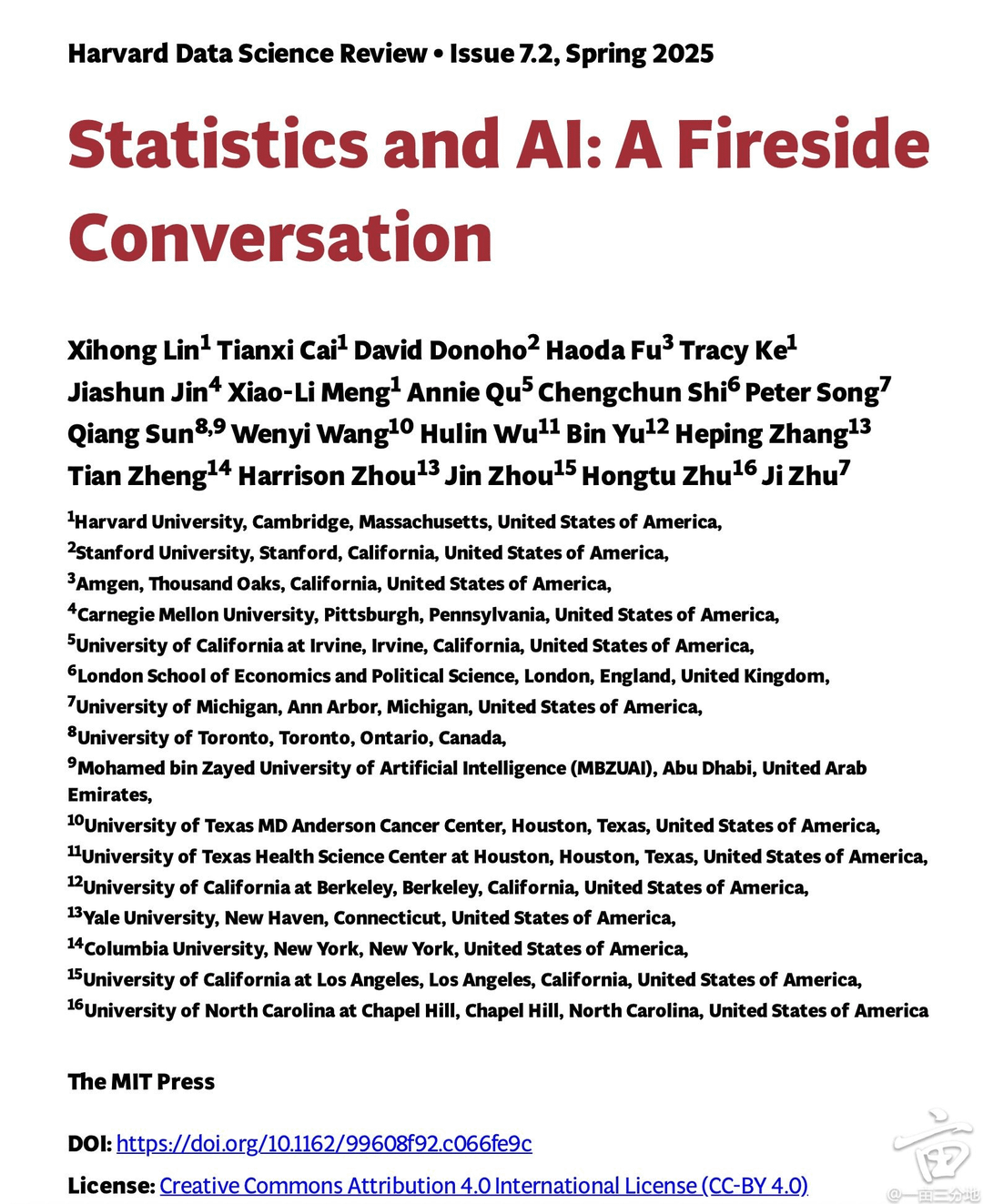
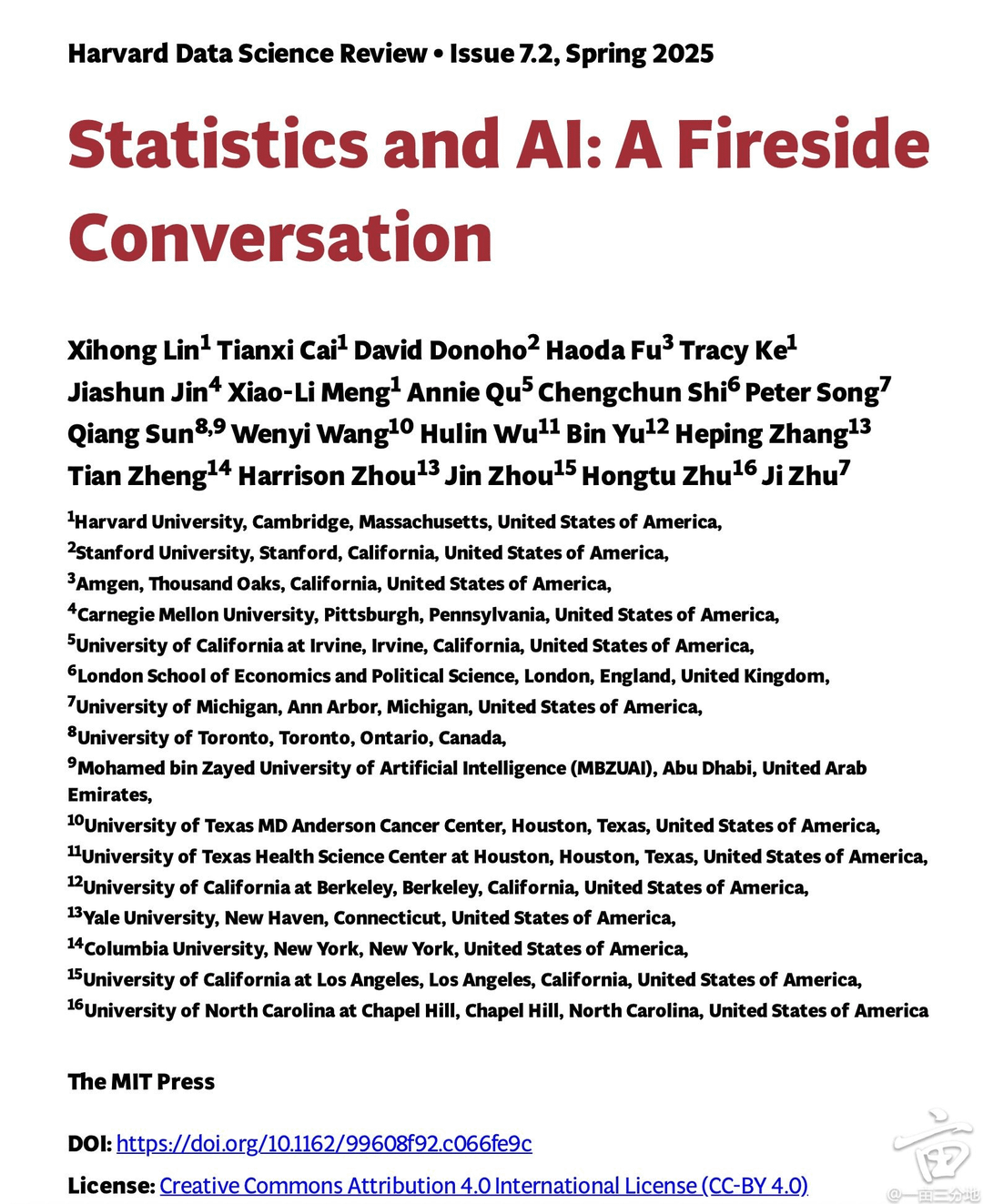
I recently came across a fantastic piece in the Harvard Data Science Review titled "Statistics and AI: A Fireside Conversation." It’s a massive, in-depth roundtable led by Harvard, featuring over 20 top statistical minds from institutions like Stanford, UC Berkeley, and MD Anderson, discussing the challenges and future of statistics in the AI era.
The whole discussion is packed with information, but my biggest takeaway is this: Statisticians are currently standing at a critical pivot point.
Simply put, the field of statistics is facing a few major existential challenges right now:
- Talent Drain: Students who traditionally would have studied statistics are now pivoting to "Data Science" or "AI." Recruiting for stats departments is getting harder, and the discipline's influence is shrinking.
- Theory is Lagging: The development of statistical theory simply cannot keep up with the explosive pace of AI—especially complex models like Deep Learning. Many statistical methods are still stuck in the "interpretable" phase, while industry application and practice are racing ahead.
- The "Paper Phase" Trap: A lot of statistical research never leaves the academic bubble. There’s a massive "last-mile" problem when it comes to translating new methodologies into real-world applications and actual products.
But looking at the flip side, the rapid development of AI actually provides the perfect opportunity for statistics to rebrand and reposition itself.
The Pivot: What Statisticians Need to Do Now
Many experts in the roundtable pointed out that folks in stats need to transition, and fast:
- Go Full-Stack: Stop just doing "modeling" or "hypothesis testing." We need to grow into Full-Stack Data Scientists who can manage the entire pipeline.
- Level Up Engineering Skills: Learn Git, write highly efficient code, understand GPU architecture, and actively contribute to open-source projects.
- Treat AI as a "New Data Source": More importantly, realize that AI itself is a novel data source. Statistics can play a huge role here: signal extraction, error analysis, and uncertainty quantification. We are the ones who can make AI robust, trustworthy, and safe.
Academia & Publishing
The panel had some sharp critiques regarding research publications. Stats journals are notoriously slow, have impossibly high barriers, and use convoluted processes. They’ve long been left in the dust by fast-paced ML conferences. Today, top ML conferences are the go-to venues for interdisciplinary submissions, while many stats journals are still gatekeeping with traditional standards and completely missing the rhythm of the AI era.
Their recommendations for academia include:
- Drastically shortening peer-review times and encouraging the rapid publication of short papers.
- Incentivizing real-world, data-driven research.
- Emphasizing data quality and reproducibility.
- Fully embracing AI topics to expand the field's influence.
Modernizing Education
The discussion also highlighted harsh realities in education. Traditional stats curricula are way too theoretical, fragmented, and completely fail to meet the modern student's need for "product sense," cross-disciplinary skills, and deployment capabilities. If stats departments don't proactively overhaul their courses, they will become increasingly marginalized.
Some schools are already taking action—for example, rebranding to "Data Science PhDs," integrating AI courses, and offering tracks in Deep Learning, Reinforcement Learning, and explainable modeling. The future of stats education should look more like "AI education with a statistical soul."
by nian2326076