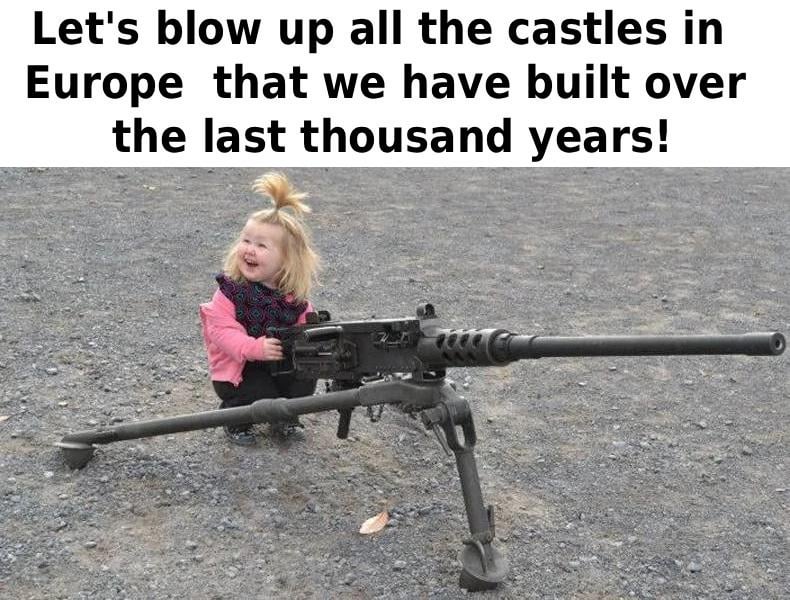
Why does that girl remind me of Isabelle from Animal Crossing?
Canofsad on
Sure beats the hell out of their other methods they used to breakdown castle walls.
Cryptkeeper_ofCanada on
Someone more well versed in post-Medieval eras please correct me if I am wrong, but I’m almost sure that castles only stopped being used by the start of World War I and/or II. They evolved to become star fortresses (five sided castles with thicker walls built at an angle) and until the heavy barrages of elevation artillery (howitzers, mortars), tanks, and bi-planes came into play, castles remained in use for a few centuries
Fredwood on
I really want to see that baby shoot the gun.
TheRogueWolf_YT on
I mean, it’s not like catapults and trebuchets were just gentle suggestions….
Knight_Castellan on
Medieval castles were still practical buildings, and in common use, during the early modern period. Although their historical significance was *somewhat* valued (archeology was in its infancy), they were still expected to perform their function as fortifications. This is in the same way that many medieval churches, pubs, and other buildings are still in use today.
The suggestion that castles shouldn’t be used for defence would have been absurd in the 16th and early 17th centuries. It was only after the mass adoption of sophisticated gunpowder artillery that the obsolescence of medieval fortresses was made obvious. From the late 1600s onwards, castles ceased to be used a defensive positions and became structures of cultural significance… or ruins.
This was also around the time when the medieval period ceased to be recent history and became a romanticised, distant past.
No_Explanation4912 on
M2HB spotted. Ejaculation in progress.
Malvastor on
I love ancient castles too but if it comes down to “blow up this castle or the Burgundians burn your women and rape your home”, pass me the dynamite.
DocB630 on
Children and guns are simply a bad idea. The average firearm is too unwieldy for a child to operate in a safe and effective manner.
Children are much better suited to crew served weapons. The semi-stationary characteristic of a heavy machine gun relies less on the child’s strength and stamina, and also builds teamwork.

10 Comments
Why does that girl remind me of Isabelle from Animal Crossing?
Sure beats the hell out of their other methods they used to breakdown castle walls.
Someone more well versed in post-Medieval eras please correct me if I am wrong, but I’m almost sure that castles only stopped being used by the start of World War I and/or II. They evolved to become star fortresses (five sided castles with thicker walls built at an angle) and until the heavy barrages of elevation artillery (howitzers, mortars), tanks, and bi-planes came into play, castles remained in use for a few centuries
I really want to see that baby shoot the gun.
I mean, it’s not like catapults and trebuchets were just gentle suggestions….
Medieval castles were still practical buildings, and in common use, during the early modern period. Although their historical significance was *somewhat* valued (archeology was in its infancy), they were still expected to perform their function as fortifications. This is in the same way that many medieval churches, pubs, and other buildings are still in use today.
The suggestion that castles shouldn’t be used for defence would have been absurd in the 16th and early 17th centuries. It was only after the mass adoption of sophisticated gunpowder artillery that the obsolescence of medieval fortresses was made obvious. From the late 1600s onwards, castles ceased to be used a defensive positions and became structures of cultural significance… or ruins.
This was also around the time when the medieval period ceased to be recent history and became a romanticised, distant past.
M2HB spotted. Ejaculation in progress.
I love ancient castles too but if it comes down to “blow up this castle or the Burgundians burn your women and rape your home”, pass me the dynamite.
Children and guns are simply a bad idea. The average firearm is too unwieldy for a child to operate in a safe and effective manner.
Children are much better suited to crew served weapons. The semi-stationary characteristic of a heavy machine gun relies less on the child’s strength and stamina, and also builds teamwork.
This post was brought to you by [Erich Ludendorff](https://www.reddit.com/r/Damnthatsinteresting/s/ldhA0nvW90)