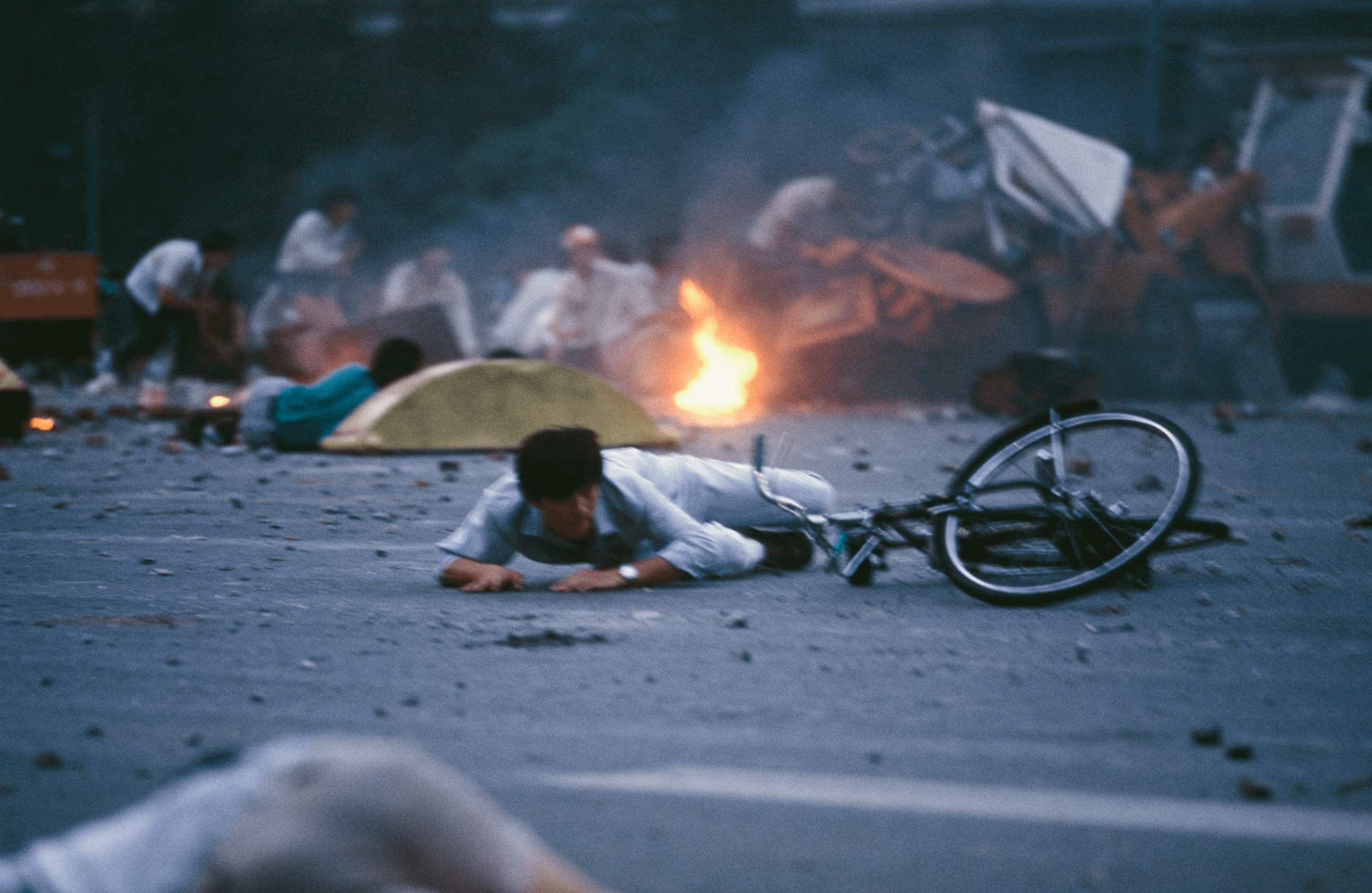
Chinese protestors dive and scatter for cover under gunfire, photographed during the Tiananmen Square Massacre which killed 700 to 2,600 civilians. The morning of June 4th, 1989. Beijing. [2626×1720]
Chinese protestors dive and scatter for cover under gunfire, photographed during the Tiananmen Square Massacre which killed 700 to 2,600 civilians. The morning of June 4th, 1989. Beijing. [2626×1720]
>The woman spoke first. “You soldiers, how can you do this?” she said. They didn’t answer.
>“Do you know where you are?” I asked. One of the soldiers, who looked very young, shook his head. “You don’t know you’re in Beijing?” I shouted in disbelief. “You are the People’s Liberation Army and you’re shooting your own people. We are against violence!”
>I was talking nonstop, desperately trying to get them to understand. The people around me were at a loss for words. The two young men held up the bloodstained shirt and cried, but no words came out their open mouths.
>“Talk to me! You heard what I said, say something!” I pleaded. “Tell the other soldiers they cannot shoot anymore.”
>An officer got up, took out his pistol, and pointed it at me. All of a sudden someone pulled me backward. Then a shot rang out, and everyone started screaming. I turned around to see the girl who had been standing next to me fall to the ground. Now her face was completely gone; there was nothing but a bloody hole.
>When I looked up, I saw a group of young men running and trying to jump over a fence across the avenue. Several soldiers leaped down from another personnel carrier and went after them. One of the young men fell as he tried to get over to safety, and crouched with his back against the fence and his hands clutching the rails.
>All at once, they fired shots at his head. His skull must have shattered, because pieces of his head went flying and splattered on the white fence. As his body slowly slid to the ground, a piece of his skull landed on top of the railing.
* From the memoir of student leader Shen Tong, one of the main figures in the Tiananmen Square Protests and a witness to the bloodshed of the ensuing Massacre
The Tiananmen Square Massacre was never inevitable (similar developments had ended bloodlessly in 1979), but it was not an accident. China’s soldiers followed orders. The leaders giving the orders were hardened and brutalized by decades of civil war, deadly Maoist politics, and a chaotic Cultural Revolution. They never would have tolerated anything akin to instability.
Iron_Cavalry on
This photo was taken on morning of June 4th on the Chang’an Highway, after armored columns of the Chinese military had torn a bloody path through Beijing’s main highways. The massacre followed a seven week protest movement composed of workers, students, and eventually Beijing locals demanding first economic reforms, then political reforms, then a repeal of the CCP’s martial law imposed in mid-May.
After a failed attempt to clear the strikes and occupation, PLA military formations returned with live ammunition, APCs and tanks, and were finally authorized to use deadly force. In eight hours, these armored columns ripped a path through Beijing’s suburbs, killing hundreds (and possibly thousands) of people in their way, mainly unaffiliated bystanders. By sunrise, between 700 and 2,600 people were dead or dying.
Jack-of-Hearts-7 on
And they still deny anything happened
catsrmurderers on
Wow, never saw this before. What a powerful photo.
thomasrat1 on
My highschool had roughly 10% of the kids from china.
And yeah if you brought up this massacre. Their eyes would get very big and they would repeat the parties stance.
bakerfaceman on
You ever watch the video of the tank man photo?
Moooowoooooo on
Good for him. Many people got hit by a bullet when watching TV at home near the conflict zone at that time.

7 Comments
>The woman spoke first. “You soldiers, how can you do this?” she said. They didn’t answer.
>“Do you know where you are?” I asked. One of the soldiers, who looked very young, shook his head. “You don’t know you’re in Beijing?” I shouted in disbelief. “You are the People’s Liberation Army and you’re shooting your own people. We are against violence!”
>I was talking nonstop, desperately trying to get them to understand. The people around me were at a loss for words. The two young men held up the bloodstained shirt and cried, but no words came out their open mouths.
>“Talk to me! You heard what I said, say something!” I pleaded. “Tell the other soldiers they cannot shoot anymore.”
>An officer got up, took out his pistol, and pointed it at me. All of a sudden someone pulled me backward. Then a shot rang out, and everyone started screaming. I turned around to see the girl who had been standing next to me fall to the ground. Now her face was completely gone; there was nothing but a bloody hole.
>When I looked up, I saw a group of young men running and trying to jump over a fence across the avenue. Several soldiers leaped down from another personnel carrier and went after them. One of the young men fell as he tried to get over to safety, and crouched with his back against the fence and his hands clutching the rails.
>All at once, they fired shots at his head. His skull must have shattered, because pieces of his head went flying and splattered on the white fence. As his body slowly slid to the ground, a piece of his skull landed on top of the railing.
* From the memoir of student leader Shen Tong, one of the main figures in the Tiananmen Square Protests and a witness to the bloodshed of the ensuing Massacre
The Tiananmen Square Massacre was never inevitable (similar developments had ended bloodlessly in 1979), but it was not an accident. China’s soldiers followed orders. The leaders giving the orders were hardened and brutalized by decades of civil war, deadly Maoist politics, and a chaotic Cultural Revolution. They never would have tolerated anything akin to instability.
This photo was taken on morning of June 4th on the Chang’an Highway, after armored columns of the Chinese military had torn a bloody path through Beijing’s main highways. The massacre followed a seven week protest movement composed of workers, students, and eventually Beijing locals demanding first economic reforms, then political reforms, then a repeal of the CCP’s martial law imposed in mid-May.
After a failed attempt to clear the strikes and occupation, PLA military formations returned with live ammunition, APCs and tanks, and were finally authorized to use deadly force. In eight hours, these armored columns ripped a path through Beijing’s suburbs, killing hundreds (and possibly thousands) of people in their way, mainly unaffiliated bystanders. By sunrise, between 700 and 2,600 people were dead or dying.
And they still deny anything happened
Wow, never saw this before. What a powerful photo.
My highschool had roughly 10% of the kids from china.
And yeah if you brought up this massacre. Their eyes would get very big and they would repeat the parties stance.
You ever watch the video of the tank man photo?
Good for him. Many people got hit by a bullet when watching TV at home near the conflict zone at that time.