
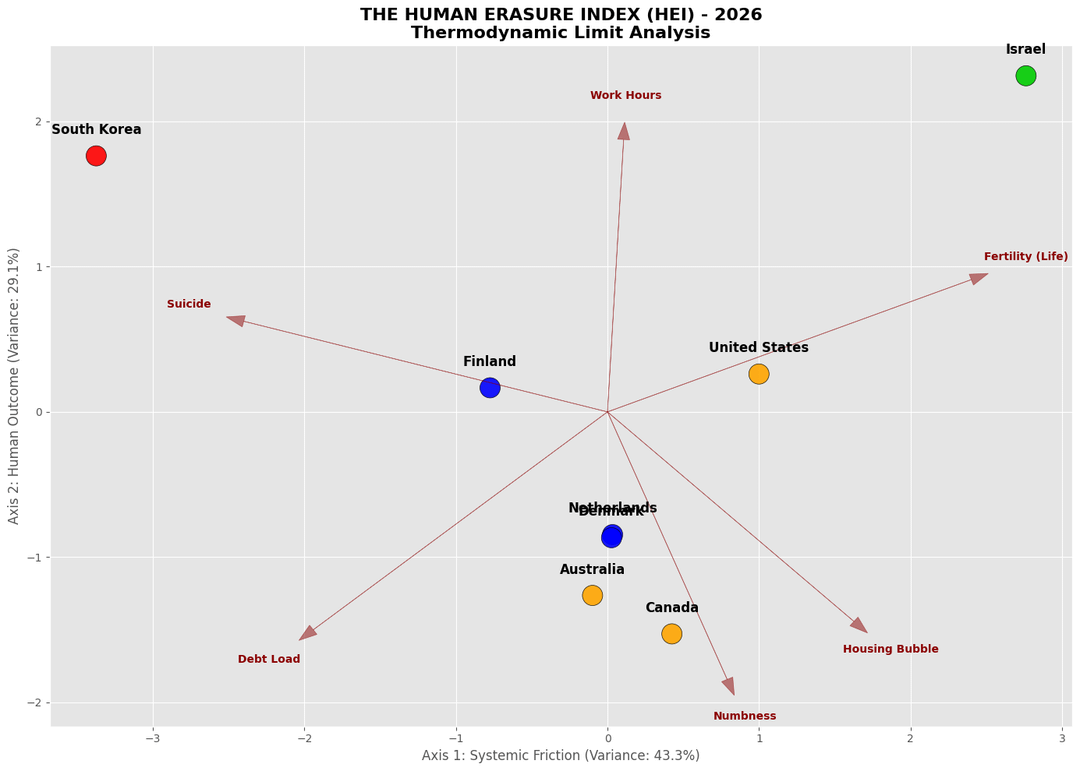
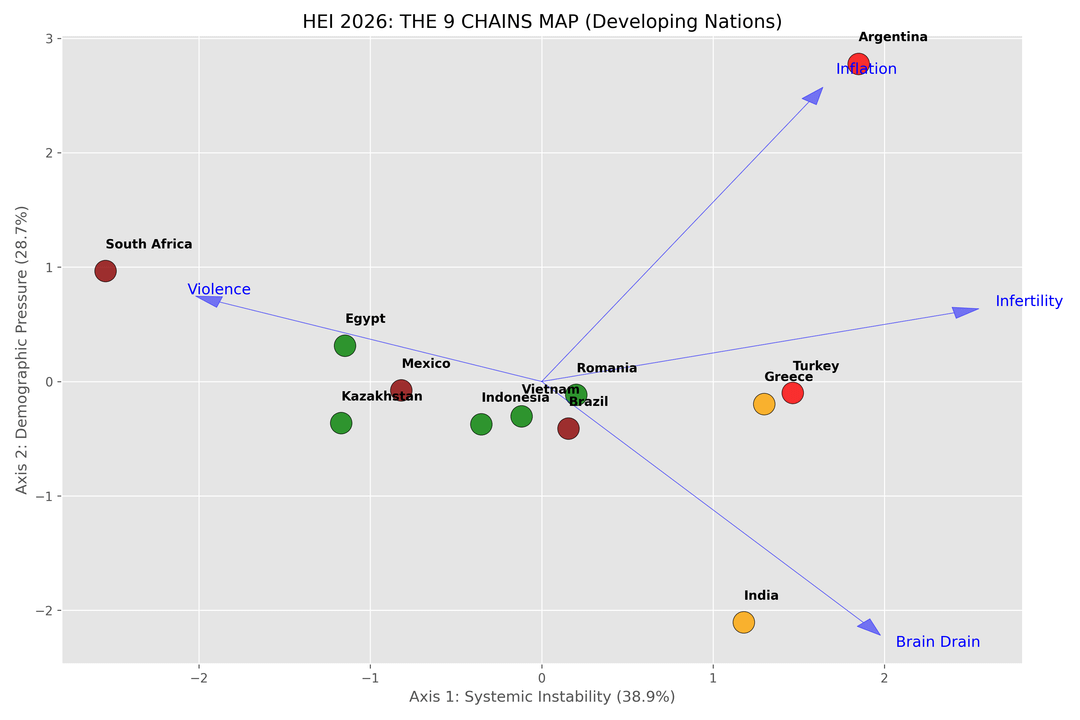
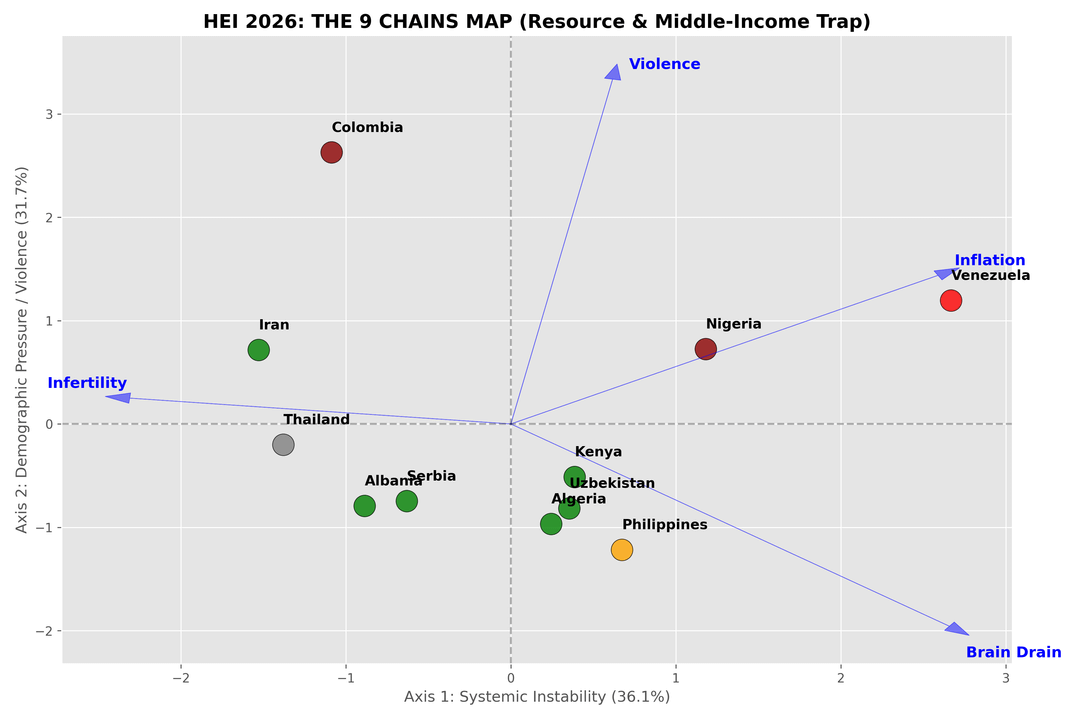
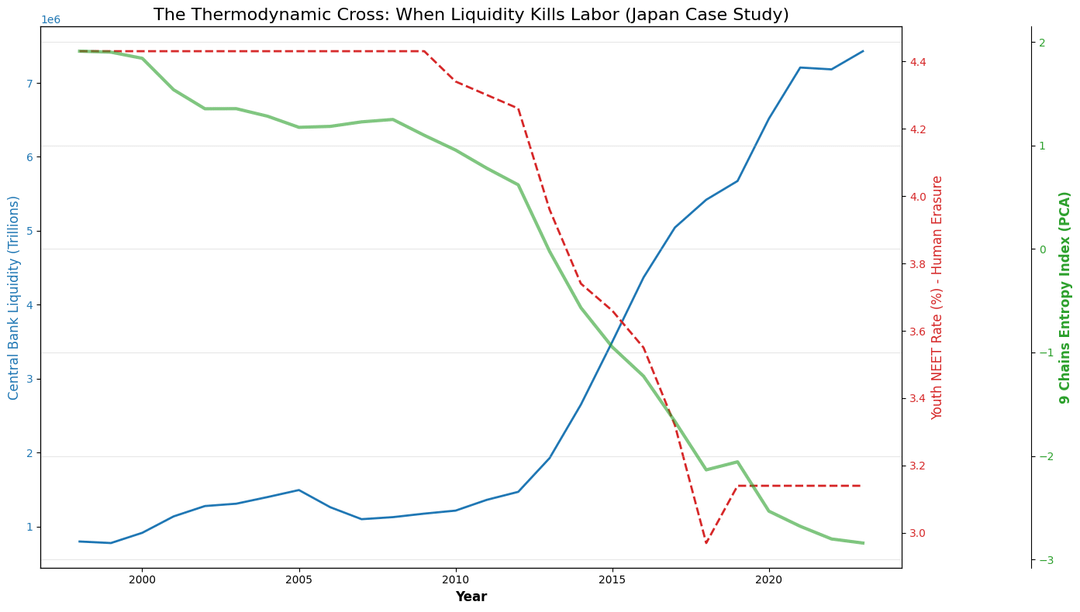
Classical indices like GDP or HDI measure the accumulated wealth of a system, but they ignore the "thermal friction" required to generate it. I wanted to map the biological and social cost of surviving in modern economies. To do this, I treated macroeconomic data not as finance, but as a thermodynamic system experiencing overheating. Methodology & Tools:
- Data Source: World Bank Open Data (2016–2024 window, using Latest Available Data method), OECD
- The Math (PCA): Because these metrics have completely different scales (e.g., 200% inflation vs. 1.5 fertility), I converted everything into Z-scores (
StandardScaler). Then, I ran a Principal Component Analysis (PCA) to find the orthogonal vectors of systemic stress. - The Index (HEI): The final "Burnout Score" for each country is the Euclidean distance from the center of homeostasis: d=sqrt (PC1^2+PC2^2.)
The Architecture of the HEI: Measuring Two Types of Collapse
The Human Erasure Index (HEI) does not use the same metrics for every country. A failing developed nation looks physically different from a failing developing nation due to the strength of their institutional "containers." Therefore, the PCA algorithm uses two different sets of thermodynamic sensors.
However, there is one metric common to both systems: The Fertility Rate. In thermodynamics, if the system cannot generate new charge (q→0), it is mathematically dead. Whether a country burns out from hyperinflation or from a 60-hour workweek, the biological result is identical: human erasure. Generation of new life is the ultimate, undeniable proof of systemic sustainability.
Here is how the sensors are distributed:
1. The Explosion Model (Developing Nations)
These countries generally have weaker institutional containers. When the macroeconomic circuit overheats, the pressure violently vents outward.
- Inflation: Financial Friction. The rapid devaluation of labor and savings.
- Homicide Rate: Kinetic Friction. The physical breakdown of the social contract and street-level entropy.
- Migration (Brain Drain Risk): Systemic Bleeding. Human capital physically escaping a localized overheating circuit.
- Fertility Rate: Biological Shutdown.
2. The Implosion Model (Developed Nations)
These countries have rigid, highly enforced institutions (e.g., Japan, South Korea). The systemic heat cannot escape into the streets, so it turns inward, crushing the individual.
- Housing Friction: Systemic Resistance (R). The infinite cost of basic shelter and asset inflation, which acts as a wall for the middle class.
- Work Hours: Labor Current (I). The extreme physical and mental voltage required just to maintain basic survival against housing friction.
- Suicide Rate: Internalized Kinetic Friction. Since the society prevents outward violence, the thermodynamic pressure destroys the biological node from the inside.
- Fertility Rate: Biological Shutdown. The ultimate "quiet quitting." The population freezes itself to Absolute Zero to avoid generating more heat.
Full disclosure: I am the architect of the thermodynamic hypothesis and the PCA model, but I used LLMs (Large Language Models) to do the "dirty work" — parsing the messy World Bank CSVs, handling NaN values, and optimizing the Python scripts.
HEI score for countries, link here https://docs.google.com/spreadsheets/d/1MenpVBYhL-wRvfr3coLNK6JN-KG6X_VCljt4rfJ33ig/edit?usp=sharing
by Alibek2309
2 Comments
[https://github.com/AlibekBekzhigitov/9_Chains/tree/main/01_Chains_Anatomy/C6_Brain_Drain](https://github.com/AlibekBekzhigitov/9_Chains/tree/main/01_Chains_Anatomy/C6_Brain_Drain)
This is fascinating, great work.