
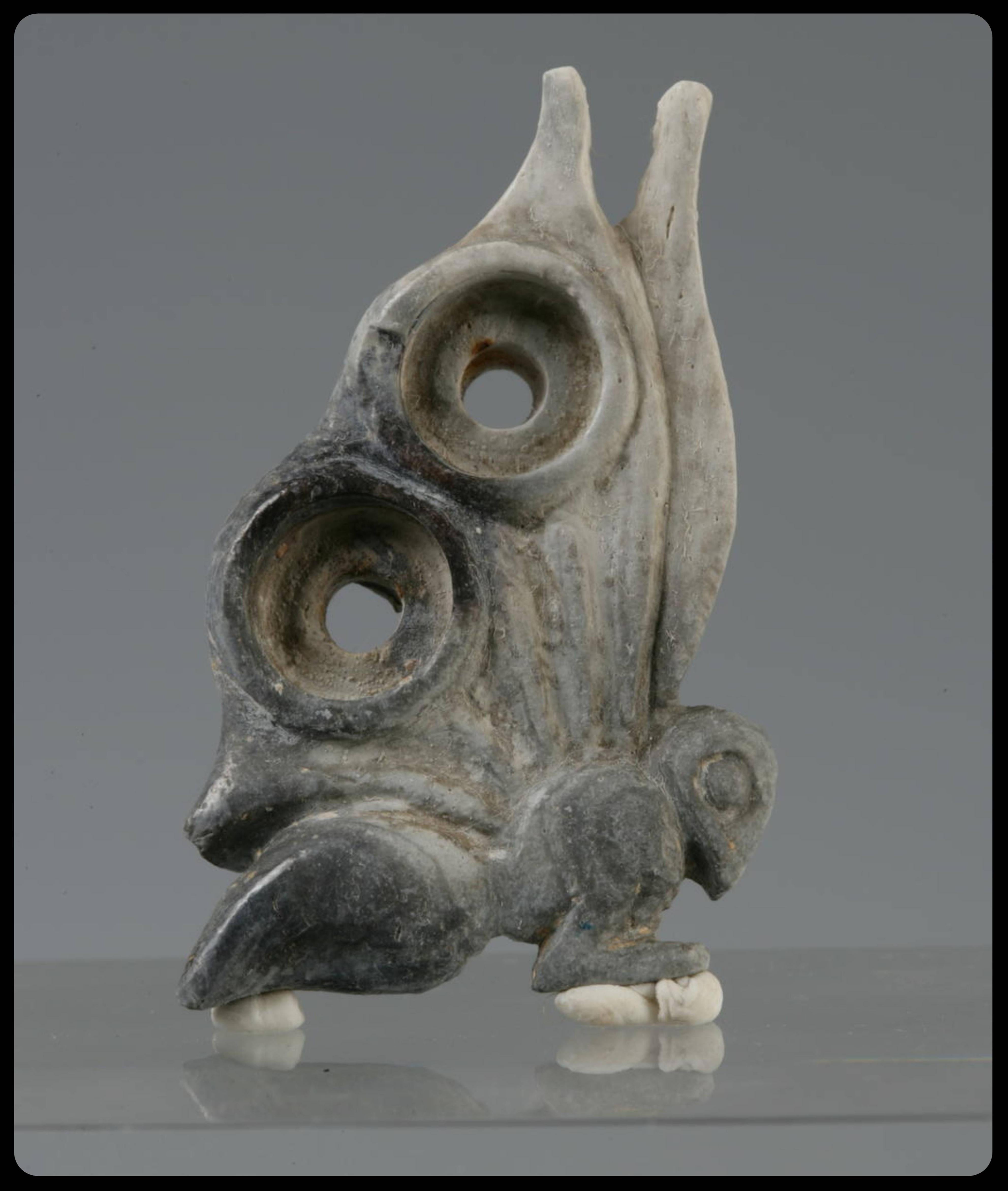
Ivory Moth or Butterfly from Crete, c.1500 BCE: the scorch marks on this figurine were acquired when the palace complex at Zakros was razed to the ground in 1450 BCE [3967×4688]
by SixteenSeveredHands
Ivory Moth or Butterfly from Crete, c.1500 BCE: the scorch marks on this figurine were acquired when the palace complex at Zakros was razed to the ground in 1450 BCE [3967×4688]
by SixteenSeveredHands
1 Comment
This artifact was unearthed from the “Treasury of the Shrine” at Zakros, which is a Bronze Age site located on the island of Crete. It was crafted by a Minoan artist at some point in roughly 1600-1450 BCE, and it depicts an unknown lepidopteran (i.e. moth or butterfly) with its wings held upright.
The gray discoloration was caused by the flames that engulfed the palace complex at Zakros in roughly 1450 BCE, when the site was destroyed. Most of the other major centers of the Minoan civilization (which were spread out across the island of Crete) were also destroyed during the same period; the exact cause of the destruction is still widely debated, but most experts attribute it to a catastrophic earthquake and/or invasion by the Mycenaean civilization of mainland Greece.
According to [this article:](https://whitelevy.fas.harvard.edu/publication-west-wing-minoan-palace-kato-zakros)
> The palace complex of Kato Zakros is one of the most important buildings in Minoan Crete. The site is located in the far-east part of Crete, in a coastal location of great strategic and economic importance.
> The “destruction horizon” recovered around the complex includes thousands of ceramic vessels, but also hundreds of artifacts of rare materials, many of which were imported from other regions in the Aegean and the Eastern Mediterranean, such as the Peloponnese, the Cyclades, the Dodecanese, Cyprus, Egypt and the Near East. The finds from the undisturbed “Treasury of the Shrine” in the West Wing of the complex includes more than a hundred ritual objects used in palatial ceremonies and is considered the most important assemblage of such items that has been hitherto unearthed in Minoan Crete.
Researchers believe that the peoples of ancient Crete and Mycenae used butterfly motifs as symbolic representions for the souls of the dead. Butterflies were (and still are) associated with concepts like transformation and rebirth.
#Sources & More Info:
– Harvard University: [Publication of the West Wing of the Minoan Palace of Kato Zakros](https://whitelevy.fas.harvard.edu/publication-west-wing-minoan-palace-kato-zakros)
– Illustrated Guide to the Herakleion Museum: [Ivory Butterfly](https://archive.org/details/herakleionmuseum0000jasa/page/78/mode/1up?q=%22butterfly%22)
– Zakros: The Discovery of a Lost Palace of Ancient Crete: [Page 145](https://archive.org/details/zakrosdiscoveryo0000plat/page/145/mode/1up?q=%22Butterfly+in+ivory%22) and [Page 148](https://archive.org/details/zakrosdiscoveryo0000plat/page/148/mode/1up?q=%22Ivory+Butterfly%2C+from+the+Treasury+of+the+Shrine%22)
– Minoan Civilization: [Minoan Religion](https://archive.org/details/AlexiouStylianosMinoanCivilization/page/n115/mode/1up?q=Butterfly)