I wonder if the Yuan had the same feeling about Mongols.
p_pio on
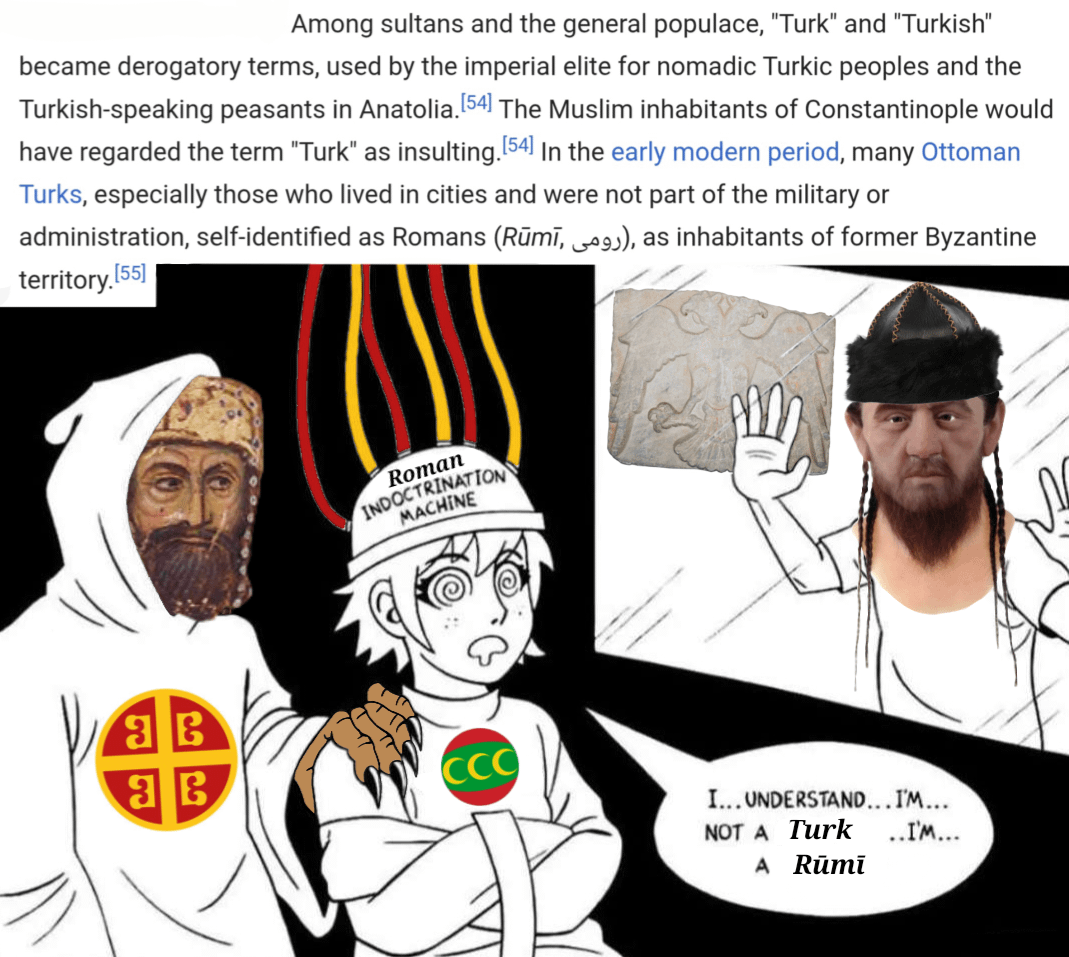
Greeks got indoctrinated into Romans got indoctrinated into Turks got indoctrinated into Romans got indoctrinated into Turks again.
Frickin priests use too much *wololo* in that area…
TheMidnightBear on
I think it was less prevalent than the memes would suggest.
MegaLemonCola on
I wonder why they eventually named their nation Turkey and not something derived from Rum.
Whole_Obligation_776 on
Rumi in this instance shouldn’t be understood as the state of Rome but the geography, The Roman Lands.
Ottoman Palace culture was based on a Farsi-Arabic cultural background. With farsi and arabic speakers getting held in high regard (By late 18th to early 19th century French would also getting added as the ‘Lingua Franca’ century knocks on Ottoman doors).
In this instance it shouldn’t be forgotten that this palace and surrounding elite had little reason of contact or transformation of the Ottoman population, so an identity building based on the public consent only arrived by the Ottomanist Era: An identity building approach to give more legitimacy of power on especially the Balkanite non-muslim populations, around Mahmut II’s era in late 1820s.
What is mentioned in the post is something else and the use of the term ‘Türk’ in a deragatory term. To the palace elite and huge segments of the population most likely under the influence of Ottoman clergy, Türk became a deragatory term for the ignorant, the un-educated and commoner. Although much of the army and state bureaucracy was still Turkish speakers, to get ahead in life it became a burden of the person to rid of their identity behind.
With Nationalism ideology finally arriving to Ottomans (And they had much reason to stop its development as much as possible) first effecting the European ethnicities under Ottoman domain, it still took an almost 50 to 60 years for Turkish speakers even starting entertaining the idea of being a Nation.
This is why much of early Turkish nationalism went through a renaissance era of its own, and started seeking clean breaks from the Ottoman traditions and identity. One of its ill results unfortunately became a complete rejection of all identities and heavy assimilation policies of early Turkish republic era. As the nation building process began, an encompassing national identity pushing education system got attached to the education reforms.
With just 5% of literacy rates at the start of the Turkish republic, this first in its history approach to reach the population found almost no resistance among many small communities that made up the population besides the Turkish speakers, only showing its first time failures to country’s second biggest identity, namely the Kurds.

5 Comments
I wonder if the Yuan had the same feeling about Mongols.
Greeks got indoctrinated into Romans got indoctrinated into Turks got indoctrinated into Romans got indoctrinated into Turks again.
Frickin priests use too much *wololo* in that area…
I think it was less prevalent than the memes would suggest.
I wonder why they eventually named their nation Turkey and not something derived from Rum.
Rumi in this instance shouldn’t be understood as the state of Rome but the geography, The Roman Lands.
Ottoman Palace culture was based on a Farsi-Arabic cultural background. With farsi and arabic speakers getting held in high regard (By late 18th to early 19th century French would also getting added as the ‘Lingua Franca’ century knocks on Ottoman doors).
In this instance it shouldn’t be forgotten that this palace and surrounding elite had little reason of contact or transformation of the Ottoman population, so an identity building based on the public consent only arrived by the Ottomanist Era: An identity building approach to give more legitimacy of power on especially the Balkanite non-muslim populations, around Mahmut II’s era in late 1820s.
What is mentioned in the post is something else and the use of the term ‘Türk’ in a deragatory term. To the palace elite and huge segments of the population most likely under the influence of Ottoman clergy, Türk became a deragatory term for the ignorant, the un-educated and commoner. Although much of the army and state bureaucracy was still Turkish speakers, to get ahead in life it became a burden of the person to rid of their identity behind.
With Nationalism ideology finally arriving to Ottomans (And they had much reason to stop its development as much as possible) first effecting the European ethnicities under Ottoman domain, it still took an almost 50 to 60 years for Turkish speakers even starting entertaining the idea of being a Nation.
This is why much of early Turkish nationalism went through a renaissance era of its own, and started seeking clean breaks from the Ottoman traditions and identity. One of its ill results unfortunately became a complete rejection of all identities and heavy assimilation policies of early Turkish republic era. As the nation building process began, an encompassing national identity pushing education system got attached to the education reforms.
With just 5% of literacy rates at the start of the Turkish republic, this first in its history approach to reach the population found almost no resistance among many small communities that made up the population besides the Turkish speakers, only showing its first time failures to country’s second biggest identity, namely the Kurds.