
Hello again, everyone!
While we look out the window at the dreary winter weather here in Belgium, we dream of someplace nice and warm with a little sunshine. Then, we open one of our cabinets and see our magnificent collection of Sicilian coins – now that’s a fine, sunny place to go!
If there’s one moment in time we’d love to visit Sicily, it would be at the end of the 5th century BCE, when some of the most gifted die engravers of all time plied their trade on the island. Most famous are no doubt Kimon and Euainetos, but there were several others, including the talented Herakleidas, who produced exquisite dies for Katane. This polis had been at the forefront of the political upheaval in Sicily in the 5th century BCE. Syracuse conquered it circa 476 BCE and expelled its citizens in order to found a new colony, Aetna (of which we have the unique Tetradrachm of Aetna in our collection). Eventually, the Katanians managed to regain their city, but in 415 BC, war was again on their doorstep. This time, it were the Athenians who came knocking. Katane became their initial foothold on the island during the ill-fated Sicilian Expedition, something the Syracusans did not particularly appreciate. After the Athenians were crushed, Syracuse again had Katane in its sights.
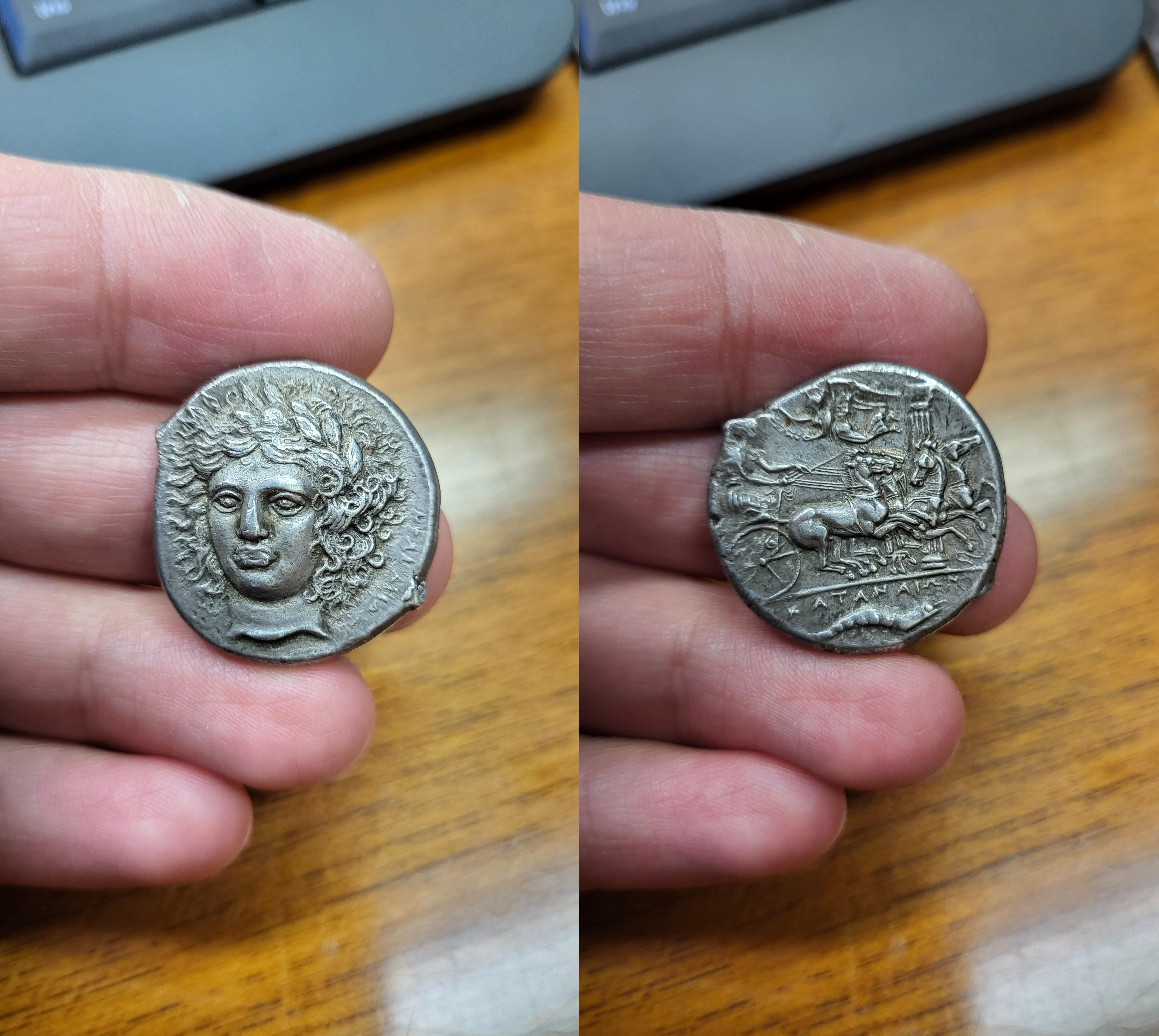
Probably shortly before Katane’s capture by Syracuse in 403 BCE, which saw the city plundered and its population sold into slavery, this beautiful tetradrachm was struck. Switching convention, Apollo’s head is placed on the obverse. As usual, he is slightly effeminate, with sensual lips, his luscious hair flowing on all sides, giving a great sense of dynamism to the scene, while still maintaining a very dignified composition. To the right, one can read Herakleidas’ signature. The reverse shows a victorious charioteer, to be crowned by Nike, as he turns his chariot around the turning post, here depicted as an Ionic column. Below, a crayfish can be seen. All in all, a wonderful coin that can be rightfully be termed the swansong of Katane.
by KBRCoinCabinet