
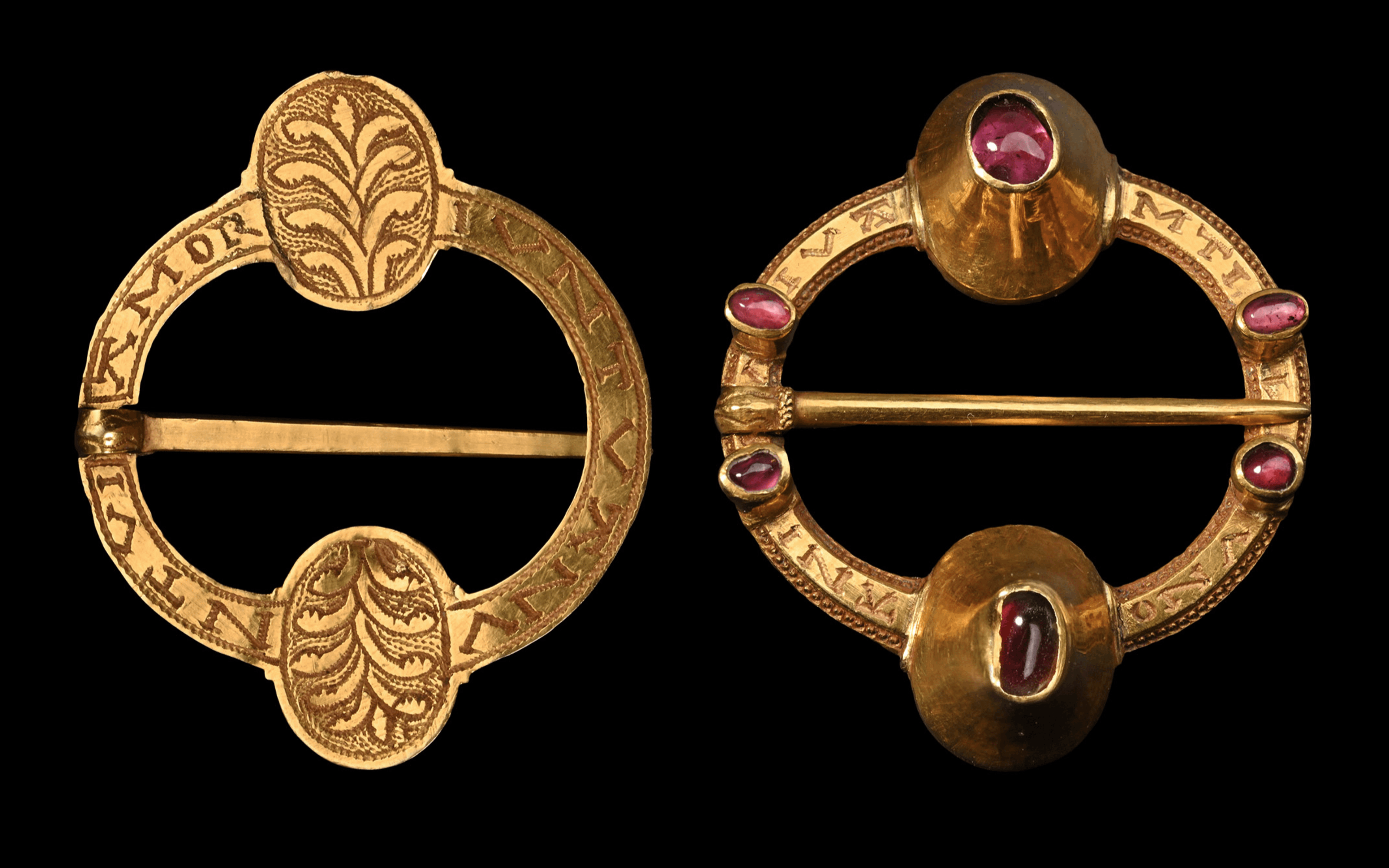
An annular 13th-14th century brooch with pelletted edges, six garnet cabochons adorning the brooch, each in a tall closed setting; inscribed on the front 'VIVAMTINVNOANI', the reverse inscribed with 'AMORIVNTVANVNTVI' divided between two palmettes.
by SashSegal
2 Comments
Both inscriptions can be interpreted differently according to the order of their reading; the front can be read ‘IN JUNO ANI VIVAM TI’, which roughly translates as ‘May I live for you in the fastening’, alternatively ‘VIVAM[vs] IN VNO ANI[mo]’ which roughly translates as ‘Let us live as one soul’. The back reads: ‘AMORIVNTVANVNTVI’ ‘AMOR[is] IVN[c]T[i] ANVNTIV[s]’ which roughly translates as ‘a message of joint love’.
The inscriptions on the brooch serve as metaphors, linking its function of fastening materials to the binding of lovers in medieval romance. Gift-giving was central to courtly love, and the brooch symbolised both affection and protection, reminding the wearer of the giver’s love while also warding off unwanted advances.
[https://timelineauctions.com/lot/medieval-gold-ring-brooch-with-garnets-and-let-us-live-as-one-soul-pos/254009/](https://timelineauctions.com/lot/medieval-gold-ring-brooch-with-garnets-and-let-us-live-as-one-soul-pos/254009/)
Go watch a few videos on YouTube of a gold ring set with stones being made and you’ll understand why intricate ancient jewellery making is astonishing. It’s hard enough with modern blow torches, carbon steel engravers, electric furnaces, professional mills etc. To make something like an inlayed brooch with a soldered clasp 700 years ago without our tech is remarkable.