Followed by the North America map, this is Part 2 of my Urban Stress Index (USI) series.
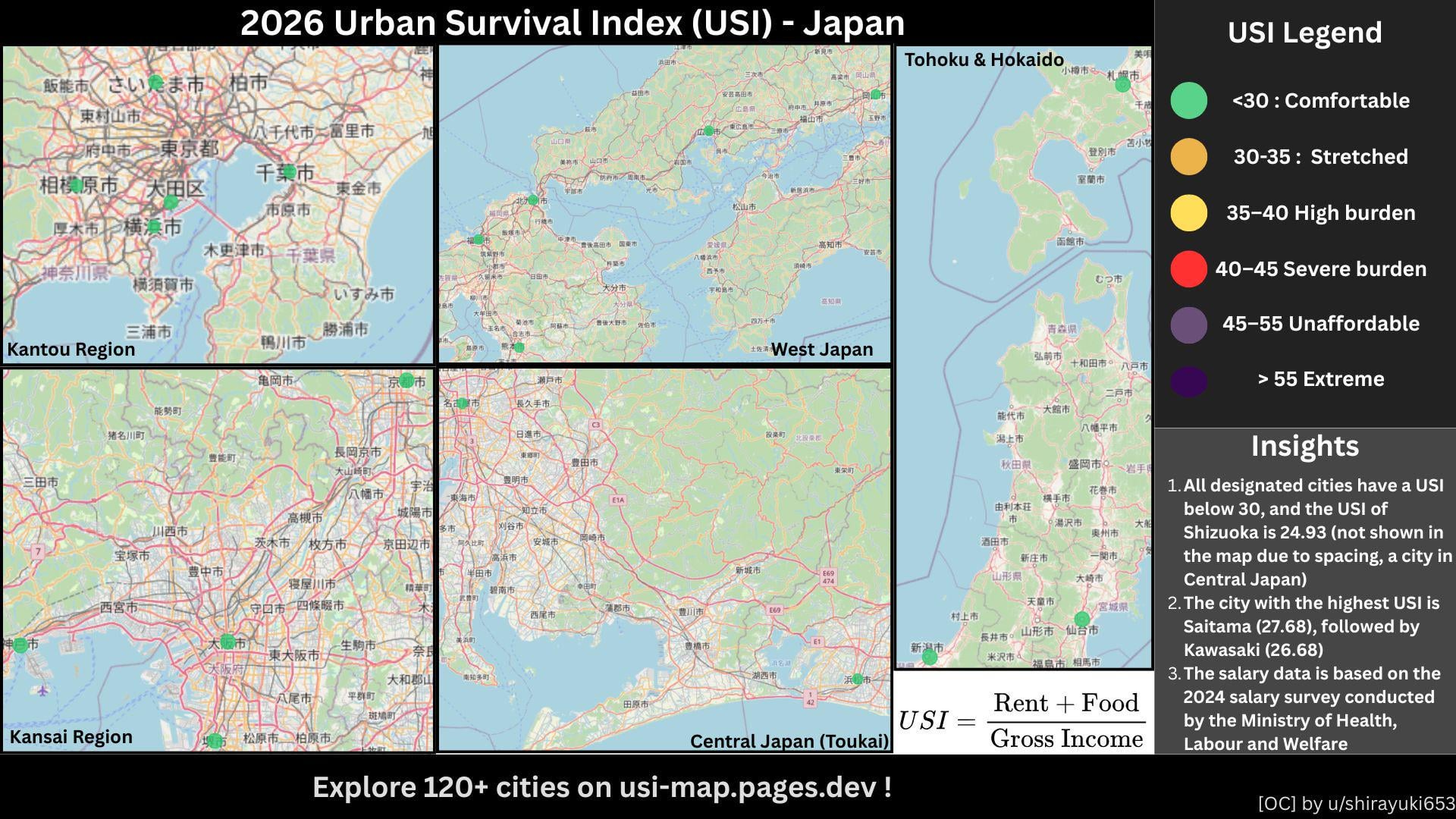
The Urban Stress Index measures how much of a single full-time worker’s gross monthly salary is required to cover:
• Rent (1-bedroom equivalent in the city centre) • Basic food costs
For Japan, I focused on the 20 designated cities (政令指定都市).
Methodology (Japan):
Housing: Average rent of a 1DK unit in the ward where the city’s main JR station is located, extracted from SUUMO (In Japan, 1DK is the standard self-contained option for a single worker.)
Income: Prefecture-level wages for general full-time workers (monthly cash earnings, bonus excluded). Source: Ministry of Health, Labour and Welfare (latest available data: 2024)
Food: A proxy based on a low-cost Japanese set meal (Ootoya baseline)
Key observations:
Housing + food burden is relatively uniform (compressed) across Japanese cities;
Greater Tokyo metro cities are slightly higher
This index measures structural baseline pressure for a single full-time worker, so it does not account for taxes, family households, etc.
Hiroba on
Is this based on local currency or USD?
shirayuki653 on
Note: The 23 Special Wards of Tokyo are NOT designated cities, they are not included in this map
Punchinballz on
Dasaitama 1st? It must be true, you’d have to pay me to live in Saitama.

4 Comments
Followed by the North America map, this is Part 2 of my Urban Stress Index (USI) series.
The Urban Stress Index measures how much of a single full-time worker’s gross monthly salary is required to cover:
• Rent (1-bedroom equivalent in the city centre) • Basic food costs
For Japan, I focused on the 20 designated cities (政令指定都市).
Methodology (Japan):
Housing: Average rent of a 1DK unit in the ward where the city’s main JR station is located, extracted from SUUMO (In Japan, 1DK is the standard self-contained option for a single worker.)
Income: Prefecture-level wages for general full-time workers (monthly cash earnings, bonus excluded). Source: Ministry of Health, Labour and Welfare (latest available data: 2024)
Food: A proxy based on a low-cost Japanese set meal (Ootoya baseline)
Key observations:
Housing + food burden is relatively uniform (compressed) across Japanese cities;
Greater Tokyo metro cities are slightly higher
This index measures structural baseline pressure for a single full-time worker, so it does not account for taxes, family households, etc.
Is this based on local currency or USD?
Note: The 23 Special Wards of Tokyo are NOT designated cities, they are not included in this map
Dasaitama 1st? It must be true, you’d have to pay me to live in Saitama.