
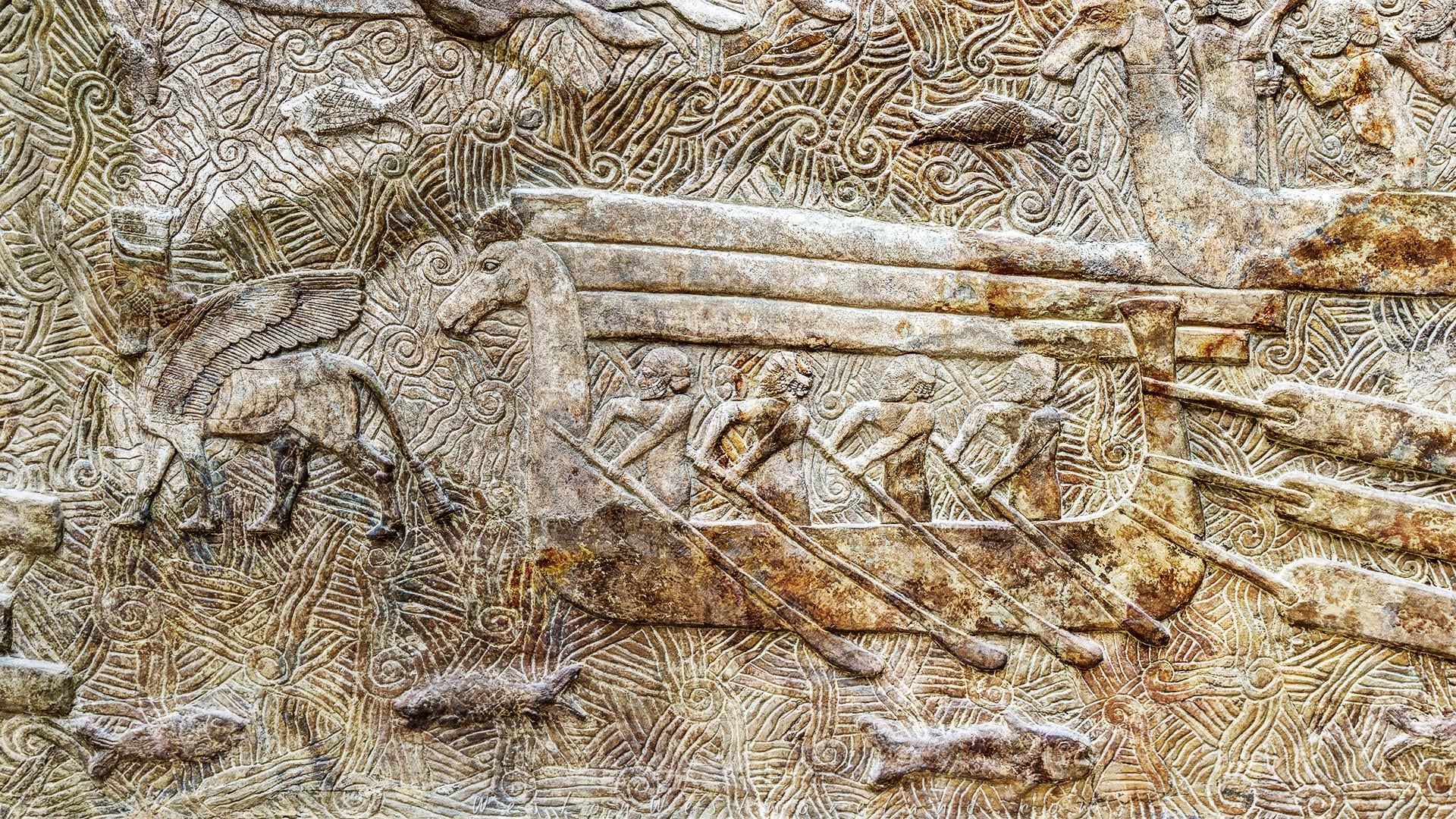
Neo-Assyrian bas-relief depicting ships carrying and dragging cedar logs from Lebanon, guided by protective deities. Court in Dur-Sharrukin, present day Khorsabad, the unfinished capital city of Sargon II, c. 700 BCE. Mesopotamian lands were poor in stone and forest, so… [1920×1080] [OC]
by WestonWestmoreland
1 Comment
…the supplying of these goods presented great political relevance.
Sargon II ascended amid revolts after Shalmaneser V’s death, quickly ending the siege of Samaria and deporting about 27,000 Israelites, contributing to the legend of the Ten Lost Tribes. He defeated Urartu, sacking its holy city Musasir, reconquered Babylonia, and built a new capital, Dur-Sharrukin, completed in 706 BCE. His victories over rivals like Egypt-aligned states in the Levant and Anatolian kingdoms marked the empire’s peak expansion.
Sargon II ruled the Neo-Assyrian Empire from 722 to 705 BCE, founding the Sargonid dynasty that governed until the empire’s collapse. He stabilized and expanded Assyrian power through military campaigns but died in battle, with his unrecovered body seen as an ill omen.
In 705 BCE, Sargon led a campaign in Anatolia against Cimmerians or Tabal rebels led by Gurdî of Kulumma, where he was killed and his body lost—a rare dishonor that shook Assyrian morale. His son Sennacherib abandoned Dur-Sharrukin for Nineveh, but the dynasty endured under rulers like Esarhaddon and Ashurbanipal. Sargon’s death initiated subtle decline, as overextension and unrest grew.
The Neo-Assyrian Empire fell in 612 BCE, roughly a century after it reached its peak with Sargon II, with Nineveh’s sack by a Medo-Babylonian alliance. Endless revolts, military overstretch, civil wars after Ashurbanipal’s death, drought, and overpopulation had weakened the structures of the aggressive Sargonid empire, sustained by the use of terror as a tool of war and dominance, and abruptly brought their 300 years of dominance to an end.
My apologies for inaccuracies and mistakes.