
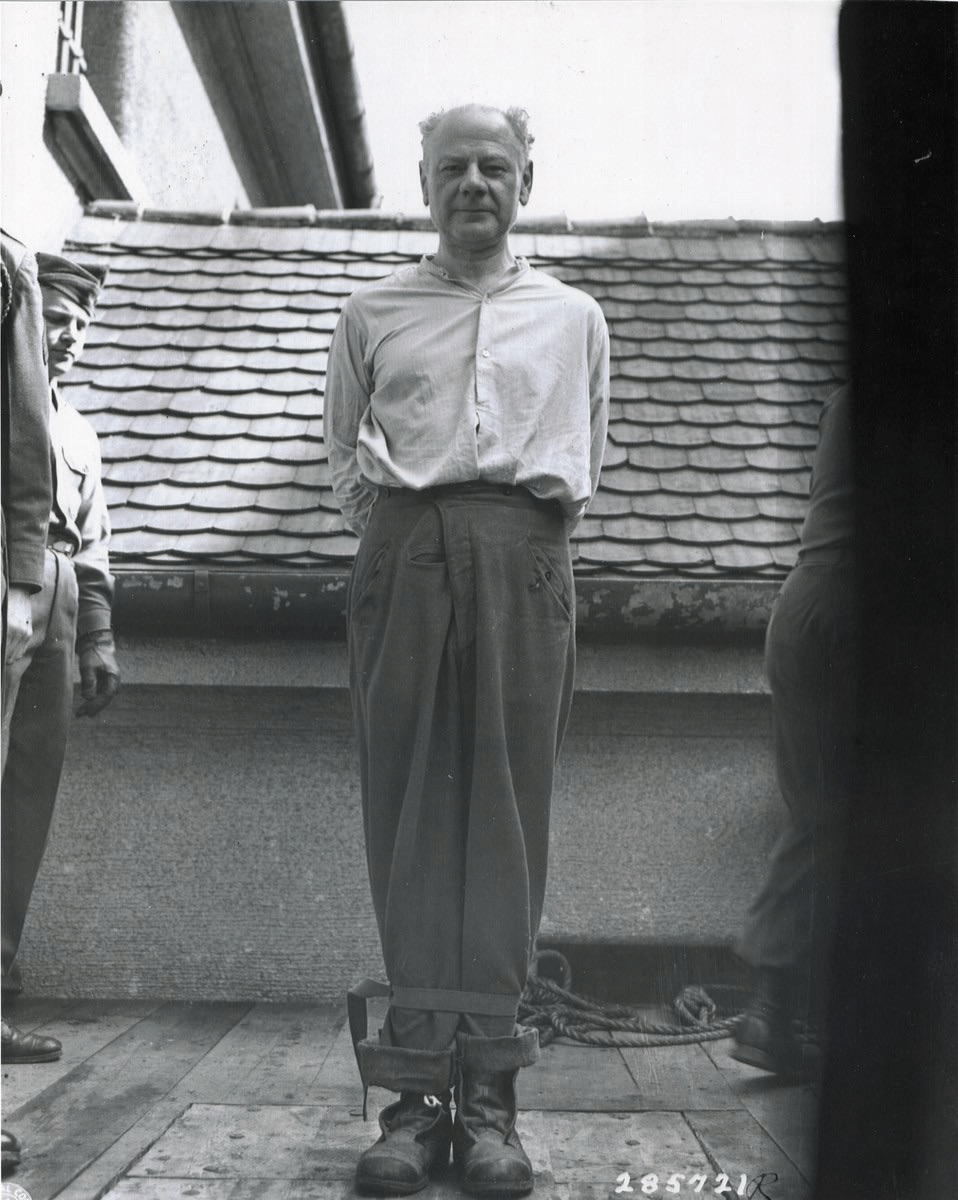
Krebsbach attended a high school in Cologne. From 1912, he studied medicine at the University of Freiburg. His studies were interrupted by the Great War. Krebsbach served four years in the German Army, survived, and resumed his studies. In 1919, he earned his doctorate. That year, he cofounded a local group of the proto-Nazi Deutschvölkischer Schutz- und Trutzbund. In mid-1920, Krebsbach moved away from Freiburg and worked as a company and district doctor. He had no children and later got a divorce. He remarried in 1943. In 1933, corrupt officials falsely accused Krebsbach of being an opponent of Nazism and dismissed him as a district doctor.
Krebsbach opened a medical practice in Freiburg and worked as a contract doctor for the police department there. The same year, he joined the Nazi Party and SS. Kresbach was the leader of a medical squadron in Freiburg. During Kristallnacht, he and several others set the local synagogue on fire. Krebsbach joined the Waffen-SS in 1939. He took part in the western campaign with the SS Totenkopf Division. In 1941, Krebsbach became the garrison doctor of Mauthausen concentration camp, tasked with supervising medical care and all medical personnel of the camp. He initiated mass killings by lethal injection to the heart of handicapped and sick prisoners.
Under Krebsbach's supervision, approximately 900 Russian, Polish and Czech prisoners were murdered by lethal injections of gasoline, phenol, and benzene, starvation, and shooting. Inmates nicknamed Krebsbach "Dr. Spritzbach" (Dr. Injection). Krebsbach was also responsible for the construction of a gas chamber in the basement of the hospital in the Mauthausen camp. Krebsbach often inspected the prisoners and conducted selections for execution. Former inmate Josef Herzler later recalled how the inspections went.
As the senior SS doctor in the camp, Dr. Krebsbach sometimes came to block 5 and had the still surviving Jews paraded before him. He then asked if any of them were doctors. If there were, he would say: "You Jewish pig, you're just an abortionist." The next day they were done away with by the Kapos. If a Jewish inmate was lying on the floor with a broken limb – a not uncommon occurrence at work – he was usually thrown over a wall by a Kapo. If Dr Krebsbach were passing, he would say ironically: "Yes, this broken foot is a hopeless case."
Krebsbach was transferred to Kaiserwald concentration camp in Latvia in the autumn of 1943. On the night of May 22, 1943, Krebsbach had killed a drunken German soldier named Josef Breitenfellner. A startled Krebsbach had shot after Breitenfellner woke him up by making a disturbance in his garden. At Kaiserwald, Krebsbach conducted selections of camp inmates for execution, forcing prisoners to perform physical exercises to determine their strength and then identifying the 2000 weakest to be killed. He also admitted to hundreds of shootings. After the camp's closure, Krebsbach resumed a career as “Epidemic Inspector for Latvia, Estonia and Lithuania”. Soon after, he transferred to the regular army as a senior staff doctor, serving until late 1944. At the end of 1944, he left the army and became a company doctor in a spinning mill in Kassel.
After the liberation of Mauthausen, commandant Franz Ziereis was fatally wounded in a shootout with U.S. soldiers after a brief manhunt. Prior to his death, Ziereis confessed and named several other people, including Krebsbach, who had been heavily involved in atrocities at the camp. Krebsbach was promptly arrested as a suspected war criminal. He was sent to the former Dachau concentration camp to await trial. In 1946, he was one of 61 defendants in mass trial of Mauthausen personnel.
Numerous eyewitnesses confirmed the details of the confession of Franz Ziereis, such as that Krebsbach had performed selections for the mobile gas van driven between the Mauthausen and Gusen camps. Ernst Martin, one of the star witnesses for the prosecution, described Krebsbach as "a sadist of the worst sort". Like Ziereis on his deathbed, Martin also implicated Krebsbach as instrumental in the construction of Mauthausen's gas chamber. Asked by the prosecution to tell the court what nutrition a regular prisoner received, Dr. Joseph Podlaha testified that one only received 1000 calories a day – roughly one third the amount required to sustain life when performing the obligatory hard labor. For the sick who did not fall victim to either starvation or the horrific sanitary conditions in the camp hospitals, there were selections for gassing, carried out, Podlaha testified, Krebsbach among several others.
"The weak prisoners had to undress and [Dr. Krebsbach] picked them out, saying 'You, and you, and you', and they were put aside… The next day these prisoners were reported as dead."
Hans Marsalek confirmed Ziereis's statement that Krebsbach was chiefly responsible for the killing of the sick:
"Dr. Krebsbach introduced the injections in the camp, while on the other hand the gassings were introduced by Dr. Wasicky. At the same time he pointed to the fact that the murder of the thirty-eight people from Linz and Steyr on the 28th of April, 1945 was done upon the orders of Eigruber."
For his part, Krebsbach did not deny his guilt, named camp pharmacist Erich Wasicky as chiefly responsible for the installation of the camp's gas chamber, and identified 15 codefendants who had participated in executions. He confessed to participating in the shooting of hundreds of prisoners and the selection for the gas chamber of thousands of others. In mitigation, he pleaded superior orders and medical necessity. "Under my leadership," he explained, "about 200 TB patients were selected," but only because they had "open, contagious TB of the lungs" and therefore threatened the welfare of other prisoners.
The following exchange between Krebsbach and the chief prosecutor, Lieutenant Colonel William Denson, is from court records of the trial.
- When I started work I was ordered by the head of Office III D to kill or have killed all those who were unable to work, and the incurably sick.
- And how did you carry out this order?
- Incurably sick inmates who were absolutely incapable of work were generally gassed. Some were also killed by gasoline injection.
- To your knowledge, how many persons were killed in this way in your presence?
- (No answer)
- You were ordered to kill those unfit to live?
- Yes. I was ordered to have persons killed if I was of the opinion that they were a burden on the state.
- Did it never occur to you that these were human beings, people who had the misfortune to be inmates or who had been neglected?
- No. People are like animals. Animals that are born deformed or incapable of living are put down at birth. This should be done for humanitarian reasons with people as well. This would prevent a lot of misery and unhappiness.
- That is your opinion. The world does not agree with you. Did it never occur to you that killing a human being is a terrible crime?
- No. Every state is entitled to protect itself against asocial persons including those unfit to live.
- In other words, it never occurred to you that what you were doing was a crime?
- No. I carried out my work to the best of my knowledge and belief because I had to.
All 61 defendants were found guilty. Fifty-eight of them, including Krebsbach, were sentenced to death. The judges also read out a special verdict declaring that everyone who worked at Mauthausen was to be considered guilty by association until proven innocent and that anyone who claimed to not know what was happening at the camp was a liar. To prove innocence, one would need an alibi or have prisoners vouch for them.
On appeal, nine of the death sentences were reduced to prison terms. Those spared were a camp dentist who extracted the golden teeth of dead prisoners, but did not kill anyone, seven guards who had each shot and killed a single prisoner after giving them at least one warning to stop, and one guard who had shot and killed two escaping prisoners. The eighth guard, Wilhelm Mack, was spared since he had once prevented fellow guards from murdering a downed American pilot and risked arrest to give extra food rations to the prisoners on his work detail.
The court-appointed counsel had not filed a clemency petition for Krebsbach and several others, knowing it'd be a waste of time. After exhausting their appeals, 48 out of the remaining 49 condemned defendants (one won a stay and was executed a month later) were executed by hanging at Landsberg Prison on May 27 and 28, 1947. It was the largest mass execution by the United States in the 20th century and the largest mass execution of Nazi war criminals in Western Europe.
Eduard Krebsbach, 52, was executed by hanging on May 28, 1947.
by lightiggy