
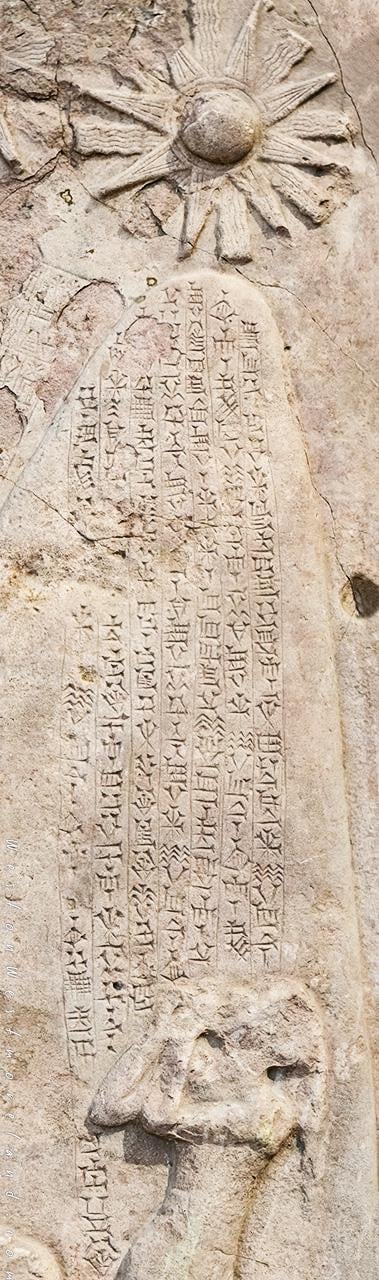
The Elamite inscription on the Victory stele of Naram Sin, c. 2230 BCE, Akkadian Empire. The stele commemorates King Naram-Sin’s military triumph over the Lullubi people. This inscription, however, was added by Elamite king Shutruk-Nahhunte, boasting of the capture of the stele… [1280×379]
by WestonWestmoreland
1 Comment
…The inscription was carved on the 12^(th) century BCE, it boasts of conquering Sippar, seizing the stele, and dedicating it to his god Inshushinak. The translation of the cuneiform inscription goes as follows:
“I am Shutruk-Nahhunte, son of Hallutush-Inshushinak, beloved servant of the god Inshushinak, king of Anshan and Susa, who has enlarged the kingdom, who takes care of the lands of Elam, the lord of the land of Elam. When the god Inshusinak gave me the order, I defeated Sippar. I took the stele of Naram-Sin and carried it off, bringing it to the land of Elam. For Inshushinak, my god, I set it as an offering.”
Shutruk-Nakhunte was a descendant of the Lullubi mountain people, whose defeat the stele commemorated. He also claimed to carry the stele there himself. The already ancient inscription was kept, indicating respect for Naram-Sin’s victory. He did, however, add an Elamite cuneiform inscription declaring his own glory and tells how the stele was carried out of the city after the pillage of the city Sippar.
The Victory Stele of Naram-Sin (full image [here](https://www.reddit.com/r/ArtefactPorn/comments/11e3juz/victory_stele_of_naramsin_king_of_akkad_grand_son/)) commemorates King Naram-Sin’s military triumph over the Lullubi mountain people in the Zagros Mountains, depicting him as a larger-than-life, god-like ruler leading his army up a mountain while trampling enemies.
The remains of the original inscription, located over Naram-Sin’s head, records his victory over the Lullubi. It reads: “Naram-Sin the powerful . . . . Sidur and Sutuni, princes of the Lullubi, gathered together and they made war against me…”
Carved in low relief on a tall slab of pink limestone (about 2 meters high), the stele breaks from tradition with its diagonal composition rather than registers, showing soldiers in hierarchical scale ascending toward Naram-Sin at the peak. Naram-Sin wears a horned helmet (reserved for gods), strides powerfully with weapons raised, and gazes upward, emphasizing his deification and divine right to rule.
The two visible sun-like stars (originally three, with one damaged) at the top represent solar deities, likely the sun god Shamash or astral symbols of divine approval watching over the battle. They signify celestial endorsement of Naram-Sin’s victory, reinforcing his god-king status despite his gaze upward humbly acknowledging higher powers; some interpretations link them to past monarchs blessing him.
My apologies for inaccuracies and mistakes