
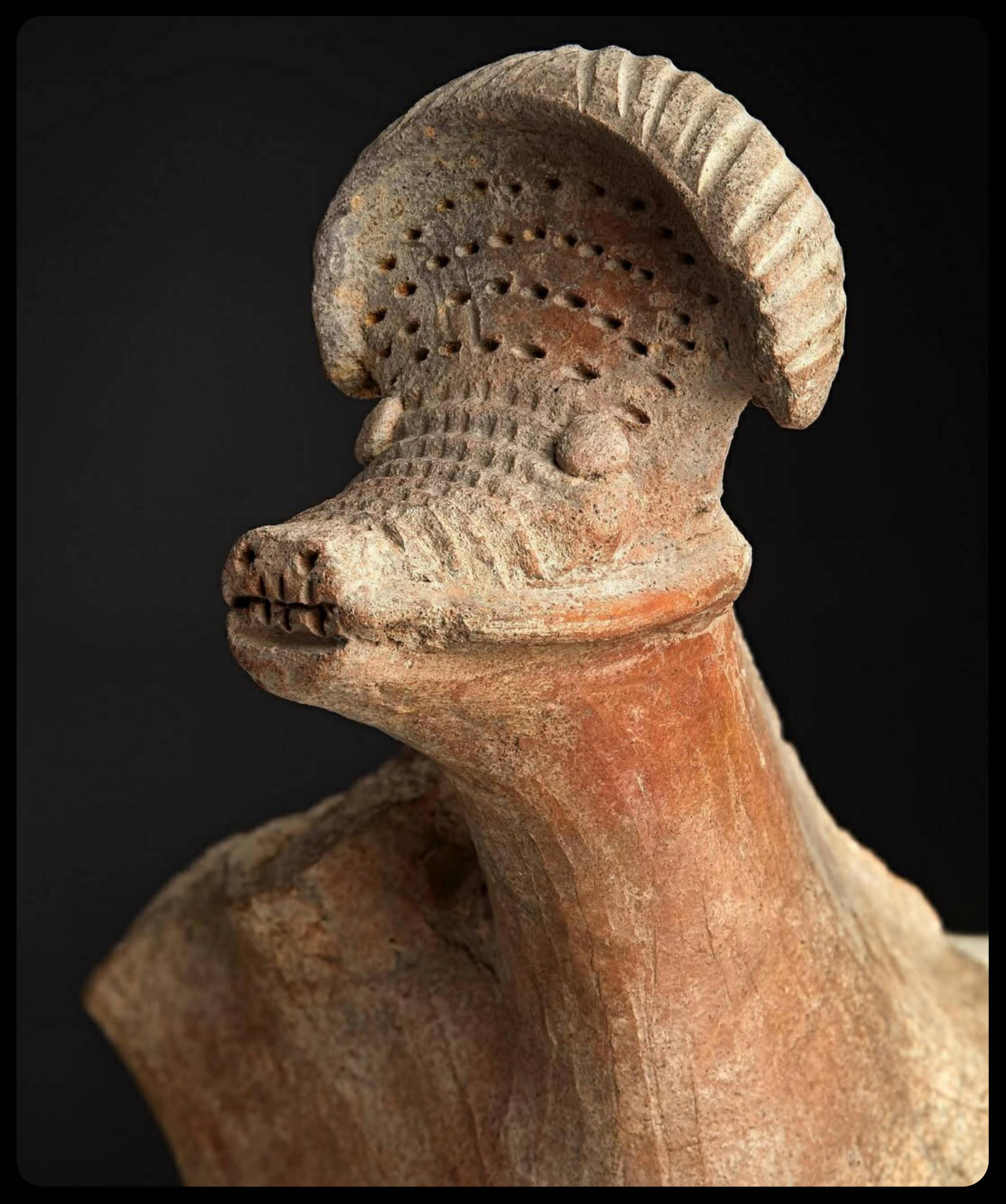
Three-Headed Protome from Georgia (South Caucasus) c.800-650 BCE: this sculpture originally depicted multiple heads on opposite ends of a four-legged body, and several other sculptures with this design have been found at the same site [3985×4832]
by SixteenSeveredHands
1 Comment
This artifact was unearthed in the central terrace at Vani, which is an archaeological site located in what is now western Georgia (the country, not the state). It was created roughly 2,800 years ago, when Vani served as the religious, cultural, and administrative center for the Kingdom of Colchis.
The sculpture was originally equipped with several heads located on opposite ends of a single body, but only two of these heads are still intact; the remaining heads are adorned with zoomorphic features and large crowns.
Several other sculptures with a similar design have also been discovered at Vani and Nokalakevi, which is another site in ancient Colchis.
As [this article](https://grbs.library.duke.edu/article/download/3871/5645) explains:
> Numerous terracotta figurines of various animals occur at Vani (e.g. deer, rams, etc.) but particularly interesting are four-footed figures with multiple heads on opposite ends. The protomes of two- and three-headed fantastic creatures with characteristic post-like legs apparently belong to figures of this type.
> Such figures, also common in the Greek world and generally assigned to the geometric period, have been found in 8th-7th century [BCE] contexts at Olympia, Delphi, Athens, Crete, Rhodes, Samos, and elsewhere. In Italy, these figures frequently appear in 7th-6th century contexts. Although at present a firm decision on which culture influenced the Vani figures (four-footed with two heads on opposite ends) is difficult to discern, the earlier emergence and wide distribution of such representations in the Greek world suggest a link with Hellenic culture.
> Perhaps these new elements in Colchian culture c.800-650 BCE resulted from Greek contacts (still intermittent) in the precolonial era, which were reflected in the great popularity of stories of the Argonauts in the 8th-7th centuries and in the first geographical and ethno-political reports of Colchis (e.g. geographical references in the Homeric Catalogue of the Trojans, mention of Colchis in Eumelos and of the Phasis River in Hesiod). Regular Greek contacts began only c.550 BCE, after the establishment of Greek settlements on the eastern shore of the Black Sea.
#Sources & More Info:
– Journal of Greek, Roman, and Byzantine Studies: [Vani: an Ancient City of Colchis](https://grbs.library.duke.edu/article/download/3871/5645) (PDF)
– The Georgian National Museum: [Figurine of a Fantastical Beast](https://www.instagram.com/georgiannationalmuseum/p/CMy_EnQB_h3/?hl=en)
– Phasis: [New Discoveries in Colchis](https://phasis.tsu.ge/index.php/PJ/article/download/2177/2440/0) (PDF)