
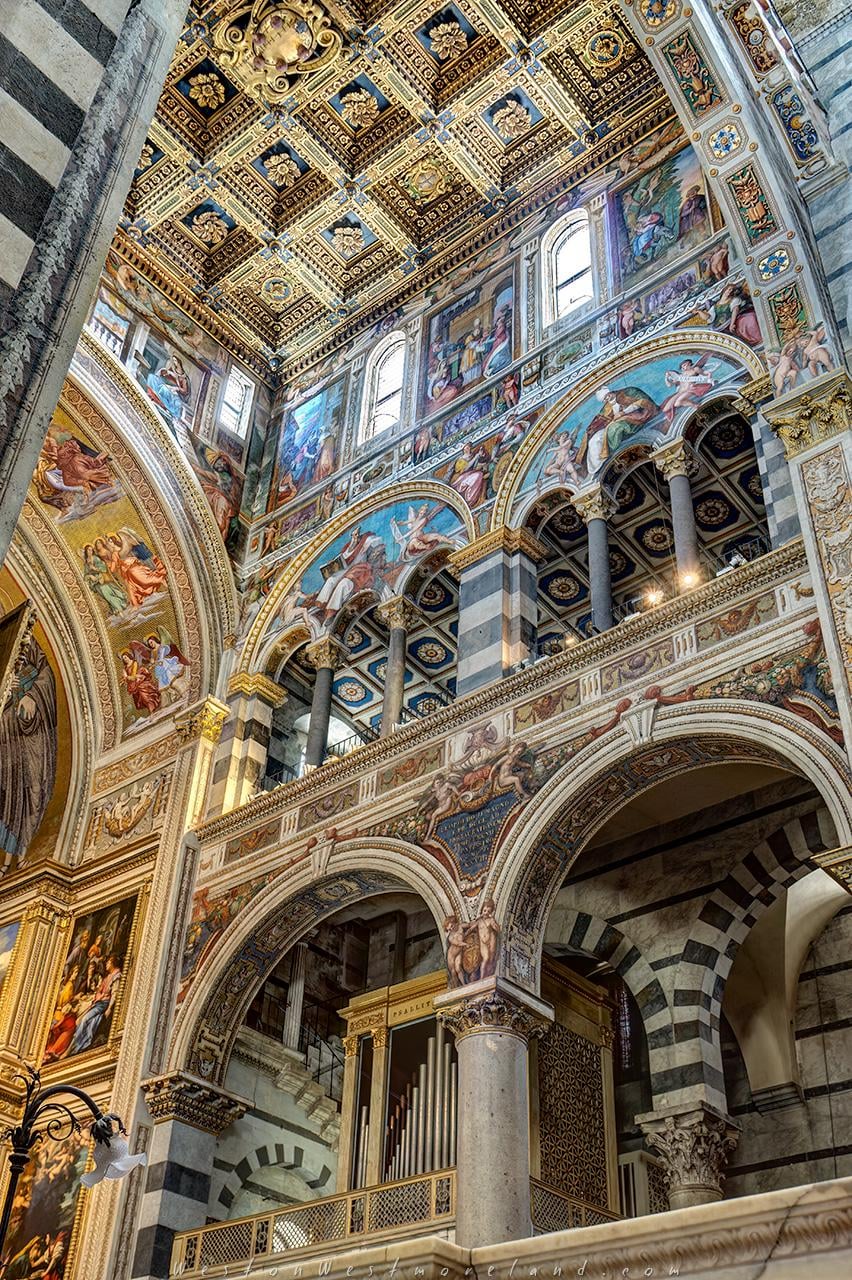
Intricacies of the Pisa Cathedral, the gilded coffered ceiling, the arches, the frescoes. Construction began in 1064 and set the model for the distinctive Pisan Romanesque style of architecture. The mosaics and the pointed arches show a strong Byzantine and Mediterranean influence… [1280×852] [OC]
by WestonWestmoreland
2 Comments
…The decision to build a completely new and monumental cathedral came at a time when Pisa was a powerful maritime republic competing with Venice and others for control of Mediterranean trade. In 1063–1064, after a Pisan victory over Muslim forces at Palermo in Sicily, a tenth of the war booty was devoted to the construction of a grand new cathedral dedicated to the Virgin Mary. The project was intended both as an act of piety and as a declaration of Pisa’s wealth and prestige.
The building was placed deliberately outside the line of the early medieval city walls, a bold statement that Pisa was strong enough not to need defensive protection for its most important shrine. The architect Buscheto designed a Latin cross basilica with a central nave, four side aisles, and a large transept, crowned by a dome over the crossing.
The cathedral combined elements drawn from many artistic traditions—Classical, Lombard‑Emilian, Byzantine, and Islamic—reflecting Pisa’s wide Mediterranean connections. This fusion produced what came to be recognized as “Pisan Romanesque”: arcaded facades, striped marble, re‑used Roman columns and inscriptions, and rich sculptural decoration. The extensive use of spolia (re‑used Roman building materials) and the alternating black‑and‑white marble on the exterior were meant to evoke both ancient Rome and the cosmopolitan, maritime character of Pisa as an “other Rome” (*altera Roma*).
The church, originally a diocesan cathedral, was elevated to “primatial” status in 1092, when Pope Urban II granted the title of primate to the Archbishop of Pisa, underlining its ecclesiastical importance. The cathedral was solemnly consecrated in 1118 by Pope Gelasius II, even though building work continued afterwards.
In the first half of the 12th century a second architect, Rainaldus, took charge, lengthened the nave and designed the great [western façade](https://www.reddit.com/r/ArtefactPorn/comments/1oozyh1/the_duomo_seen_from_the_baptistry_with_the/), which is articulated by blind arches and tiers of open galleries. The main building was essentially completed by the last quarter of the 12th century, when bronze doors by Bonanno Pisano were installed on the central portal (these would later be lost in a fire). For a time, Pisa’s cathedral was the largest church in Europe, a visible sign of the city’s prominence.
From the 13th century onward, the cathedral was progressively enriched with sculpture and painting. Important Tuscan sculptors contributed works, and significant panel paintings and frescoes were added inside. The cathedral’s bell tower—the famous Leaning Tower of Pisa—was begun in the late 12th century as the cathedral’s independent campanile, completing the core group of monuments on the square.
The entire complex—cathedral, baptistery, campanile, and cemetery (Campo Santo)—came to define what is now called [Piazza dei Miracoli](https://www.reddit.com/r/ArchitecturePorn/comments/voy5ns/baptistry_duomo_and_tower_piazza_dei_miracoli/#lightbox), one of the most celebrated ensembles of medieval Christian architecture. The square’s layout expresses a symbolic narrative of human life: birth (baptistery), life (cathedral and its bell tower), and death (cemetery)… (follows in replay)
I love going into these places with the mindset of someone who spent their entire lives living in a single story house, in a village of probably only one or two story houses. Walking in and seeing the scale, hearing the music. It must have been truly awe inspiring