
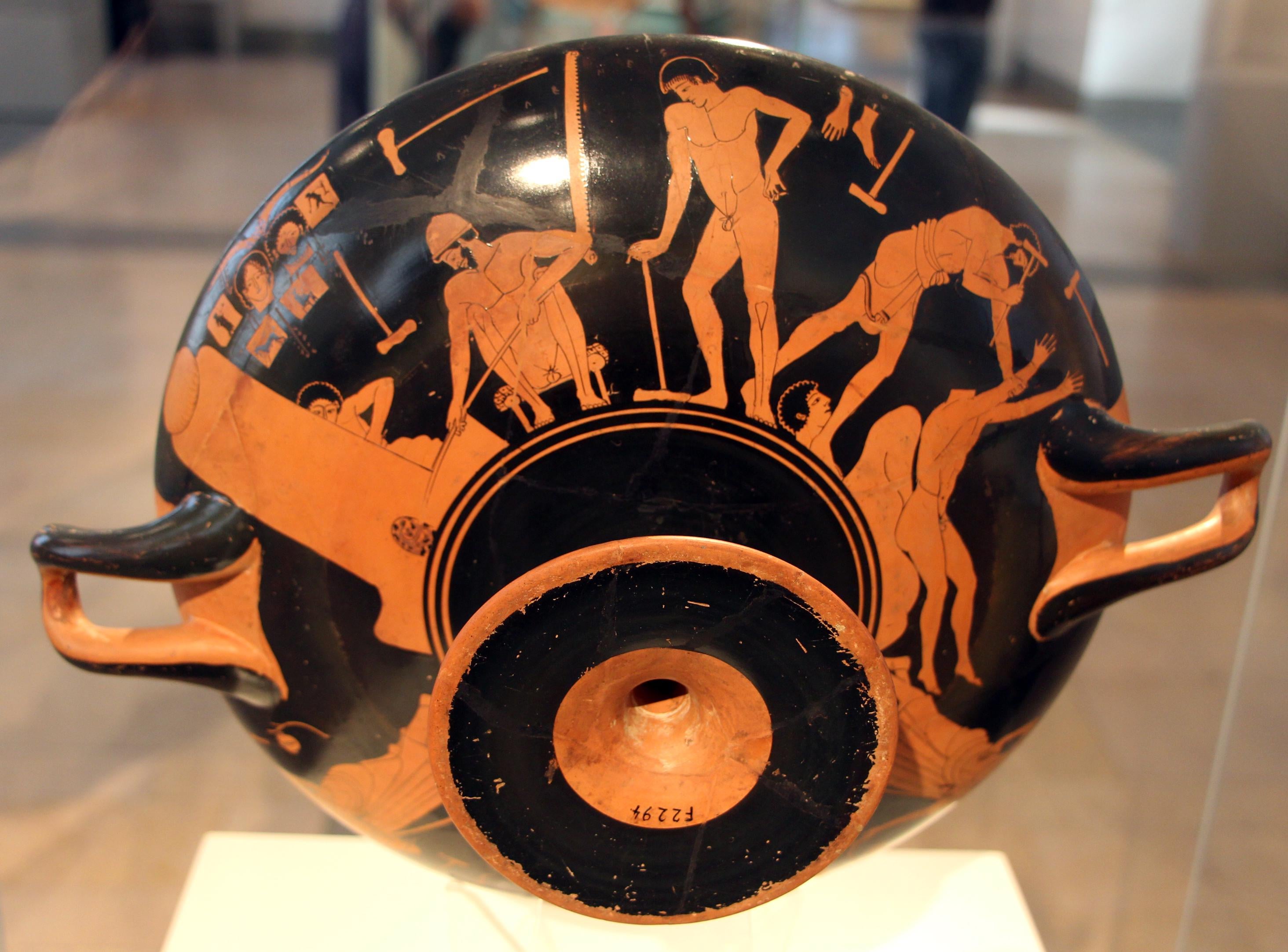
The Berlin Foundry Cup, early 5th century BC, a red-figure kylix depicting the activities in an Athenian bronze foundry [2928×2164]
by WheelspinAficionado
The Berlin Foundry Cup, early 5th century BC, a red-figure kylix depicting the activities in an Athenian bronze foundry [2928×2164]
by WheelspinAficionado
4 Comments
The exterior image is unusual. It depicts a bronze workshop. The production of a variety of bronze statues is shown at different stages.
A statue is being made. It appears to be that of an athlete. The statue, still headless, is lying on a sand or clay support; a workman is holding one of its arms, carefully manipulating it with a hammer. The statue’s head lies at his feet. A line between the statue’s arm and hand indicates that the two parts are not fully joined yet. The soldering to join them is probably being prepared in the furnace. Behind the furnace, a youth is manipulating a bellows to kindle the fire; in front of it, a seated workman appears to be heating a metal rod.
Metal workshops existed in the Athenian potters’ quarter, the Kerameikos. Thus, it is likely that the Foundry Painter’s depiction of the workshop is based on personal observation. Some details, such as the furnace, are, however, depicted in a way that differs from the known archaeological evidence. This is probably simply because certain adjustments of reality were necessary to effectively paint or compose the scene. At least some of the depicted workmen appear to be slaves. For example, the man in front of the oven is crouched in such a way that his genitals are visible, a style of depiction normally limited to satyrs and slaves.
[https://en.wikipedia.org/wiki/Berlin_Foundry_Cup](https://en.wikipedia.org/wiki/Berlin_Foundry_Cup)
Ancient supervisor detected, leaning on his hammer. Stunning work.
It takes an amazing level of confidence in your own craftsmanship to work d*ck out in a foundry.
I wonder if the lack of PPE is a stylistic choice, as the ancient Greeks liked to depict the male body, or if they really did work naked