
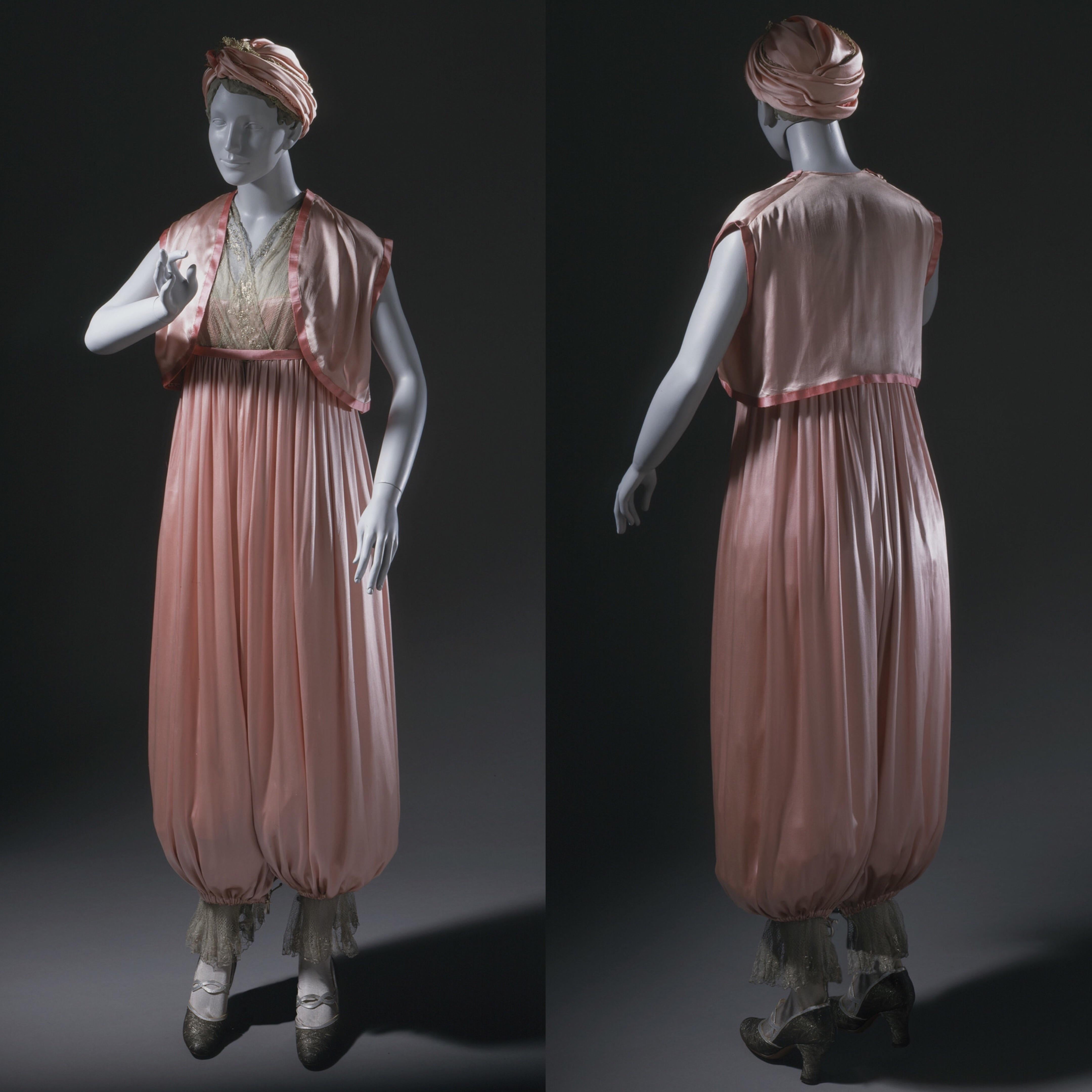
Woman’s Lounging Pajamas by Callot Soeurs (Couture house) France, 1911. Silk satin, ribbon, metallic lace and chiffon trim. [4319 x 4319]
by Saint-Veronicas-Veil
Woman’s Lounging Pajamas by Callot Soeurs (Couture house) France, 1911. Silk satin, ribbon, metallic lace and chiffon trim. [4319 x 4319]
by Saint-Veronicas-Veil
1 Comment
The Ballets Russes revolutionized 20th-century fashion by introducing opulent, Orientalist, and avant-garde aesthetics that broke from Victorian constraints. Designer Léon Bakst’s vibrant, exotic costumes—featuring harem pants, turbans, and bold colors—influenced designers like Paul Poiret and Callot Soeurs. They popularized a new, fluid, and artistic style.
Callot Soeurs was one of the leading fashion design houses of the 1910s and 1920s. Callot Soeurs opened in 1895 at 24, rue Taitbout in Paris, France. It was operated by the four Callot sisters: Marie Callot Gerber, Marthe Callot Bertrand, Regina Callot Tennyson-Chantrell and Joséphine Callot Crimon.
The eldest sister, Marie, was trained in dressmaking, having earlier worked for Raudnitz and Co., prominent Parisian dressmakers, and they were all taught by their mother, a lacemaker. The sisters began working with antique laces to enhance blouses. Their success led to an expansion into other clothing.
In 1897, Joséphine was rumored to have committed suicide. There is no substantiated proof and family members believe her death was accidental.
In 1900, they were featured at the Paris World’s Fair. That year, they had a staff of two hundred and did two million francs in sales. By 1901, they had tripled their workforce and doubled their sales.
Callot Soeurs’s day dresses were well received at the 1915 Universal Exhibition in San Francisco. In 1916, Henri Bendel was the largest buyer of Callot Soeurs in New York City. That same year, American Vogue dubbed the sisters the Three Fates, and declared them “foremost among the powers that rule the destinies of a woman’s life and increase the income of France.”
During World War I, American support was vital to the continued success of Callot Soeurs. While European sales fell, American buyers would order between 300 and 800 pieces every July. In response to the proliferation of knockoffs in the 1910s and 1920s, Callot Soeurs regularly placed advertisements in The New York Times listing the official retailers of their designs. In 1919, Callot Soeurs moved to larger premises at 9-11 Avenue Matignon. In 1920, Marthe Callot Bertrand suddenly died and the widowed Regina Callot Tennyson-Chantrell retired to care for her son. Marie Callot Gerber single-handedly ran the house for the next seven years.
In the 1920s, Callot Soeurs established branches in Nice, Biarritz, Buenos Aires, and London. A January 1922 article in Ladies’ Home Journal claimed that “Callot probably has more rich clients than any other establishment in the world.” In 1926, the American designer Elizabeth Hawes, while working in Paris, regularly wore Callot Soeurs. Hawes insisted that people should wear what they personally liked, not what was considered fashionable, and although some American buyers at that time considered Callot Soeurs’ dresses out of date and unfashionable, she happily wore their “simple clothes with wonderful embroidery” that lasted her for several years.
Callot Soeurs’s greatest American supporter was Rita de Acosta Lydig who ordered dozens of dresses at a time. According to her sister Mercedes de Acosta, “Rita designed most of her own clothes and they were made for her by Callot Soeurs.” Supposedly, Rita was such a fashion plate that when she learned her husband was having an affair with a poorly dressed woman, she sent the mistress to Callot Soeurs for new clothing. Rita wore a silver Callot Soeurs dress when she posed for Giovanni Boldini in 1911.
Marie Callot Gerber died in 1927. Her obituary in Le Figaro commented: “One of the most beautiful figures of the Parisian luxury business has now disappeared.”
In 1928, Pierre Gerber, Marie Callot Gerber’s son, took over the business but could not survive in the highly competitive market and, in 1937, the House of Callot Soeurs closed and was absorbed into the House of Calvet under the Callot label. However, World War II made matters difficult in France. Similarly to what happened
with the House of Vionnet in 1939, Calvet and the Callot label finally closed in 1952.
The couturier Madeleine Vionnet was head seamstress at Callot. It was here that she refined her technique in couture. She explained that “Without the example of the Callot Soeurs, I would have continued to make Fords. It is because of them that I have been able to make Rolls-Royces.” Marie-Louise Bruyère was another designer who trained with the Callot Soeurs. Callot Soeurs clothing was known for its exotic detail. They were among the first designers to use gold and silver lamé to make dresses.